

Cohere’s Command A paired a 256K context window with a two-GPU serving claim
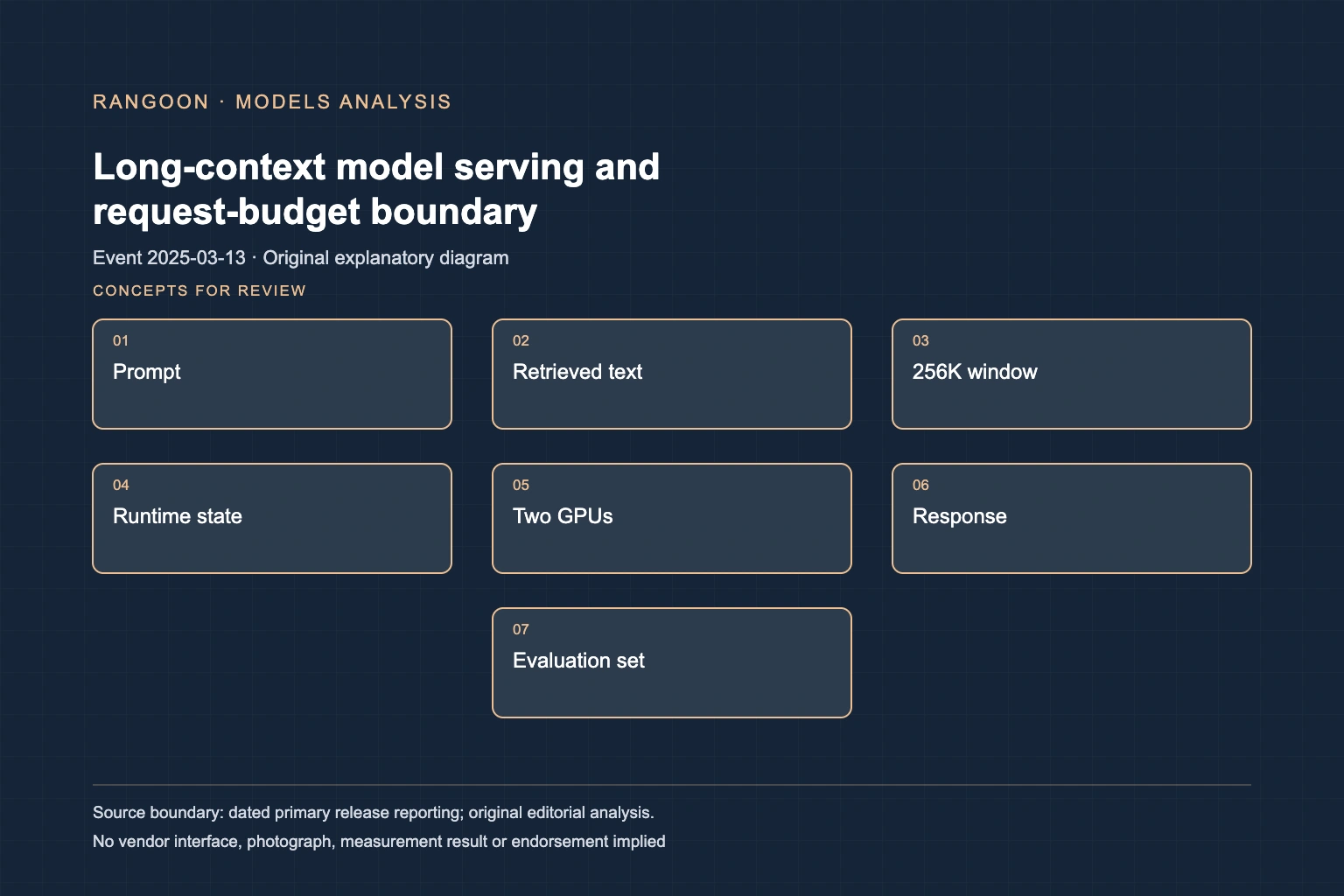
Cohere released Command A on March 13, 2025, describing a 111-billion-parameter enterprise model with a 256K-token context window.
Historical reporting: Cohere released Command A on March 13, 2025. The launch notes give the 111-billion-parameter, 256K-context, platform, and two-A100-or-H100-GPU claims. Cohere’s maintained model overview is later specification context, not proof of launch-day access, a deployment result, or an independent throughput measurement. Its comparative throughput statement remains Cohere’s claim.
Key takeaways
- Cohere presented Command A as a 111-billion-parameter model with a 256K-token context window.
- The company said the model could run on two A100 or H100 GPUs, a serving claim that still depends on workload and configuration.
- A large context specification increases what can fit in one request but does not settle latency, memory cost, or retrieval design.
The March release named a large enterprise model and its claimed serving envelope[source 1]
Cohere announced Command A on March 13, 2025. Its release described a 111-billion-parameter model with a 256K-token context window, and named the model identifier command-a-03-2025 for the Cohere platform and SDK. Cohere also said the model was available through Hugging Face.
The same release said Command A could run on two A100 or H100 GPUs and reported higher throughput than its earlier Command R+ model. Those are supplier statements about a selected comparison and serving setup, rather than an independent result for another prompt mix, batch size, quantization, or hardware configuration.
A 256K window changes the request budget, not the work required to use it well[source 1][source 2]
Context length sets an upper bound on how much input a model can consider in one call. It can accommodate longer documents, conversation history, retrieved passages, and tool results, but those pieces still compete for a finite token budget with instructions and the model response. A maintained Cohere model overview later lists Command A in its catalog; it is specification context, not evidence of what every account could use on March 13.
Longer prompts also make attention-state memory and prompt processing material to serving design. Sending every available document can increase cost and delay while placing irrelevant material beside the facts a model needs, so retrieval, filtering, and evaluation remain part of the system boundary.
A two-GPU statement is not a complete capacity plan[source 1]
Model parameters describe stored weights, while an active service also allocates memory for runtime state, input processing, output generation, and concurrency. The feasible number of accelerators therefore depends on precision, memory capacity, context length, batch policy, parallelism, and the latency objective. Cohere’s two-GPU statement is useful as a vendor deployment claim, but it does not disclose all of those operating choices.
A production evaluation needs a declared model revision, request distribution, token lengths, concurrent users, accelerator memory, software stack, and failure behavior. Without them, a claim about fitting a model cannot be converted into a guarantee about tokens per second, cost per request, or availability under load.
Release availability and application behavior are separate questions[source 1][source 2]
Cohere’s announcement established that Command A had entered its named distribution channels. It did not establish that a particular organization had deployed it, that every feature was available in every channel, or that an application would preserve accuracy over a long context. Access policy, regional service, account terms, and later model changes can each alter the practical result.
The historical conclusion is narrow: Cohere released Command A with the stated model scale and context claim. It is not evidence that the model is the lowest-cost choice, that its vendor throughput comparison transfers to another workload, or that a larger prompt alone improves an agent or search product.
Sources
Continue reading
Related reading
 News analysisCohere released Rerank 4 with Pro and Fast variants for multilingual and JSON document ranking3 min read
 News analysisCohere released Aya Vision as an open-weight multilingual vision-language family3 min read
 News analysisAI21 positioned Jamba 1.6 for private enterprise deployment, while keeping context and benchmark claims testable3 min read