Figma Make turned copied design frames into prompt-driven interactive prototypes
Figma introduced Figma Make on May 7, 2025, a prompt-to-app capability for turning Figma design context into interactive prototypes and proofs of concept.
Historical reporting: Figma introduced Figma Make at Config on May 7, 2025. Its launch described a prompt-to-app tool that could use copied Figma Design frames, preserve structure and metadata, and generate interactive prototypes; it said Make then used Claude 3.7 Sonnet. The simultaneous Config recap positioned Figma Make alongside Figma Sites and said some Sites capabilities were forthcoming. A prototype, a published site and maintained production software remain separate deliverables.
Key takeaways
- Figma Make used design frames as context, moving beyond a blank-prompt workflow for prototypes and proofs of concept.
- The launch identified Claude 3.7 Sonnet at that time; later model changes must not be projected back onto May 2025.
- Interactive prototypes can reveal product questions, but they do not prove production architecture, data handling or release readiness.
The May event made an existing design file part of the input[source 1][source 2]
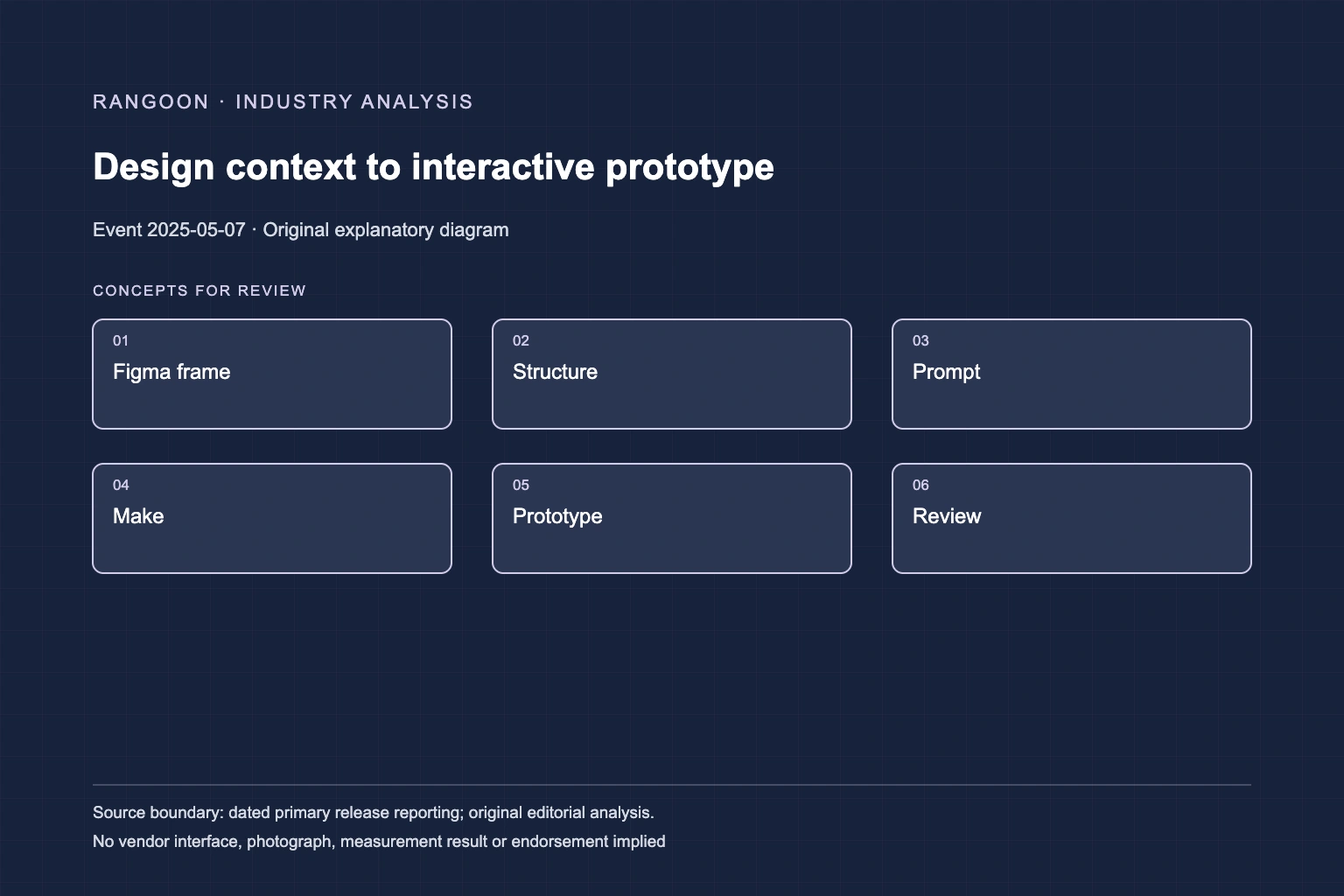
On May 7, 2025, Figma introduced Figma Make as a prompt-to-app capability at Config. The company described designers and product teams copying existing Figma Design frames into Make, preserving their structure and metadata, then using natural-language instructions to produce an interactive experience. That input path was the important product change. Instead of asking a model to infer a product from a blank prompt, a team could begin with an already discussed screen and its visual context.
Figma framed the result as a way to explore, iterate and refine concepts, including high-fidelity prototypes and proofs of concept. Those terms should stay narrow. A high-fidelity prototype can make a flow observable and testable with stakeholders, while still lacking real authorization, server behavior, durable data, error handling or operational monitoring. The May launch described an exploratory tool, not a promise that generated work was ready to operate as a production application.
The named launch model was a time-bound implementation detail[source 1]
Figma’s launch note said Figma Make currently used Claude 3.7 Sonnet and that other models would be introduced in the future. That sentence gives the release a concrete model boundary. It does not establish a permanent underlying model, a benchmark comparison or a guarantee that every account received identical behavior. Hosted AI features can change through model revisions, feature flags, capacity policies and product updates even when a familiar tool name stays visible.
The announcement also described dynamic data experiments and planned third-party database integrations. Planned integration is not an available connection, and an uploaded file used in a prototype does not turn a prototype into a secured system of record. Teams evaluating the launch had to separate what Make could show in a design exercise from the credentials, permissions, data-retention rules and deployment architecture needed for an actual service.
Interaction can validate a design question without validating a system[source 1][source 2]
Figma described adding animations, interactive buttons, responsive adaptations and real-time feedback without complex code. These features can expose whether a flow is understandable before engineering begins. They can also reveal ambiguous labels, missing states and assumptions about small screens. But a simulation of a response is not evidence that an external API authorizes a request, that data is complete, or that a transaction has succeeded. The gap matters most when a polished prototype is used in a decision meeting.
Figma’s Config recap put Make next to Figma Sites, responsive layout tools and forthcoming capabilities. The pairing explains the product narrative: design, prototype and publish were being drawn closer together. It does not erase their handoffs. Design assets, generated prototype code, a website publication path and a maintained repository have different owners and verification needs. Treating those stages as one artifact makes it harder to identify who tested behavior and who approved a live change.
May 2025 did not settle the later product or production contract[source 1][source 2]
Figma Make’s launch gives a useful early marker in the design-to-code market: product context could be a frame and its metadata, not only a prose specification. That can improve iteration because a model sees intended layout and content at the start. It can also reproduce a design’s omissions. If a frame does not show an empty state, permissions boundary or accessible interaction, generation cannot establish that those product decisions exist elsewhere.
This article does not attribute later availability, model selections, publishing rules or source-control workflows to the May launch. It also does not claim that Figma Make exported production-quality software from every design. The dated evidence supports a more precise conclusion: Figma introduced a collaborative, prompt-driven way to turn design context into interactive prototypes, leaving production code review, access control, testing and deployment to the systems and people beyond the prototype.
Sources
- Figma Blog: Introducing Figma Make (May 7, 2025)
- Figma Blog: Config 2025 recap (May 7, 2025)
Continue reading