

Figure reported an 11-month F.02 BMW deployment with site-specific production measures
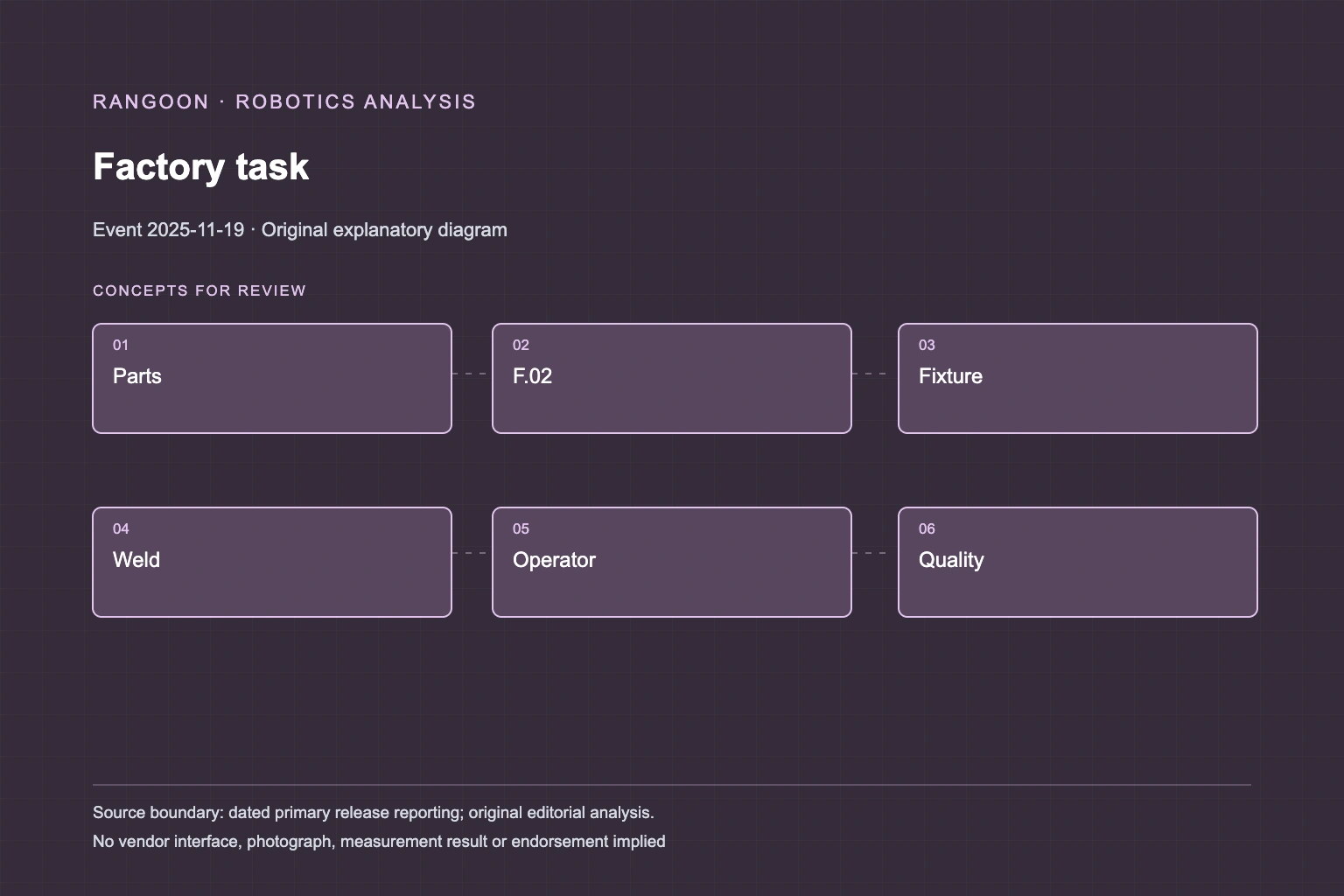
Figure reported on November 19, 2025 that its F.02 humanoid had completed an 11-month BMW Spartanburg deployment, with task and runtime measures tied to that site.
Historical reporting: Figure dated its BMW F.02 deployment report November 19, 2025. BMW’s September 2026 record supplies a later primary customer account. The sources establish site-specific work at Spartanburg and stated measures; they do not establish results at other factories, general robot availability, a universal safety result or a forecast for subsequent Figure models.
Key takeaways
- Figure reported F.02 work at BMW Spartanburg over an 11-month period.
- The records identify sheet-metal handling as the reported task and publish site-specific measures.
- One customer deployment does not establish performance at every factory or task.
The report describes a specific automotive-factory deployment rather than a generic robot claim[source 1]
Figure reported on November 19, 2025 that Figure 02 had completed an 11-month deployment at BMW Group Plant Spartanburg. It names sheet-metal loading as the use case, reports hours, parts and shifts, and says the robot contributed to the production of BMW X3 vehicles. This is stronger evidence than a laboratory demo because it identifies a customer facility and an operating task. It is still site-specific. The record does not establish that Figure 02 performed every assembly operation, produced vehicles independently, or achieved the same results in another factory. Automotive production is a linked system involving people, fixtures, industrial robots, quality controls and line management; the humanoid’s recorded role must remain bounded to its stated workflow.
Published measures belong to Figure’s described task and operating period[source 1]
Figure lists a 10-hour weekday shift, more than 90,000 loaded parts, more than 1,250 runtime hours and a contribution to more than 30,000 X3 vehicles. It also describes cycle-time, placement-accuracy and intervention goals for sheet-metal loading. Those figures give useful context, but they should not be stretched into a fleet-wide benchmark. The source does not publish raw logs, independent comparison data, every intervention type or a causal analysis showing how the robot changed total factory output. The company also reports hardware learnings, including a forearm issue that informed a subsequent wrist-electronics redesign. That detail makes clear why one deployment’s operational findings cannot be assumed to describe every model or future configuration.
BMW’s later account confirms the project context while keeping dates separate[source 1][source 2]
BMW’s September 2026 production release describes the Spartanburg pilot, including the same general sheet-metal positioning work and the integration context around production IT, safety, process management and shop-floor logistics. It supports that the deployment was a defined factory project, rather than a vendor-only demonstration. The later BMW publication does not change the November 2025 date of Figure’s report, and it should not be used to claim a completed Figure 03 deployment on the earlier date. Customer confirmation also does not prove that all future customers will have identical layouts, interfaces or results. The archive uses the records together to describe a documented site deployment with clear boundaries.
A reported deployment result does not prove universal production readiness[source 1][source 2]
The sources establish a notable, named deployment at one BMW plant and identify a repeatable material-handling task. They do not disclose a universal availability programme, total ownership cost, broad safety certification or performance across all automotive environments. Nor do they establish how a different robot generation will behave in a later sequencing project. Customer work can yield valuable reliability and integration lessons, but translation from one task to another requires separate validation. The historically accurate conclusion is specific: Figure and BMW described F.02 operating in Spartanburg with stated site measures. Claims about general-purpose manufacturing autonomy need records from additional tasks, facilities, operators and time periods.
Sources
- Figure: F.02 contributed to the production of 30,000 cars at BMW (November 19, 2025)
- BMW Group: First humanoid robot introduced in Plant Leipzig (September 21, 2026)
Continue reading
Related reading
 News analysisFigure presented BotQ as a planned high-volume humanoid manufacturing facility3 min read
 News analysisFigure described its F.03 battery design and certification path for a future humanoid platform3 min read
 News analysisBMW opened a Figure 03 sequencing project in Spartanburg after its earlier Figure 02 deployment3 min read