

Figure’s Helix split language grounding from a 200 Hz humanoid control loop
Figure introduced Helix on February 20, 2025, pairing a 7B vision-language system with an 80M control policy for upper-body humanoid manipulation.
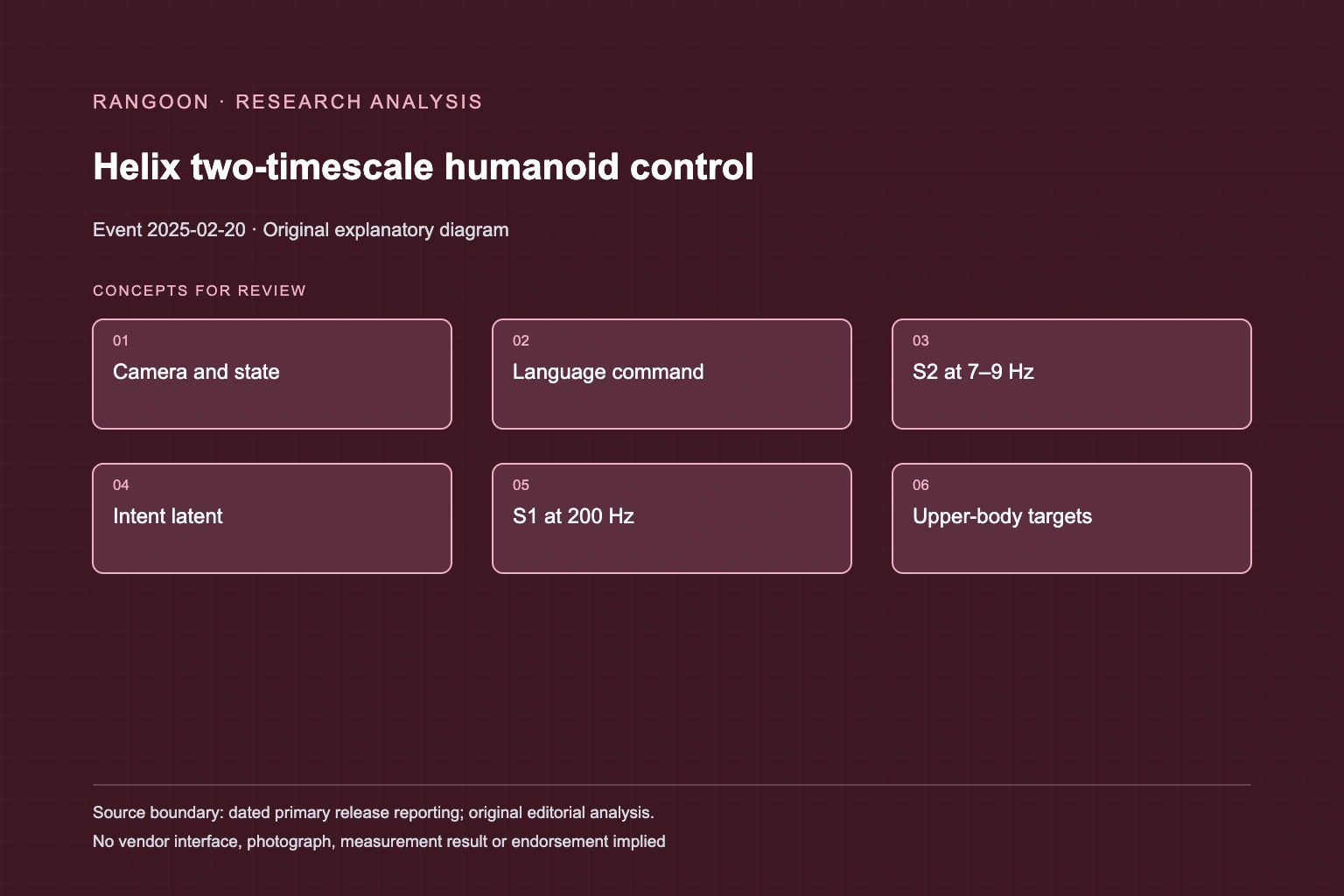
Historical reporting: Figure introduced Helix on February 20, 2025 as a generalist humanoid vision-language-action system. The announcement describes System 2, a 7B vision-language model running at 7–9 Hz, and System 1, an 80M visuomotor transformer producing upper-body targets at 200 Hz. A February 26 Figure logistics post is later application context. Neither source offers public Helix weights or a public model license.
Key takeaways
- Helix used separate-rate semantic and motor systems, with language and scene features conditioning continuous upper-body control.
- Figure’s novel-object and two-robot demonstrations were company experiments on Figure hardware, not a general household autonomy guarantee.
- The release described onboard inference but did not publish Helix weights or model-license terms.
The February event showed a layered VLA on Figure humanoids[source 1]
Figure introduced Helix on February 20, 2025 as a humanoid upper-body VLA. Its launch demonstration showed two Figure robots sorting groceries through natural-language prompts and handling objects the company said were unseen in training. The video is evidence of the company’s selected setup and test objects. It does not establish that a humanoid can safely handle every household object, infer every ambiguous instruction, or operate without supervision in an arbitrary home.
The release matters because Helix connected a language-capable system with motor commands for wrists, fingers, torso, and head. Humanoid manipulation couples many variables: moving a head alters camera view, moving a torso changes reach, and a poor grasp can create a new obstacle. A model that produces a coherent demo still requires physical constraints, collision handling, speed limits, and task-specific verification.
System 2 supplied semantic context while System 1 closed the motor loop[source 1]
Figure described Helix as a two-part architecture. System 2 is a 7B internet-pretrained vision-language model that processes a monocular robot image, wrist pose, finger positions, and language at 7–9 Hz. It produces a continuous latent representation of behavioral intent. System 1 is an 80M latent-conditioned visuomotor transformer that receives related image and state inputs at higher frequency and turns that context into desired upper-body control targets at 200 Hz.
Separating timescales is a practical response to a familiar robotics tradeoff: semantic interpretation can be slow, while contact and motion corrections need faster feedback. Figure said System 1 output wrist poses, finger flexion and abduction, plus torso and head orientation targets across a 35-degree-of-freedom action space. The architecture is not proof that a high-level latent is correct or that fast reactions will recover every failed manipulation; both layers depend on the sensor stream, learned data, and controller boundary.
Teleoperation data and auto-labeled instructions shaped the reported behaviors[source 1]
Figure reported approximately 500 hours of teleoperated behavior data across robots and operators. It said an auto-labeling VLM generated hindsight instructions from segmented onboard-camera video, and that training items were excluded from evaluation. The company also described end-to-end regression from pixels and text to continuous actions, with an inference-latency offset included during training. These are concrete choices for creating language-conditioned robot examples, though an auto-generated label can still simplify or miss the human intent behind an action.
Figure’s results included single-weight behavior across picking, placing, drawers, refrigerators, and two-robot handovers. The company reported handling thousands of novel household objects and showed zero-shot collaborative grocery storage. Those are Figure’s results, not independent measurements. Object novelty in a controlled collection does not by itself cover uncommon materials, transparent or hazardous items, adversarial placements, humans entering the workspace, hardware wear, or a sustained deployment schedule.
Onboard inference did not make the published result a public artifact or safety case[source 1][source 2]
Figure said Helix ran on dual low-power embedded GPUs, with System 2 maintaining a shared latent representation and System 1 keeping the 200 Hz loop. A February 26 Figure follow-up discussed applying System 1 improvements to logistics package manipulation. That later post can locate Helix in the company’s continuing work, but it cannot add new capabilities to the February 20 release.
Neither Figure source published downloadable Helix weights or a public model license. More importantly, a model demonstration is not a safety case. Any claim about autonomy needs evidence for the actual robot, gripper, sensor health, workspace controls, failure detection, and recovery behavior. The event showed a model architecture and company demonstrations; it did not provide a general authorization to run a humanoid around people or property.
Sources
- Figure: Helix launch announcement (February 20, 2025)
- Figure: Helix logistics follow-up (February 26, 2025)
Continue reading
Related reading
 News analysisFigure’s Project Go-Big made human-video provenance part of its Helix pretraining claim3 min read
 News analysisPhysical Intelligence’s π*0.6 used deployment experience and corrections as VLA training inputs3 min read
 News analysisπ0.5 tested a single VLA on home-cleaning tasks outside its training scenes3 min read