

FutureHouse launched four scientific agents while separating literature benchmarks from experimental confirmation
FutureHouse launched its May 1, 2025 platform with Crow, Falcon, Owl and experimental Phoenix agents for literature and chemistry research tasks.
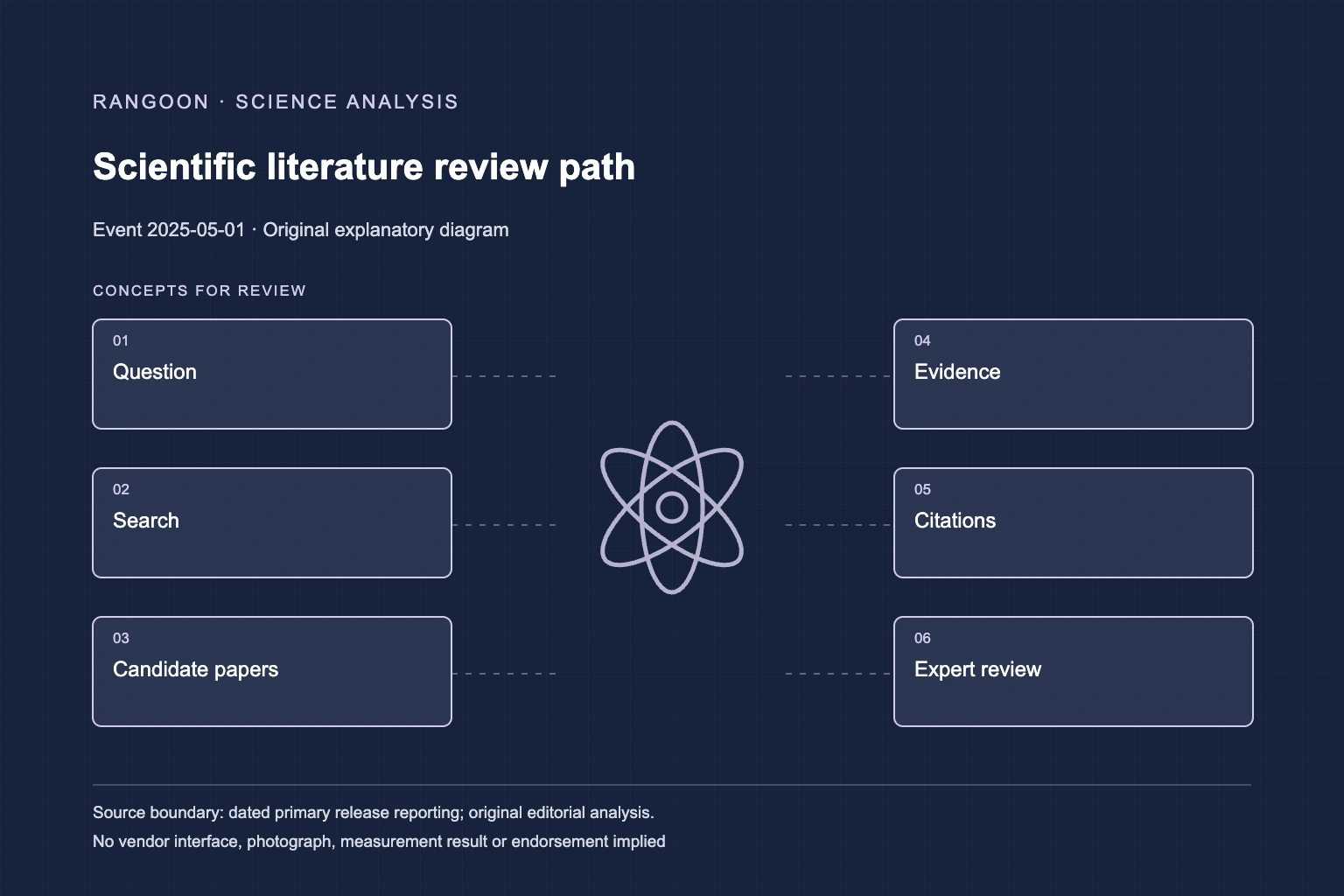
Historical reporting: FutureHouse launched its public platform on May 1, 2025 with Crow, Falcon, Owl and experimental Phoenix. Its launch post assigns distinct literature-search, review, novelty-question and chemistry-planning roles, and reports supplier benchmark results for Crow, Falcon and Owl while warning that Phoenix was less deeply benchmarked and could make more mistakes. A FutureHouse-authored PaperQA2 study describes its retrieval, summarization and contradiction-detection evaluations, including known hallucination and benchmark limitations. Those results are evidence for the reported research tasks and conditions, not proof that a platform answer is complete, correct for another corpus, or sufficient to make a laboratory or clinical decision.
Key takeaways
- FutureHouse launched a portfolio of differently scoped scientific agents rather than one interchangeable research assistant.
- The publisher’s literature-agent benchmarks are task-specific evidence, not a substitute for reproducing experiments or checking a scientific conclusion.
- Phoenix was labeled experimental, so chemistry-planning outputs need especially direct expert and laboratory review.
The May 1 platform event named four agents with different jobs[source 1]
On May 1, 2025, FutureHouse announced a public web and API platform containing four agents. It described Crow as a general literature-search and scholarly-answer agent, Falcon as a deep-literature-review agent, Owl as a system for the question of whether someone has done something before, and Phoenix as an experimental deployment for chemistry-experiment planning. Those descriptions define a division of labor rather than a single claim of general scientific competence. A question about prior art, a request to synthesize papers and a plan for a chemistry experiment each create different risks of omitted evidence, incorrect interpretation and downstream harm. The launch establishes that FutureHouse offered these named workflows. It does not establish that each workflow had equal evaluation coverage or that an answer should be treated as a validated scientific finding.
FutureHouse reported literature-search benchmarks, while its own paper states why factuality remains difficult[source 1][source 2]
FutureHouse said Crow, Falcon and Owl were benchmarked for retrieval precision and accuracy, and said its studies compared retrieval and synthesis with PhD-level researchers. Its PaperQA2 study gives more task context: it evaluates information retrieval, cited summarization and contradiction detection, and opens by noting that language models can hallucinate and that their reliability for scientific research is uncertain. The paper’s reported scores and human comparisons are meaningful as evidence of performance under its specified protocols. They do not turn a benchmark label into a universal property of a later agent run. Different databases, access rights, query wording, topic maturity, model versions and retrieval settings can change both recall and the quality of a cited synthesis.
Citations and contradiction checks can support review without deciding a scientific dispute[source 2]
The PaperQA2 report describes an agentic retrieval path that searches papers, gathers evidence, ranks and summarizes candidate chunks, then produces an answer. It also describes ContraCrow, a tool intended to surface possible contradictions in literature. Those functions can help a scientist find records that merit attention, especially where literature volume is large. They cannot establish that all relevant studies were retrieved, that two results are directly comparable, or that an apparent contradiction survives a specialist reading of methods and populations. The paper reports expert validation for a subset of surfaced contradictions; that is stronger than an unreviewed output, but it still leaves a defined sample, task and scoring procedure. A research team should preserve cited sources and make the final interpretive decision reviewable.
Phoenix’s experimental label matters when a literature result crosses into chemistry planning[source 1]
FutureHouse described Phoenix as experimental and said it was not as deeply benchmarked as the other platform agents and might make more mistakes. It also said Phoenix had specialized tools intended to help researchers plan chemistry experiments. That explicit qualifier is material because planning is not execution, and a plausible written procedure is not a safe or feasible laboratory protocol. Before a suggested route reaches a bench, qualified researchers need to assess reagents, quantities, hazards, equipment, waste handling, controls, regulatory requirements and expected measurements. The historical event supports reporting a platform release with an experimental chemistry-planning component. It does not show that the platform conducted an experiment, reproduced a finding, approved a procedure or established a therapeutic, material or clinical result.
Sources
Continue reading
Related reading
 News analysisMicrosoft introduced Discovery as an agentic R&D platform and bounded its early scientific claims3 min read
 News analysisAnthropic expanded AI for Science credits: preserve research evidence beyond access3 min read
 News analysisGoogle announced DolphinGemma for studying dolphin vocalization patterns with Wild Dolphin Project data3 min read