

Google’s Big Sleep reported a previously unknown SQLite flaw before release, with human disclosure still central
Google Project Zero and DeepMind announced Big Sleep on November 1, 2024 after it found an unknown SQLite memory-safety flaw that maintainers fixed before an official release.
Historical reporting: Google Project Zero and Google DeepMind announced Big Sleep on November 1, 2024. The team said it found and reported an exploitable stack-buffer-underflow issue in SQLite in early October; SQLite developers fixed it the same day, before an official release, so users were not affected. The earlier Naptime research explains the evaluation architecture and its limits. Google called the result the first public example of an AI agent finding a previously unknown exploitable memory-safety issue in widely used real-world software; that is Google’s public-characterization claim, not an independent census of all prior work.
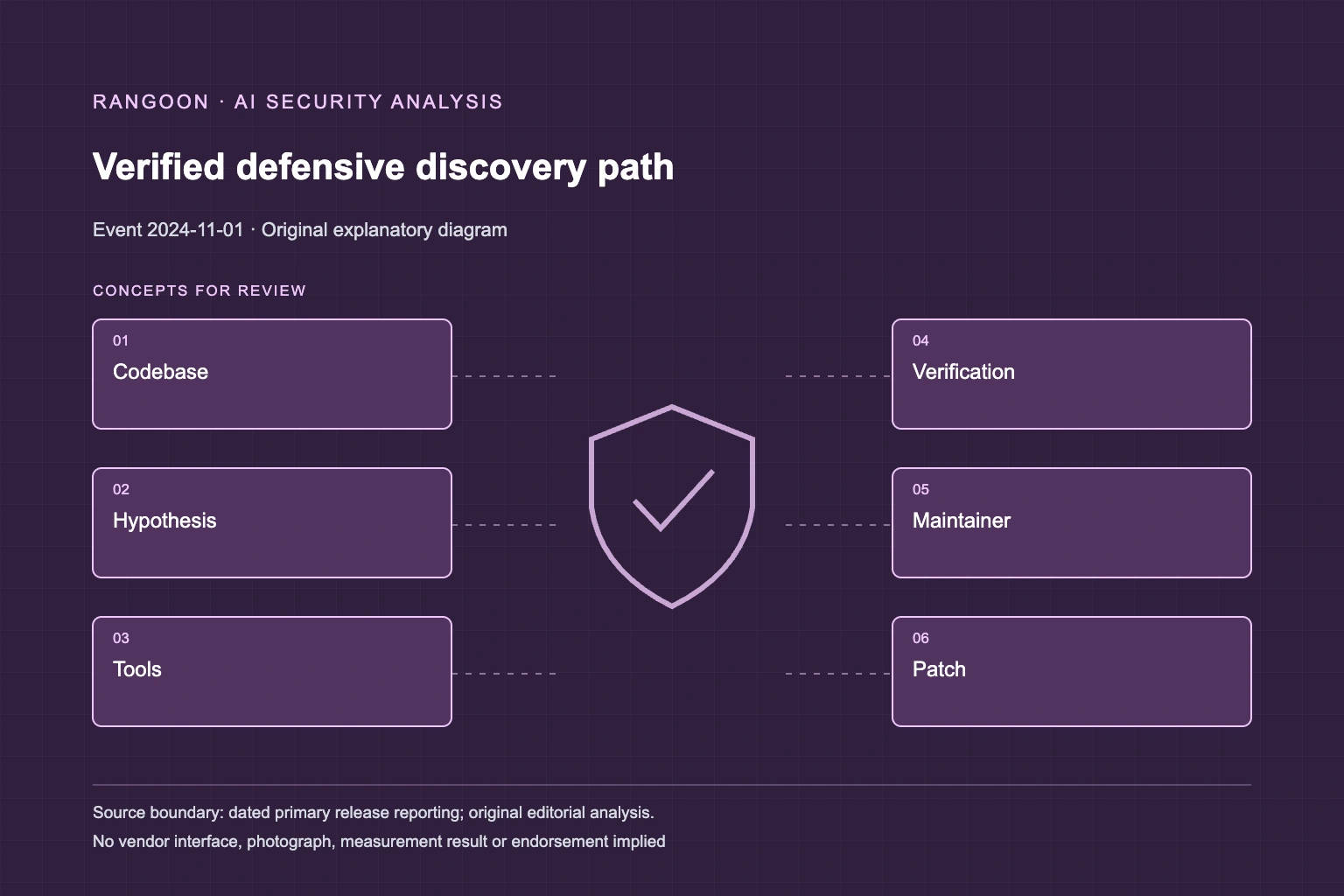
Key takeaways
- The November event described a reported and fixed pre-release SQLite issue, not a public exploit or evidence that users had been compromised.
- Big Sleep continued the tool-grounded Naptime research line, where verification and expert workflow design were part of the system rather than properties of a model alone.
- The public record supports defensive discovery and coordinated reporting; it does not prove autonomous, general-purpose vulnerability research is dependable.
The announced result was a pre-release discovery and a coordinated report[source 1]
On November 1, 2024, Google Project Zero said that Big Sleep, its collaboration with Google DeepMind, had found a previously unknown exploitable stack-buffer-underflow issue in SQLite. The post says the team discovered and reported the issue to SQLite developers in early October and that the developers fixed it the same day. It also says the affected code had not appeared in an official SQLite release, so SQLite users were not affected. Those details matter more than a broad claim that an AI “found a zero-day.” The record describes a narrow finding, a disclosure path and a fix before public distribution. It does not establish a public exploit, an impacted customer population, or a conclusion about how other codebases would respond to the same research setup.
Big Sleep followed a tool-grounded research framework rather than a bare model prompt[source 1][source 2]
Google’s June 2024 Naptime report described an LLM-assisted vulnerability-research environment built around code browsing, a sandboxed scripting tool, debugging and a structured reporting step. The researchers argued that iterative hypotheses and automatic verification were important when measuring this class of capability. The November post identifies Big Sleep as the successor collaboration and says the earlier work had informed its real-world variant-analysis experiment. That lineage prevents a misleading interpretation of the event as a standalone chatbot answer. The reported result depended on a configured environment, target-specific research, repeated investigation and a team that could validate a report. It does not show that any model, given arbitrary code and a text prompt, can perform security research to the same standard.
The claimed value was earlier defensive discovery, not a finished security control[source 1][source 2]
Project Zero framed the result as a possible defensive advantage: a flaw found and corrected before release leaves no released defect for attackers to use. That is a useful operational distinction. A security team can use AI-assisted analysis to generate leads, but a lead remains separate from reproduction, triage, root-cause analysis, coordinated disclosure, a patch and downstream adoption. Big Sleep’s post also noted that conventional testing did not find this particular issue, while its earlier research compared an AI-assisted process with benchmark settings. Neither statement means that AI research replaces fuzzing, secure engineering, code review or a vendor’s incident-response process. The event supports a specific example of assisted discovery, not an assurance that a system will find all serious defects or rank them correctly.
Google itself kept the result experimental and bounded[source 1][source 2]
The November announcement explicitly called the results highly experimental and said a target-specific fuzzer was likely at least as effective at that time. That caveat belongs in the historical record because it limits the meaning of a headline result. A verified pre-release finding can demonstrate that a research configuration worked in one important case without proving cost, speed, coverage, false-positive rate or operational safety across a software portfolio. It also does not answer who may run such tooling, what target authorization is required, or how generated artifacts should be retained and protected. Teams evaluating similar systems need separate rules for scope, human validation, disclosure and reporting. Big Sleep was news about a defensive research milestone; it was not a product guarantee or a substitute for those controls.
Sources
- Google Project Zero: From Naptime to Big Sleep (November 1, 2024)
- Google Project Zero: Project Naptime (June 20, 2024)
Continue reading
Related reading
 News analysisUK published an AI cyber-security code with 13 voluntary principles and an implementation guide3 min read
 News analysisNIST AI 100-2e2025 gave adversarial machine learning a shared taxonomy, not a risk tolerance rule3 min read
 News analysisUK’s third-party AI assurance roadmap mapped professionalization, information access and a planned innovation fund3 min read