

Gemini Advanced opened Deep Research as a report workflow with a user-reviewed research plan
Google rolled out Gemini Deep Research on December 11, 2024, giving Gemini Advanced users a multi-step web-research workflow that returned cited reports.
Historical reporting: Google rolled out Deep Research to Gemini Advanced subscribers in English on desktop and mobile web on December 11, 2024. The announcement says users could review and modify a research plan before Gemini browsed the web and returned a report with source links. Later Gemini documentation is context only, not proof of December mobile-app, Workspace, language, pricing, or reliability status.
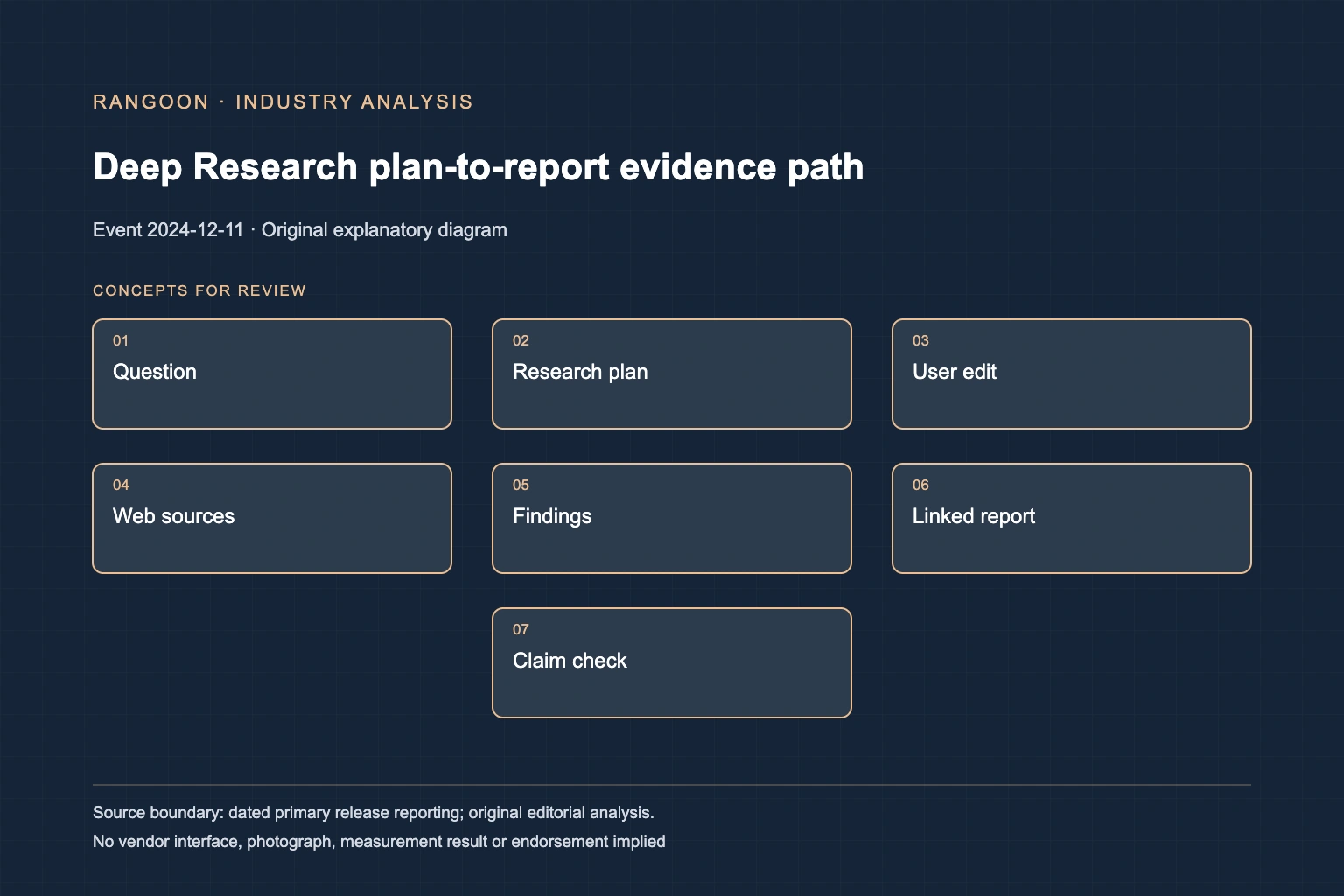
Key takeaways
- Deep Research was a staged Gemini Advanced rollout, not universal Gemini availability.
- Its workflow exposed a research plan before web exploration, making scope a user decision.
- Linked sources support inspection but do not make every synthesis correct or complete.
The December rollout put a research agent behind a subscriber and language boundary[source 1]
Google announced Deep Research on December 11, 2024 as an agentic feature in Gemini Advanced. It said the feature was rolling out in English on desktop and mobile web to Gemini Advanced subscribers, with mobile-app and Workspace availability planned for early 2025. That is a staged access statement, not a claim that every Gemini user or surface had the feature on launch day.
The product’s output was a comprehensive report with links to sources it used. Links make a research trail inspectable, but the announcement does not establish that the report covers every relevant source, resolves disagreements correctly, or meets a professional research standard.
The workflow inserted a plan before a long web-search run[source 1]
Google described Deep Research as first creating a multi-step research plan, which the user could review and modify before the system began browsing. That step turns a broad question into a proposed scope: subquestions, source directions, and the time spent investigating them. A better plan can reduce irrelevant searching, while a bad plan can send the later research effort toward the wrong evidence.
The plan is also a useful audit boundary. A user can compare the requested investigation with the eventual report and see whether important constraints, counterexamples, geography, or time period were never placed in the task.
A cited report is a synthesis layer over browsing rather than a replacement for sources[source 1][source 2]
Deep Research was designed to browse the web on a user’s behalf, analyze findings, and produce a report. That combines retrieval, page interpretation, note selection, and writing in one workflow, so an error at any stage can influence the final prose. Source links help a reader open the evidence, but they do not by themselves show why one source was selected, what was omitted, or whether a claim follows from the linked text.
For a factual decision, the useful check is claim by claim: open the cited material, confirm its date and authority, and distinguish the original statement from the model’s inference. A fluent report can still contain a stale page, an unsupported bridge, or a missing qualification.
The launch did not establish a universal research or accuracy guarantee[source 1][source 2]
Google’s December event supports a narrow historical conclusion: Deep Research began rolling out to a defined Gemini Advanced audience. It does not establish a later mobile-app release, Workspace access, new language support, a fixed response time, or an entitlement for another subscription. Those are separate product milestones.
Nor does an automated research run eliminate the need to assess sources for authority, recency, incentives, and scope. The announcement describes a product workflow, not independently measured research accuracy or a guarantee that web content is safe, complete, or current.
Sources
Continue reading
Related reading
 News analysisGoogle’s Gemini Robotics On-Device put a vision-language-action model on the robot3 min read
 News analysisGoogle put Guided Learning into Gemini with LearnLM-informed study tools3 min read
 News analysisGoogle launched Gemini Canvas for iterative documents, code and prototype previews4 min read