

Gemma 3n framed on-device multimodality as an artifact-provenance problem
Google introduced Gemma 3n on May 20, 2025, describing an open multimodal model designed for phones, laptops, and tablets.
Historical reporting: Google introduced Gemma 3n on May 20, 2025. This article makes no current download, license, hardware, or capability claim.
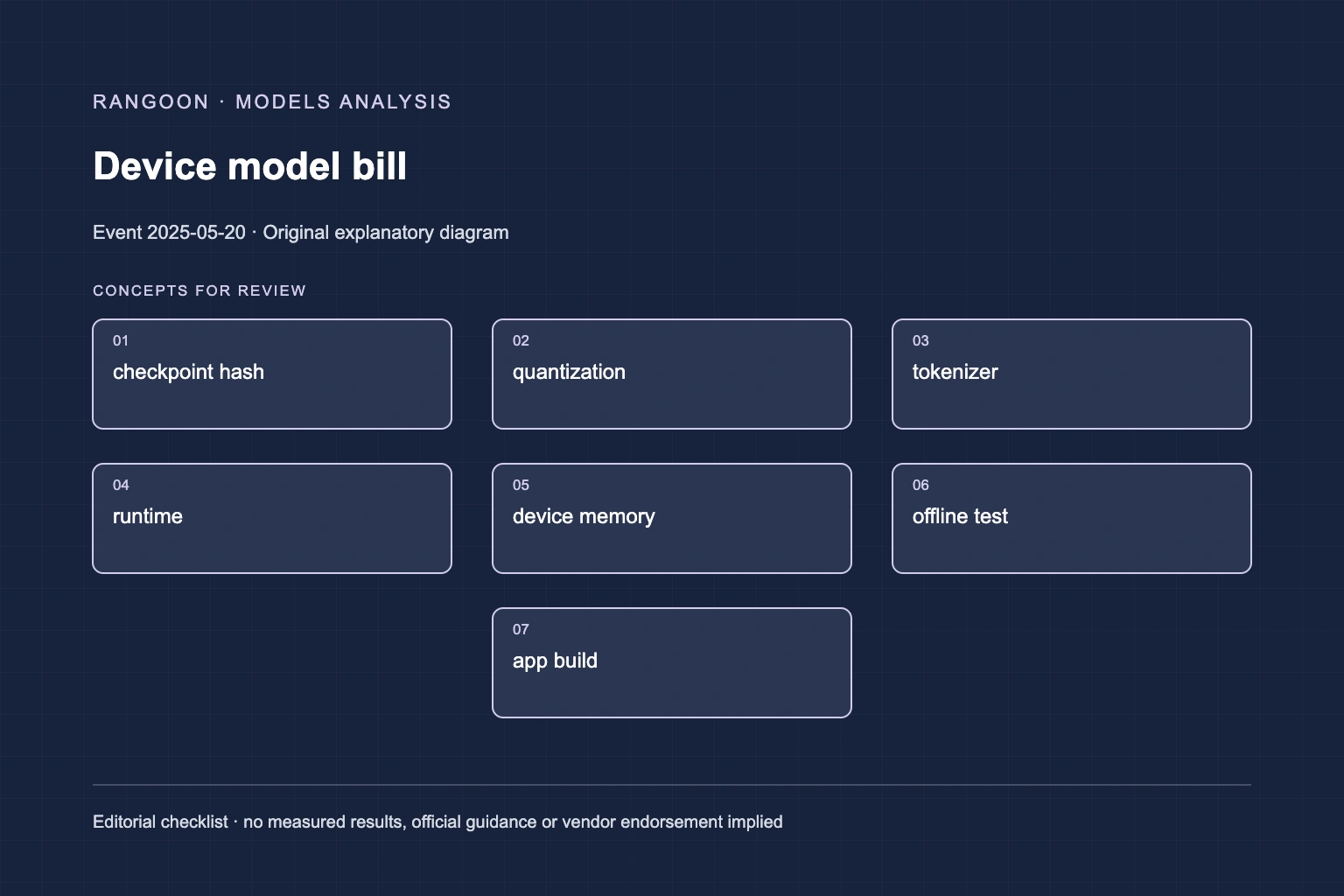
Key takeaways
- Open-model deployment needs a bill of materials for each conversion.
- On-device operation does not remove privacy or validation work.
- Multimodal tests require separate text, image, audio, and combined fixtures.
Release record[source 1][source 2]
Google introduced Gemma 3n on May 20, 2025 in its I/O developer announcements, describing it as an open multimodal model engineered to run on phones, laptops, and tablets. Google’s developer highlights and its broader I/O recap are distinct primary records that place the release in the 2025 event. They support the stated launch framing.
Technical design[source 1][source 2]
They do not prove that a particular converted checkpoint, device, runtime, or application meets the same characteristics. Open distribution broadens the artifact chain. A model family name is insufficient for an incident report or evaluation.
Operating boundary[source 1][source 2]
The record should identify the exact checkpoint, checksum, tokenizer, quantization, runtime, accelerator or device, system prompt, safety wrapper, and application revision. If a team converts or fine-tunes weights, that derived artifact has its own provenance and test requirements. On-device execution also changes the privacy and reliability analysis.
Evaluation evidence[source 1][source 2]
Data may remain closer to a user, but the application still chooses what to collect, cache, transmit, log, and expose through interfaces. Test offline behavior, memory pressure, interrupted sessions, unsupported media, and model-loading failures. Do not turn the phrase on-device into a blanket privacy claim.
Historical implication[source 1][source 2]
Multimodal evaluation needs an explicit matrix. A system can perform acceptably on text while failing on image orientation, audio noise, OCR, or the combination of a screenshot and an instruction. Preserve input files and safe synthetic fixtures in their original forms, then score each mode and cross-mode task separately.
Accessibility matters too: verify alternative text, readable error states, and controls that do not require visual interpretation alone. A locally run model can create a false sense that external governance has disappeared. It has not.
Developers still need input handling, output validation, user consent, access controls for stored artifacts, update policy, and a way to roll back a broken bundle. The historical release should be read as a model and deployment-direction announcement, not as an endorsement of a particular device application. Its practical value is clear: treat an open multimodal model as a versioned supply-chain component.
Track every artifact and environment change, test every input mode that the product accepts, and publish only claims grounded in the exact locally observed configuration. Device testing should record thermal limits, battery state, memory pressure, and offline failures when those conditions affect the experience. These observations are about the application build under test; they should never be promoted into a general claim about every Gemma deployment.
Updates should run through the same acceptance suite, because an application can regress through its runtime or preprocessing even when its named model family stays unchanged. For user-facing products, explain what happens to inputs during offline failure or deferred upload, rather than assuming local inference automatically answers every data-handling question. The artifact ledger should be readable by support staff and security reviewers, not only by the person who initially installed the model.
Sources
- Google: Building with AI highlights at I/O (May 20, 2025)
- Google: 2025 research breakthroughs recap (December 18, 2025)
Continue reading
Related reading
 News analysisMedGemma 1.5 expanded a 4B model toward volumes, slides and longitudinal imaging inputs3 min read
 News analysisHugging Face released SmolVLM2 as a compact family for image and video understanding3 min read
 News analysisGoogle released TxGemma as a Gemma 2 family for therapeutic-property research tasks3 min read