

Google introduced Stitch as a Gemini-powered experiment for turning design inputs into UI and front-end code
Google introduced Stitch on May 20, 2025 as a Google Labs experiment that used Gemini 2.5 Pro to turn text, images and wireframes into UI designs and front-end code.
Historical reporting: Source 0 is Google Developers Blog’s dated Stitch announcement; Source 1 is a separate dated Google I/O developer-keynote record that describes Stitch as a UI and front-end-code tool. Both are launch-period primary records, not an assertion about current Stitch behavior or availability.
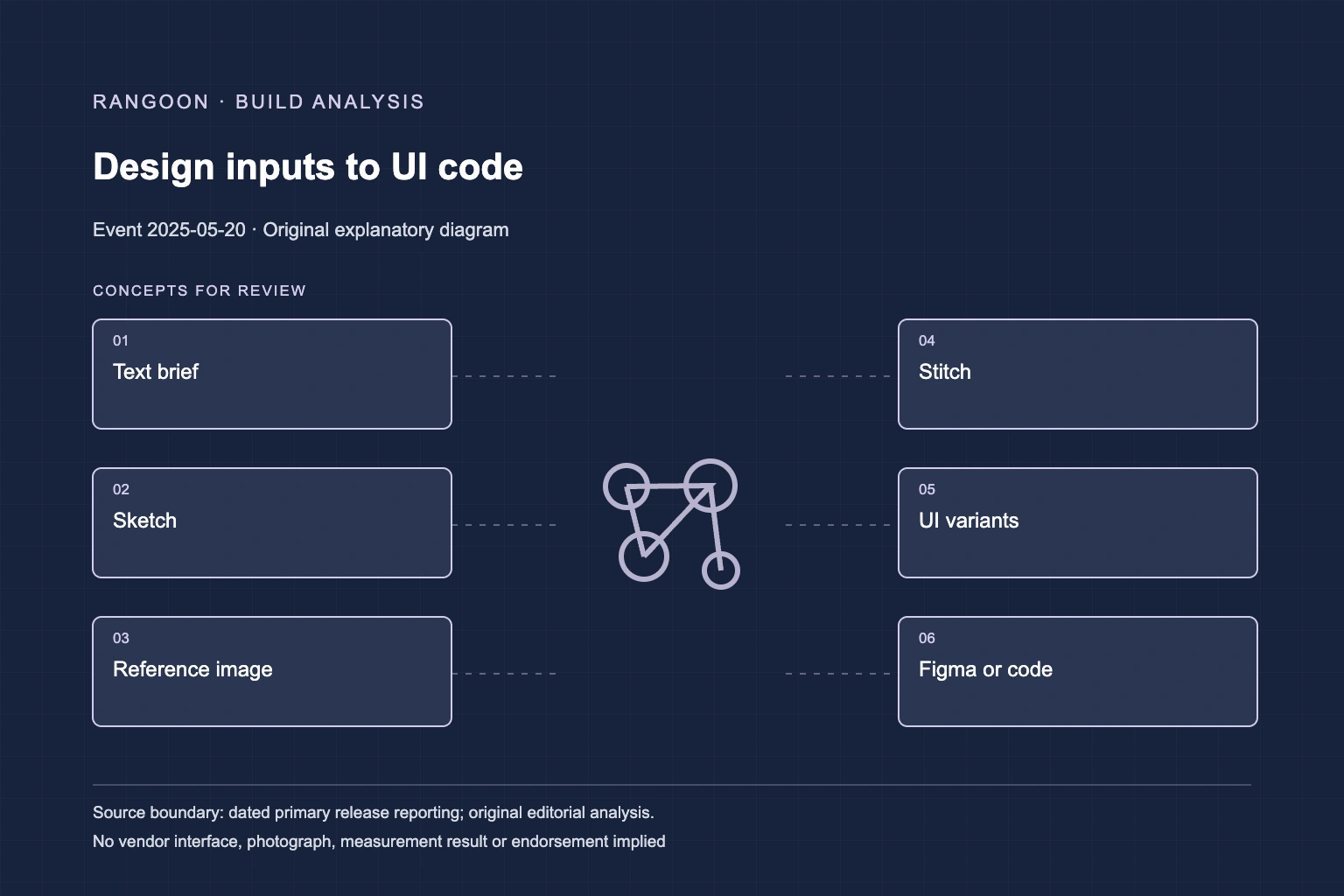
Key takeaways
- Google introduced Stitch on May 20, 2025 as a Google Labs experiment using Gemini 2.5 Pro to create UI designs and front-end code from text and image inputs.
- The launch named plain-language prompts, screenshots or wireframes, multiple variants, chat refinement, theme selection, Figma paste and code export as parts of its design-to-development path.
- A generated screen and front-end export did not supply product requirements, production logic, accessibility verification, design-system approval or evidence that an interface works for users.
Google positioned Stitch between design intent and implementation[source 1][source 2]
Google introduced Stitch on May 20, 2025 as a Google Labs experiment intended to shorten the handoff between interface design and front-end development. The announcement says the tool used Gemini 2.5 Pro to turn simple prompt and image inputs into more detailed UI designs and front-end code. It framed the problem as the manual back-and-forth between a designer imagining an experience and a developer implementing it. That makes the event a workflow-tool launch, not a claim that design judgment or software engineering had been automated away. Google’s release describes the experiment and the outputs it aimed to create. It does not establish that a generated screen met a product’s user needs, correctly represented a data model, or could be deployed as a complete application without further work.
Text and visual references were different ways into the same design task[source 1]
The first Stitch description distinguished several inputs. A user could write a plain-English description that included choices such as color palette or desired user experience. They could also provide a whiteboard sketch, screenshot or rough wireframe for the tool to turn into a digital interface. Google said an interactive chat and theme selectors could help refine a result, while repeated generations made it possible to explore layout, component and style variants. These are useful design accelerators because they turn a brief or reference into concrete alternatives. They are not independent validation. A screenshot can carry someone else’s patterns or inaccessible assumptions, and a short prompt can omit responsive states, localization, failure handling, content hierarchy or user research constraints.
Figma paste and front-end export did not settle the product boundary[source 1][source 2]
Google described two handoff mechanisms in the launch record. A generated design could be pasted into Figma for further refinement and collaboration, and Stitch could export functional front-end code. The Google I/O developer-keynote recap separately characterized Stitch as a tool for generating user-interface designs and corresponding front-end code for web applications. That independent launch-period wording narrows the claim: Stitch helped create a design artifact and a code starting point. It did not announce database logic, authorization rules, deployment ownership or a complete test suite. Design and development teams still need to decide which generated parts belong in their system, reconcile them with components and tokens, and verify that the resulting code behaves under real data, browsers and devices.
A visual result still needed product and engineering review[source 1][source 2]
The important historical change was that a Google Labs experiment placed multimodal input, visual generation and front-end export in one early design flow. That could reduce the elapsed time from an idea to something discussable, but it did not turn an image into evidence of usability or compliance. Generated interface code can lack semantic markup, keyboard behavior, error states, performance controls and integration logic. A team also needs to review whether a reference image may be used, whether generated copy makes unsupported claims, and whether a proposed workflow handles sensitive information appropriately. The launch pages support a date, model attribution and named feature path. They do not provide an independent benchmark for visual fidelity, code quality, accessibility, account access or the later evolution of the experiment.
Sources
Continue reading
Related reading
 News analysisGoogle’s Gemini Robotics On-Device put a vision-language-action model on the robot3 min read
 News analysisGoogle put Guided Learning into Gemini with LearnLM-informed study tools3 min read
 News analysisGoogle placed AI Mode in Search Labs as a query-fan-out experiment for complex questions4 min read