GPT-4.5 showed why a research preview needs its own evidence record
OpenAI introduced GPT-4.5 as a research preview in February 2025. The historical release shows why preview status, safety evidence and deployment scope need separate records.
Historical retrospective: OpenAI published the GPT-4.5 announcement and system card on February 27, 2025. Vendor statements describe that release; the operational analysis below is independent and does not claim current availability or capability.
Key takeaways
- A research preview is a bounded deployment state, not a synonym for general availability.
- A system card and a product announcement answer different questions and should remain separately cited.
- A migration decision needs a record of the exact surface, configuration and evaluation set used.
A 2025 research preview with two kinds of evidence[source 1][source 2]
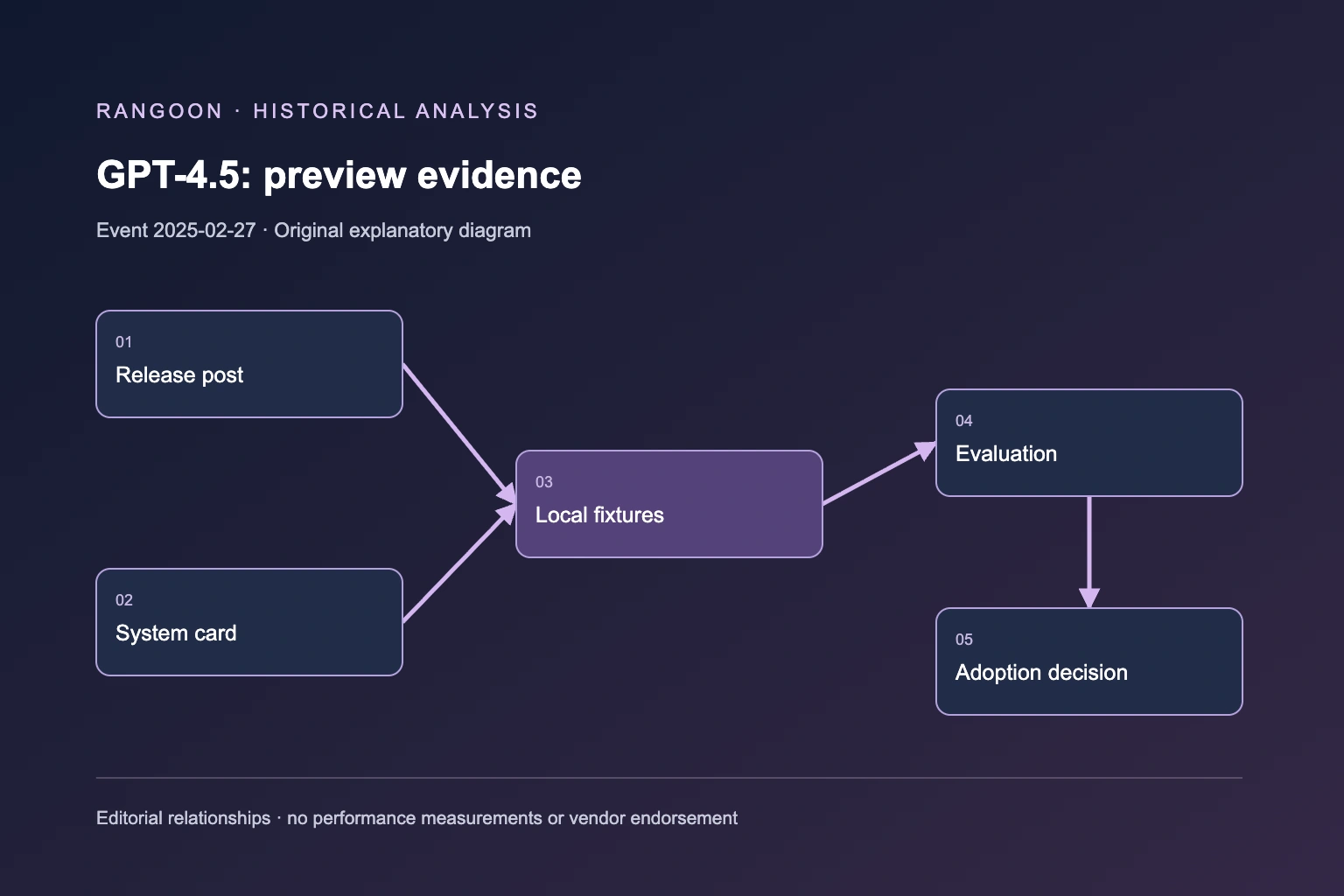
On February 27, 2025, OpenAI introduced GPT-4.5 as a research preview. Its announcement described a general-purpose model built by scaling pre-training, and positioned it for writing, programming and practical problem-solving. The concurrent system card documented OpenAI's safety process and its Preparedness Framework scorecard. Together, those pages establish a dated vendor record of a particular release, rather than a permanent statement about every later model surface carrying the GPT-4.5 name.
The distinction matters because the two records serve different purposes. A release announcement says what a provider chose to present about a product moment. A system card gives a more structured account of evaluations, mitigations and assessed risk categories. Neither source by itself proves an application's suitability, a customer's permission to use a service, or the behavior of a later configuration. This retrospective reports the February 2025 release as historical evidence only.
Preview status changes the evaluation question
Calling a model a preview should change the first engineering question from 'is this model good?' to 'what exact configuration did we evaluate?' A team may encounter different product surfaces, model identifiers, rate limits, tools, system instructions and policy controls. If those details are absent, a favorable demonstration cannot be reproduced or compared. The model label is useful metadata, but it is not a complete execution description.
A durable trial record therefore names the provider, product surface, requested model identifier, effective configuration, prompt revision, tool schema and test-data classification. It also records the date, evaluator and expected outcomes. That record lets a reviewer distinguish a result produced by the model from one produced by a changed prompt, enabled tool or revised policy. It is narrower than a broad claim about intelligence and more useful when a result later needs explanation.
Retrospective lesson: preserve evidence at the release boundary
The announcement and system card illustrate a practical evidence lifecycle. Preserve the dated source URLs and their stated scope when a trial begins. Then add local evaluation evidence without relabeling provider assertions as independently verified facts. Structured-output cases, policy-sensitive prompts, tool-call tests and failure paths should each have expected results set before comparison. A passing happy path alone rarely captures the boundary that determines whether a workflow is safe to advance.
When a preview changes, rerun the relevant fixture set against the new configuration and record the delta. The acceptable outcome may be to keep the earlier configuration, limit the candidate to a non-consequential use, or reject it for one workflow while accepting it for another. This approach avoids two common errors: treating the original announcement as current deployment proof, and treating an evaluation of one surface as proof for every surface. Historical release material can remain valuable when its date and limits stay visible.
Sources
- OpenAI: Introducing GPT-4.5 (February 27, 2025)
- OpenAI: GPT-4.5 System Card (February 27, 2025)
Continue reading