

Liquid AI released LFM2-VL as compact vision-language models for edge deployment
Liquid AI released LFM2-VL on August 12, 2025, introducing 450M and 1.6B vision-language models with conditional open-license terms.
Historical reporting: Liquid AI released LFM2-VL on August 12, 2025 as its first vision-language family, with 450M and 1.6B variants. The release says the models accept text and image inputs and are available through Hugging Face with example fine-tuning code. Liquid labels its license open and based on Apache 2.0 while describing commercial-use conditions. Vendor speed and benchmark figures are not independent validation.
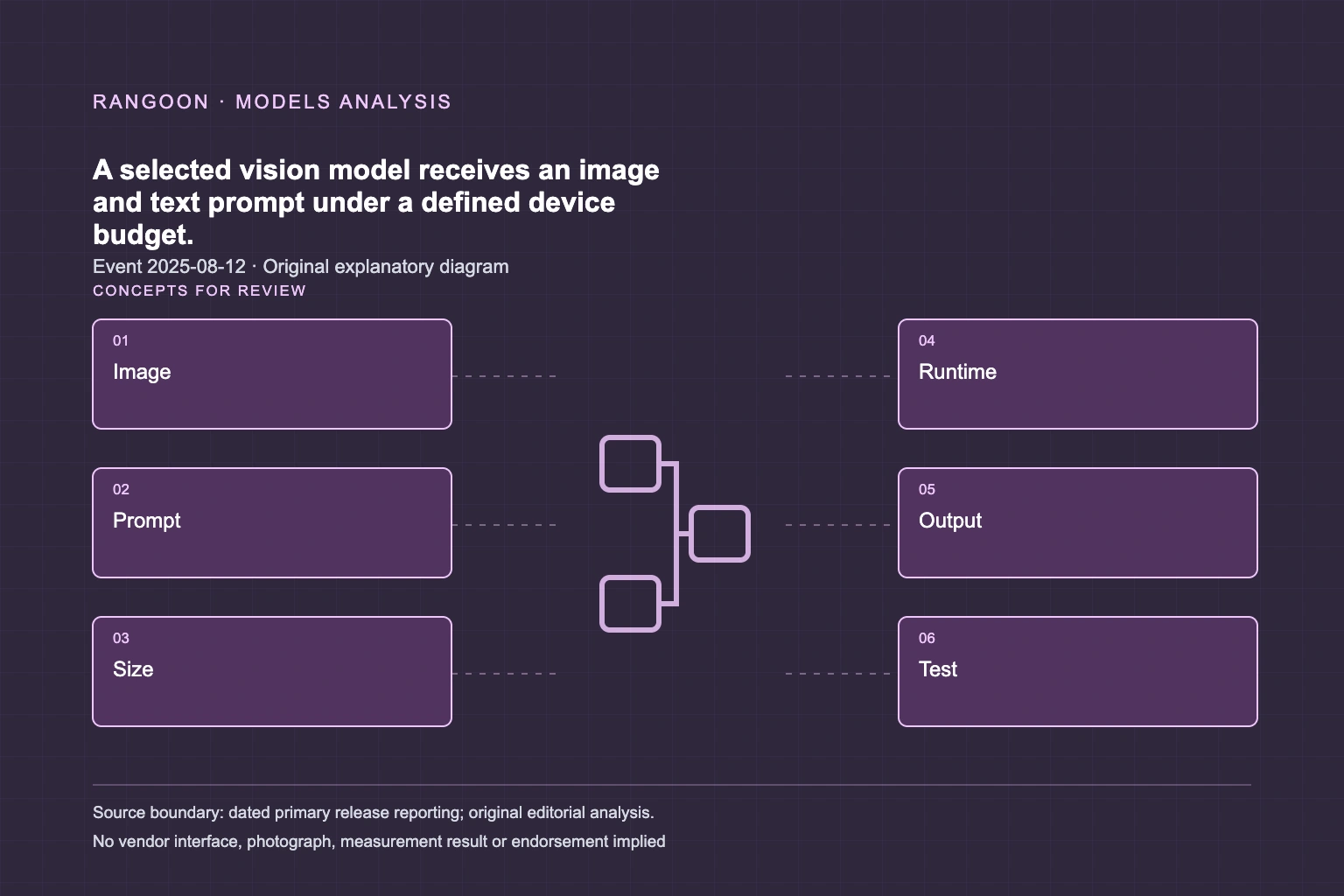
Key takeaways
- LFM2-VL added text-and-image input to Liquid’s small edge-model line.
- The 450M and 1.6B variants are separate artifacts with different capability and resource tradeoffs.
- An Apache-based license with revenue conditions needs term-by-term review.
Liquid AI released its first LFM2 vision-language family on August 12, 2025[source 1]
Liquid AI released LFM2-VL on August 12, 2025 as a vision-language family for low-latency, device-aware deployment. The release names a 450M model for tighter resource settings and a 1.6B model for a larger but still lightweight option. It says the family accepts text and image inputs at variable resolutions. This establishes a dated multimodal model event and a stated input boundary. It does not establish that an arbitrary camera feed, PDF page, or high-resolution image will fit a chosen device budget. Image decoding, tiling, pixel limits, prompt construction, output length, and runtime precision still determine what a local deployment can do.
A 450M and 1.6B release is a model-selection decision, not one uniform capability[source 1]
The launch separates LFM2-VL-450M from LFM2-VL-1.6B and publishes benchmark rows for both. That makes the release more concrete than a generic vision feature: a team can choose between named checkpoints. It also makes broad family claims less useful. A smaller model can change image-detail retention, OCR behavior, visual grounding, and generation reliability, while a larger model can change load time and memory demand. Liquid’s results are vendor measurements under its stated setup. They should not be read as a guarantee for a device, image source, or user population. A comparison needs fixed images, resolutions, token budgets, model revisions, and acceptance criteria for the task at hand.
The release describes an open license with a commercial-use threshold[source 1]
Liquid says LFM2-VL is under an open license based on Apache 2.0 and allows academic and research use, plus commercial use for companies below a stated revenue threshold. It directs larger companies to contact the vendor for a commercial license. This wording is a release-specific legal boundary, not a detail to erase in an “open model” label. A user must examine the actual license, the organization’s status, distribution plan, and any upstream component terms. Public weights do not prove unrestricted downstream redistribution, data rights, or hosted-service rights. The release identifies a path to obtain the models; it does not grant an unqualified opinion on a particular organization’s use.
Liquid’s speed and benchmark tables need their workload conditions to travel with them[source 1]
Liquid reports benchmark and timing comparisons for LFM2-VL against other compact vision models. It specifies a typical workload for its speed discussion: one 1024-by-1024 image, a short prompt, and 100 generated tokens. That is valuable method context because an image model’s apparent speed depends on visual encoding and text generation together. A deployment that uses multiple pages, longer prompts, constrained JSON, or high-resolution crops may have a different bottleneck. The event supports a claim that Liquid published a small vision-language family and vendor evaluations. It does not establish independent performance, safety, or accuracy for a product workflow. A local report should retain the selected resolution and output policy beside its own measurements.
Sources
- Liquid AI: LFM2-VL release (August 12, 2025)
- Liquid AI: LFM2 technical report announcement (December 1, 2025)
Continue reading
Related reading
 News analysisLiquid AI released LFM2-Audio as one compact audio-and-text foundation model3 min read
 News analysisLiquid AI released LFM2 as a small on-device foundation-model family3 min read
 News analysisMedGemma 1.5 expanded a 4B model toward volumes, slides and longitudinal imaging inputs3 min read