

Llama 3.3’s 70B release made license and benchmark context part of adoption
Meta released Llama 3.3 70B Instruct on December 6, 2024. Open weights, a model card, and vendor evaluations each answer different adoption questions.
Historical reporting: The December 6, 2024 Llama 3.3 70B Instruct model card records the artifact; Meta’s December 19 retrospective is a distinct primary account of the release. The analysis below is original editorial analysis; it does not claim present availability, performance, or support.
Key takeaways
- The official Llama 3.3 70B Instruct model card records a December 6, 2024 release date.
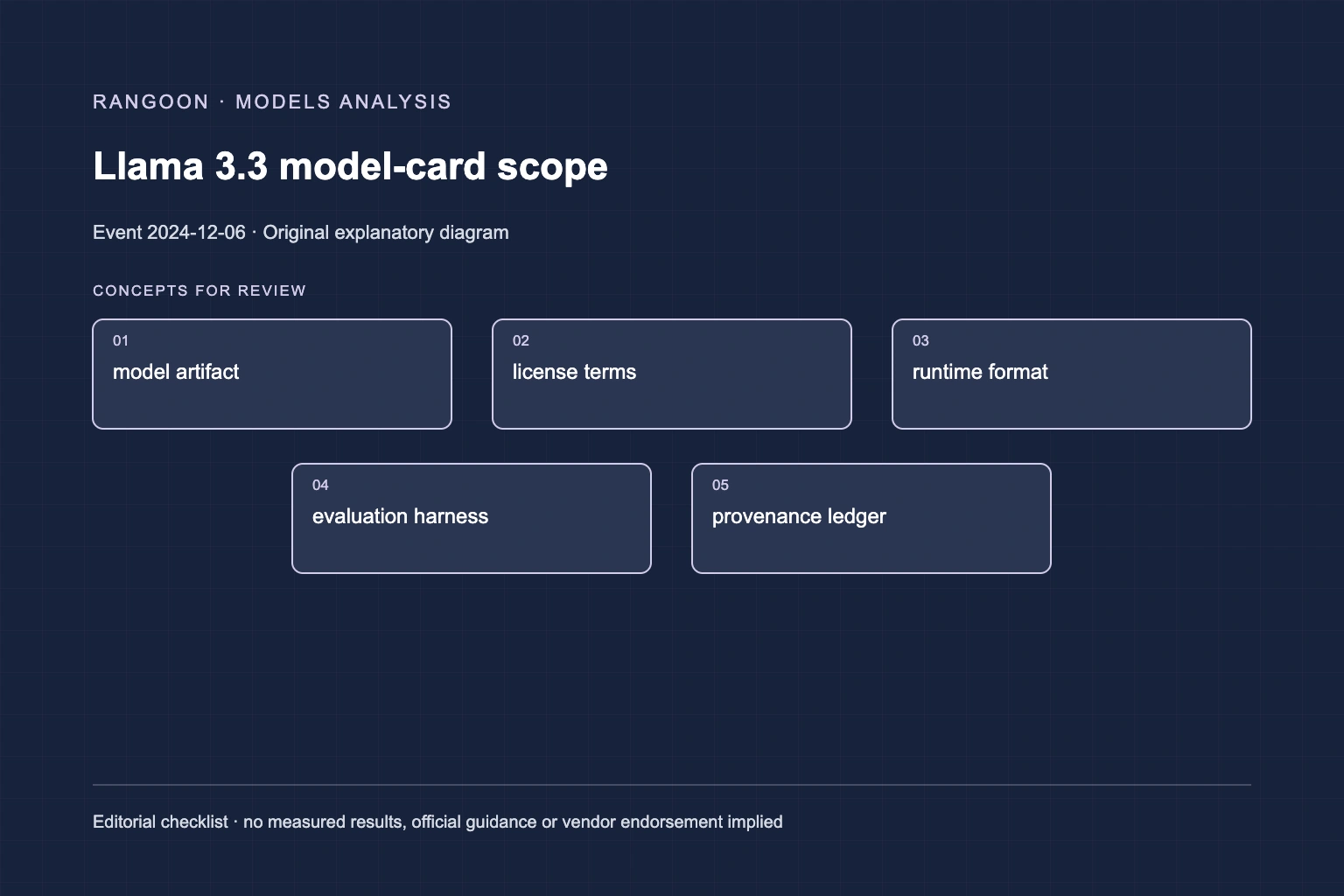
- Before adoption, pin the exact model identifier and revision, then review the applicable license and acceptable-use terms against the planned distribution, modification, hosting, and user flow.
- The December 2024 materials support Meta’s stated Llama 3.3 release. They do not establish current availability, legal interpretation, or local benchmark performance.
What Meta released[source 1][source 2]
The official Llama 3.3 70B Instruct model card records a December 6, 2024 release date. Meta’s December 19 retrospective lists the 70B Instruct model among its late-2024 releases and discusses vendor-reported comparisons. The artifact, license terms, and benchmark conditions are related, but each must be examined directly.
The Llama 3.3 70B Instruct model card is a separate primary document that describes the artifact, intended use, limitations, and license reference. A model card is not a serving benchmark, and a benchmark table is not a legal approval for a particular product use. Its declared intended-use boundaries also deserve review against the planned user task.
Editorial analysis: review the artifact and license together
Before adoption, pin the exact model identifier and revision, then review the applicable license and acceptable-use terms against the planned distribution, modification, hosting, and user flow. Record the reviewer, decision, and any constraints rather than relying on a family-level memory of ‘open.’
Treat every conversion or quantization as a new artifact in the operating record. It may preserve weights semantically while changing performance, memory needs, tokenizer packaging, or provenance details needed for incident response.
Editorial analysis: preserve supplier benchmark conditions
A vendor comparison should keep the task set, prompt method, few-shot policy, decoding, and score definition next to the result. If a local test uses another harness, present it as a different measurement rather than an attempted replica.
For multilingual workloads, evaluate each required language and format. A broad language list does not establish quality on domain terminology, regional variants, structured extraction, or user-supplied mixed-language documents.
Editorial analysis: make deployment provenance inspectable
Maintain a model bill of materials: base artifact, revision, conversion, quantization, runtime, prompt template, tools, license review, and fixture report. The record gives a later maintainer a route from an output to the exact technical and legal inputs.
Meta’s release date is a bounded historical claim. Current distribution channels, platform policies, and derivative artifacts require fresh evidence instead of being inferred from December 2024.
Editorial analysis: retain the release boundary
The December 2024 materials support Meta’s stated Llama 3.3 release. They do not establish current availability, legal interpretation, or local benchmark performance.
A model bill of materials should survive handoff. Imagine a team receives a quantized derivative from an internal artifact store months after the base release. Without the original model identifier, conversion command, checksum, license review, runtime, and prompt template, it cannot tell whether a quality or legal change came from Meta’s release, the conversion, or the application. Require the derivative to point back to its base and test report. For a multilingual use case, retain the language-specific fixtures that justified adoption. This is an operational provenance example, not legal advice and not a claim about any particular Llama derivative.
Provenance should include the date an organization obtained each artifact. That prevents a later download or repackaging from being mistakenly described as the original December release.
Sources
- Llama 3.3 70B Instruct model card (December 6, 2024)
- Meta AI: The future of AI, built with Llama
Continue reading
Related reading
 News analysisLlama 4 showed why open weights still need deployment boundaries3 min read
 News analysisTencent released Hunyuan-A13B under a territory-limited community license, separating open weights from universal permission3 min read
 News analysisQwen2.5-Coder’s family release made coding-model selection a size-and-harness decision3 min read