Mastra 1.0 locked APIs while bringing agents into existing servers
Mastra announced its stable 1.0 release on January 20, 2026, adding server adapters, composite storage, AI SDK 6 support and documented migration changes.
Historical reporting: Mastra announced stable 1.0 on January 20, 2026, and its same-day changelog records the 1.0.0 release. A December 11, 2025 first-party server-adapter article supplies prior integration context. The sources document APIs and migration changes, not a deployment or runtime outcome for an application.
Key takeaways
- Mastra 1.0 added adapters for placing its endpoints inside existing Node servers.
- The release changed imports, tool signatures, context names and several storage APIs.
- A migration must test middleware order, persisted data and observability fields together.
Stable 1.0 arrived with server adapters and migration work[source 1][source 2]
Mastra announced stable 1.0 on January 20, 2026, saying its APIs were locked and describing server adapters, composite storage, AI SDK v6 support, thread cloning, and observability changes. Its same-day changelog records the 1.0.0 release and documents the implementation changes behind that announcement. Mastra’s server adapters were designed to expose agents, workflows, tools, and MCP servers as endpoints within Express, Hono, Fastify, or Koa applications instead of requiring a separate Mastra process. That is an architectural integration option. It does not establish that an existing application’s authentication, routing, logging, or deployment behavior transfers automatically when the adapter is installed.
The release shifted framework work toward existing application boundaries[source 1][source 2]
The January changelog made the scope of 1.0 concrete. It introduced composite storage that could route domains such as memory and workflows to different backends, and added support for AI SDK v6’s LanguageModelV3 and ToolLoopAgent. It also documented breaking changes: subpath imports for most core primitives, a changed tool execution signature, `RuntimeContext` renamed to `RequestContext`, list-style collection accessors, explicit observability configuration, and updated storage access patterns. These choices show a framework reorganizing contracts around application integration and runtime state. They do not decide what data an application should retain, how long it should retain it, or which agent action is acceptable in a given product.
Middleware placement was a material migration detail[source 3]
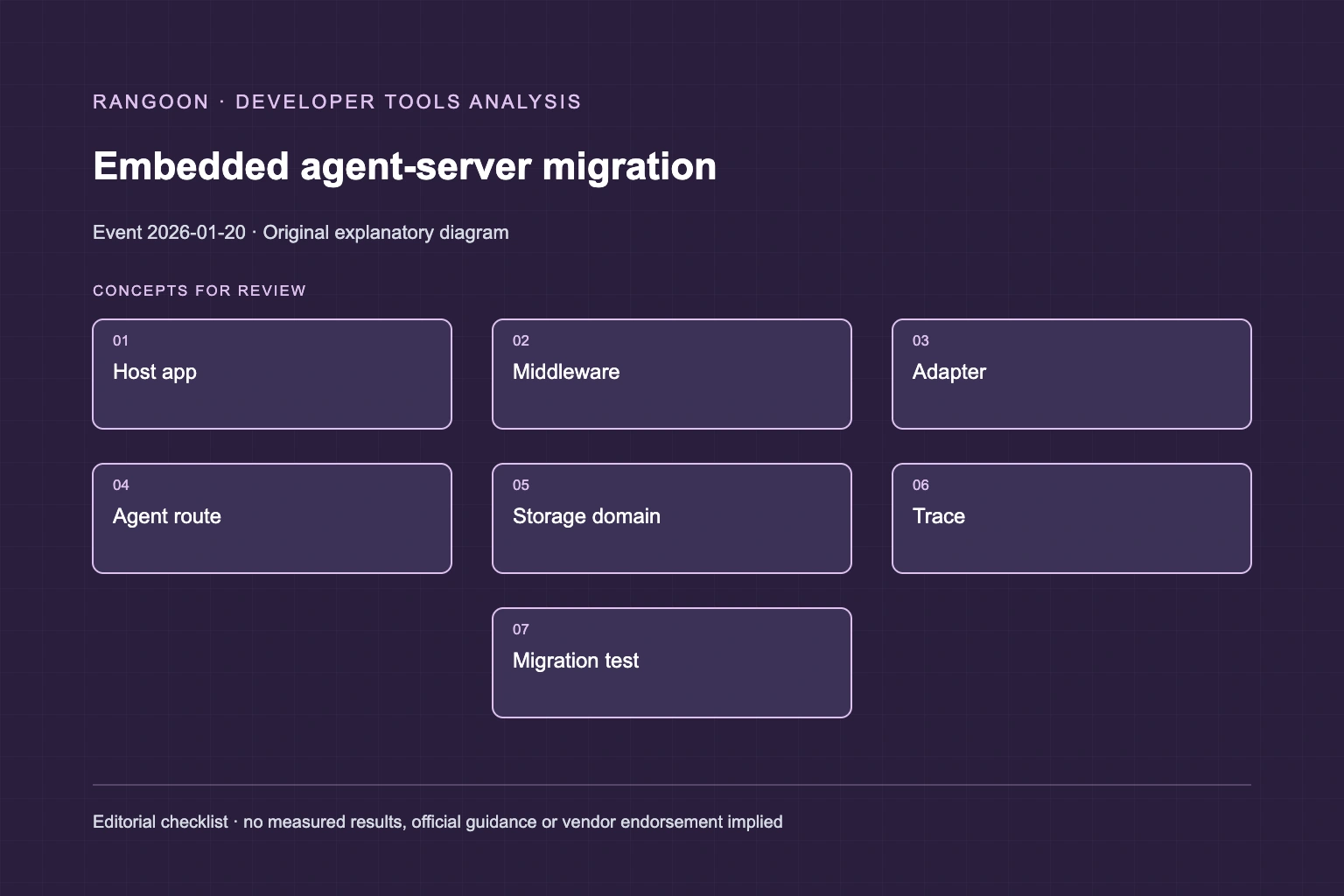
Mastra’s December 11, 2025 server-adapter article explains why migration behavior could depend on initialization order: endpoints only inherit middleware that is registered before adapter initialization. That earlier article is integration context, not a feature newly introduced by the January 1.0 announcement. An upgrade test should exercise the exact server path, including route prefixes, request parsing, identity middleware, error handling, tracing, and an endpoint that invokes a workflow or tool. Storage migrations deserve their own fixtures because composite storage and renamed accessors can change where a durable record is read from. The 1.0 documents also note a higher Node.js minimum and database migrations for some PostgreSQL or LibSQL users. Those are release-specific compatibility checks, not evidence that a project has completed them.
Version 1.0 made the surrounding host application part of the story[source 1][source 2]
Mastra 1.0 was more than an API-stability label because it supplied a clearer path for embedding agent and workflow endpoints inside the server an application already owns. That reduces one category of integration work while making host-server decisions more visible: middleware order, route ownership, error boundaries, storage domains, and observability configuration. A reliable migration record would save the core package version, Node version, adapter and prefix, registered middleware sequence, storage mapping, tool signatures, and a trace from each representative route. It should retain the exact pre-upgrade and post-upgrade persistence locations for each affected domain. That comparison makes a missing history, score, or workflow row diagnosable after cutover and preserves a route-level comparison. The January sources establish the release and its stated changes. They do not guarantee backward compatibility for every plugin, validate a database migration, or show that a particular agent system behaves safely after the upgrade.
Sources
- Mastra: Announcing Mastra 1.0 (January 20, 2026)
- Mastra: Changelog 2026-01-20 (January 20, 2026)
- Mastra: Introducing Server Adapters (December 11, 2025)
Continue reading