

Meta released V-JEPA 2 and physical-reasoning benchmarks for video world-model research
Meta released V-JEPA 2 on June 11, 2025, pairing a video-trained world model with physical-reasoning benchmarks and reported zero-shot robot-planning experiments.
Historical reporting: Meta introduced V-JEPA 2 on June 11, 2025 and released code, checkpoints and three benchmarks. The blog and same-day research publication describe video pre-training, action-conditioned post-training and laboratory robot experiments. Meta’s benchmark and robot results are research results under stated conditions, not evidence of general robot reliability, safety certification or a production deployment.
Key takeaways
- V-JEPA 2 separated broad video learning from a later action-conditioned stage intended to support planning experiments.
- Meta released benchmarks alongside the model, making reported physical-reasoning results conditional on defined tasks and metrics.
- Laboratory zero-shot robot demonstrations did not establish certification, broad operational reliability or safe deployment in uncontrolled settings.
The June event joined a video world model to three physical-reasoning benchmarks[source 1][source 2]
On June 11, 2025, Meta introduced V-JEPA 2 as a video-trained world model and said it was releasing three benchmarks for physical reasoning. The launch describes the research goal as learning from observations, predicting how a scene may evolve and using those predictions to plan actions. It also says code and model checkpoints were available for commercial and research applications. That is a public research-artifact event. It does not show that a model has a complete understanding of a physical environment or that a planned action will be safe in a new setting.
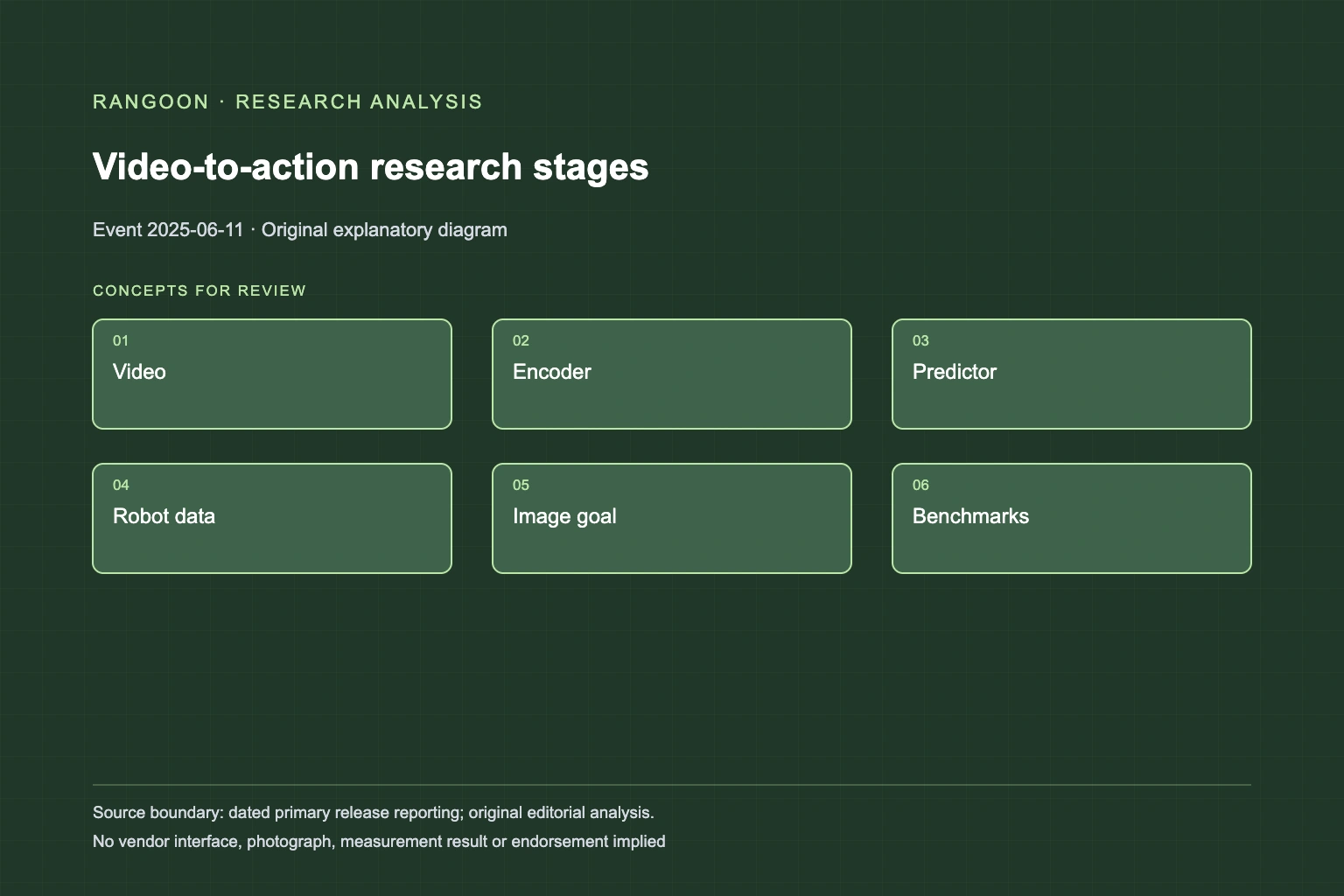
Meta describes the system as an encoder that maps raw video to semantic embeddings and a predictor that produces expected embeddings from context. The distinction matters because the release is built around learned representations and predicted consequences rather than a direct image-to-command guarantee. A benchmark result may show progress on a defined understanding, prediction or planning task, while leaving sensors, object properties, control hardware, latency and human oversight outside the result. The June record supports a technical direction, not an operational promise.
The research record separated action-free learning from later action-conditioned work[source 1][source 2]
Meta said V-JEPA 2 first used self-supervised, action-free pre-training on more than one million hours of video and one million images. It then added action-conditioned training with robot data so the predictor could account for candidate actions. This two-stage structure is important for interpreting the claim. Broad video learning can support motion and scene representations, while a later control-oriented stage gives the system information about actions. Neither stage alone turns a video model into a generally capable robot operator.
The publication says the action-conditioned version, V-JEPA 2-AC, used less than 62 hours of unlabeled robot video from the DROID dataset. It reports that the model was deployed zero-shot on Franka arms in two labs for image-goal picking and placing without collecting data in those environments. Those are bounded laboratory experiments with named hardware, tasks and goal formats. They should not be widened into a finding about homes, factories, public spaces, people nearby or systems that must recover safely from unseen failures.
Reported scores belonged to their datasets, readouts and test conditions[source 1][source 2]
Meta reported motion-understanding, action-anticipation and video-question-answering results, including measurements on Something-Something v2, Epic-Kitchens-100, PerceptionTest and TempCompass. The research page provides the numerical scores and says some video-question-answering results followed alignment with a language model. Those facts are useful for locating the work in a published evaluation record. They are not portable rankings for every video task, because data distribution, readout method, prompt design and comparison system all affect the measured result.
World-model research did not amount to a certified physical agent[source 1][source 2]
This article does not project later robot trials, model updates or field deployments back into June 2025. It treats Meta’s results as vendor-published research under the methods described in the source records. The historical conclusion is narrower: Meta released V-JEPA 2 with a staged video-and-action learning design, reported controlled robot-planning experiments and supplied benchmarks for further physical-reasoning evaluation. Those facts support scrutiny and replication, not a claim that physical agents were ready for unrestricted operation.
Sources
Continue reading
Related reading
 News analysisWayve launched GAIA-2 for controllable multi-camera driving scenarios, positioning it as an offboard training and validation tool3 min read
 News analysisMeta paired concept segmentation with 3D reconstruction in its November 2025 SAM release3 min read
 News analysisMeta introduced SAM Audio with text, visual and temporal prompts for source separation3 min read