

Micron’s Singapore HBM packaging groundbreaking set a future supply timetable
Micron broke ground on a Singapore HBM packaging facility on January 8, 2025, with a roughly $7 billion investment, 2026 operations target and 2027 capacity plan.
Historical reporting: Micron broke ground on a new HBM advanced-packaging facility in Singapore on January 8, 2025. The company described an approximate $7 billion investment over several years, operations scheduled to begin in 2026 and meaningful advanced-packaging-capacity expansion beginning in calendar 2027. Singapore’s Ministry of Trade and Industry separately recorded the groundbreaking. Construction, scheduled operations and planned capacity are not evidence of HBM units already packaged or supplied on the event date.
Key takeaways
- The January event was a groundbreaking for a packaging facility, not a report of finished HBM output from that facility.
- Micron’s 2026 operations and 2027 capacity statements were schedules and plans, each requiring later commissioning and ramp evidence.
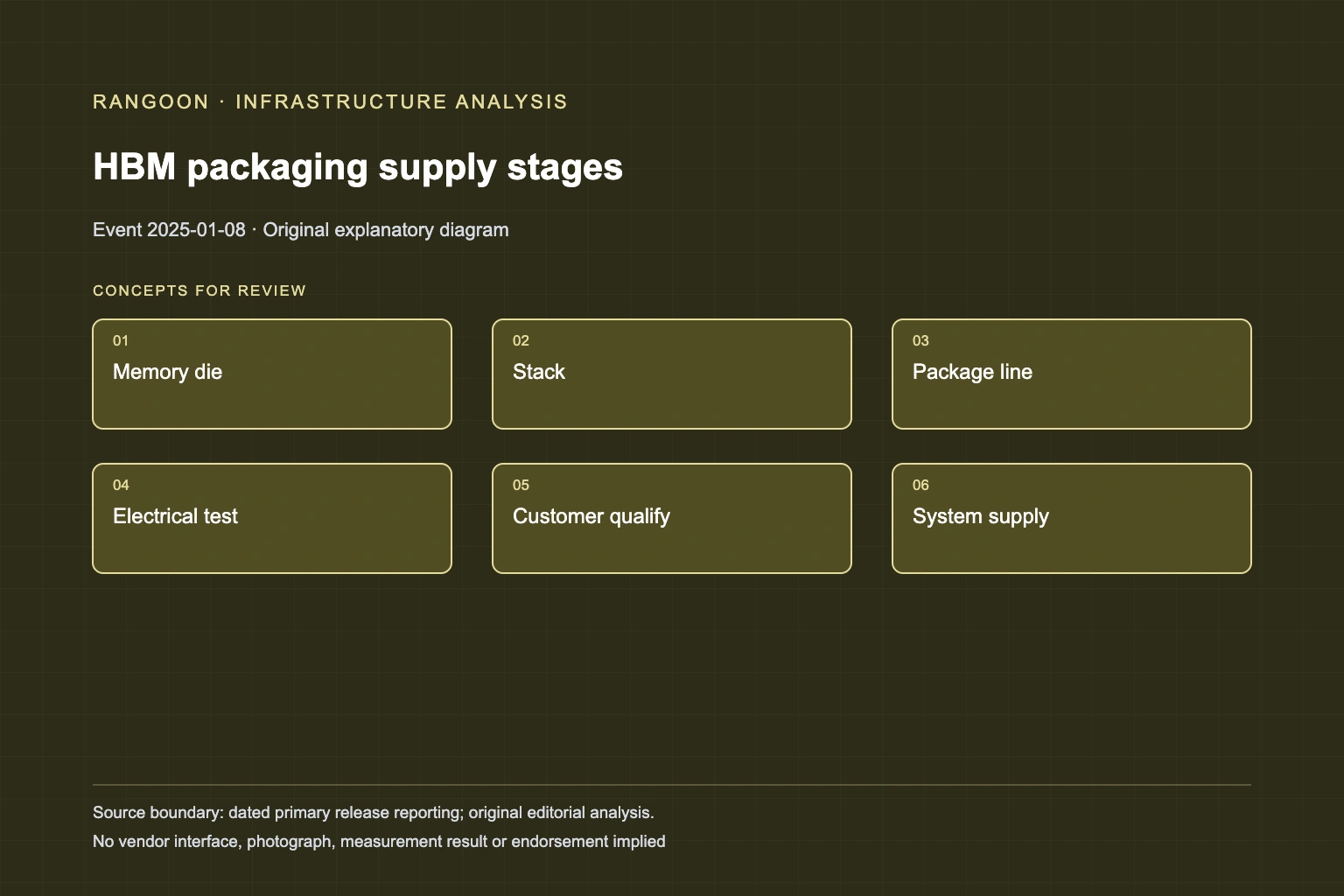
- HBM supply depends on memory production, packaging, testing, qualification and customer-system integration, not only one new building.
A groundbreaking recorded site commitment before production[source 1][source 2]
On January 8, 2025, Micron announced that it had broken ground on a new high-bandwidth-memory advanced-packaging facility adjacent to its existing Singapore operations. The company described the facility as the first of its kind in Singapore and said the investment would be approximately $7 billion over several years. A groundbreaking is a concrete development milestone: it identifies a site and a construction start. It is not the same thing as a commissioned production line, packaged HBM inventory or customer shipments from the new facility.
Micron said operations were scheduled to begin in 2026 and that meaningful expansion of its total advanced-packaging capacity was expected to start in calendar 2027. Those are useful time markers because they distinguish construction from later operating stages. “Scheduled” and “expected” are prospective language. A later test, production or supply statement would need to establish whether a facility reached those stages and under what configuration. The January source does not provide a completed-ramp measurement, so it cannot be used to assert that the expansion had already relieved memory supply constraints.
Advanced packaging is one stage in an HBM delivery path[source 1][source 2]
HBM is built from memory dies stacked and connected for high bandwidth, then incorporated into a package and ultimately a larger computing system. Packaging capacity is important because it can become a gating step even when memory dies and substrate materials are available. Yet a packaging-facility announcement does not replace the upstream work of producing suitable dies or the downstream work of test, qualification, accelerator integration and system delivery. A capacity plan should therefore identify what stage it addresses instead of implying that it measures all HBM supply.
Micron linked the site to AI data-center demand, which explains the company’s stated business rationale. That framing does not identify a particular accelerator customer, a qualified HBM generation or a guaranteed volume. Comparing supplier announcements also requires care: one company may describe package capacity, another may report samples, and a third may report mass-production readiness. Those labels are not interchangeable benchmarks. The useful comparison question is which physical stage, product form and date each supplier actually documented, rather than which announcement carries the largest AI headline.
The Singapore location narrows the infrastructure claim[source 1][source 2]
The event occurred in Singapore, beside Micron’s existing facilities, and the Ministry of Trade and Industry’s ceremony record corroborates that local setting. This supports a location-specific statement about a Singapore advanced-packaging project. It does not support an assertion of U.S. production, a global market-share conclusion or a claim that every part of a customer’s memory supply chain was located there. Manufacturing geography needs the named facility and work stage attached, especially where wafers, assembly, test and final system integration can take place in different places.
The announced investment also should not be treated as a cash-flow record. Micron described an approximate amount over several years, while government speakers described the facility’s anticipated role in the local ecosystem. Neither statement provides an audited expenditure ledger, a finished cleanroom area or a customer allocation schedule. That does not weaken the historical event; it defines it. The sources establish a planned packaging expansion with a stated site and timetable. They leave later questions of build progress, tool installation, output and commercial contribution to later evidence.
A facility schedule is not a near-term availability guarantee[source 1][source 2]
Large semiconductor projects advance through construction, facility-system readiness, tool installation, process bring-up, reliability work, product qualification and output ramp. A published target for operations does not make all those steps disappear. In HBM, customers may also need to validate a memory stack with a specific processor package and board or system design. That means an operator planning compute should treat the Micron announcement as context for a future supply path, not as a substitute for a supplier commitment, part number, qualification status or delivery schedule.
The January record is best read as a dated statement of intent and a construction start. It shows Micron moving advanced-packaging infrastructure toward a later period of anticipated demand. It cannot determine whether future capacity was enough for a market, whether an individual buyer could obtain supply, or which AI workload would benefit. Follow-up reporting can add those facts when Micron or a customer documents commissioning, output or qualification. Until then, separating groundbreaking, scheduled operations and meaningful capacity expansion keeps the account useful for both industrial history and procurement analysis.
Sources
Continue reading
Related reading
 News analysisTSMC’s Arizona expansion announcement separated a $100 billion plan from current fab output4 min read
 News analysisGlobalFoundries’ New York packaging center plan made onshore test a separate capability4 min read
 News analysisGlobalFoundries’ $16 billion U.S. plan paired expansion with packaging and research4 min read