Microsoft brought Copilot Vision to mobile and announced a staged Windows rollout
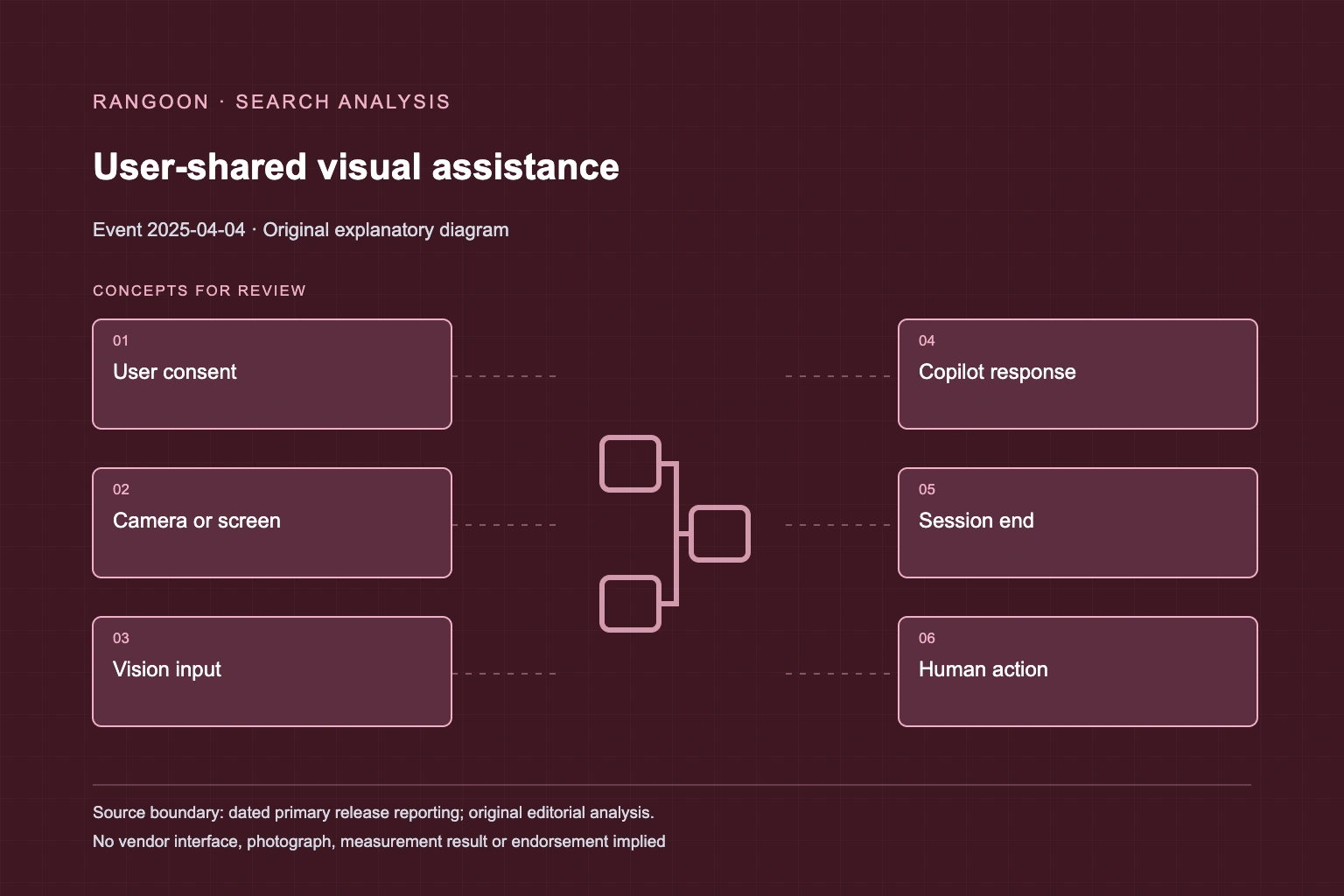
Microsoft announced Copilot Vision on April 4, 2025 for mobile camera and photo use, with Windows Vision first planned for Insiders.
Historical reporting: Source 0 is Microsoft’s dated April 4, 2025 Copilot announcement. Source 1 is current Microsoft Support privacy documentation used only for later handling context. It is not evidence that current storage, consent or availability terms applied at the 2025 announcement.
Key takeaways
- Microsoft announced Copilot Vision on April 4, 2025 for mobile camera and photo analysis, while saying Windows Vision would first reach Insiders the following week.
- The release described Vision as a user-requested tool for shared surroundings, screens, apps, tabs or files, not a claim it could independently control all it saw.
- Visual assistance needs deliberate sharing and review: current Microsoft documentation identifies session, capacity and data-handling limits that launch claims alone cannot prove.
Mobile availability and Windows staging were separate claims[source 1]
Microsoft announced Copilot Vision on April 4, 2025 as part of a wider Copilot update. The dated release said the mobile Copilot app for iOS and Android could use a phone camera in real time and analyze photos from the camera roll. It also said a new native Windows app was available that day, while Vision for Windows would first be available to Windows Insiders the following week and broaden later. Those are different availability statements. The historical event supports mobile availability on the named platforms and a staged Windows plan. It does not establish that Vision was immediately available in every market, language, account type or Windows configuration, nor does it establish later rollout completion.
The announced experience depended on user-supplied visual context[source 1]
Microsoft described mobile Vision as an interactive experience in which a person points a camera at surroundings and asks for information, guidance or ideas. Its examples included examining a plant or scanning an office for decoration suggestions. For Windows, the announcement said Copilot could be called while working across applications, browser tabs or files, read the screen and interact with content. This is a claim about a multimodal assistance surface, not a claim that the assistant possesses reliable knowledge of the physical world or the authority to operate a user’s device. A camera frame can be incomplete, an image can be ambiguous and a visible interface can omit the business rule that explains it. Human judgment remains necessary for identification, safety and action.
A feature announcement did not settle control or correctness[source 1]
The April release grouped Vision with memory, actions, pages, podcasts, shopping, deep research and search features. That broader context can make a launch sound like a single general upgrade, but each component had different inputs, platform conditions and maturity. Microsoft’s wording specifically placed the Windows Vision experience behind an Insider-first rollout, then said availability would vary by platform, market and language as the company expanded it. That is an operational limit worth retaining in an archive. Product announcements can accurately describe a direction while leaving eligibility and behavior conditional. A team assessing a visual-assistant workflow should verify its own platform, consent cues, regions, supported content and error behavior instead of assuming any broad “Copilot Vision” label answers those questions.
Current privacy guidance needs its own date and scope[source 2]
Current Microsoft Support documentation says Copilot Vision processes images shared to answer a request, says camera images and screenshots are not stored after a session ends, and distinguishes text transcripts that may be saved. It also describes consent for biometric processing when a user captures or uploads visual material. Those are specific handling claims worth checking before use, particularly where people or sensitive surroundings are visible. They are current help context, not proof of the April 2025 implementation. The launch announcement did not provide a complete privacy specification, a safety evaluation or a universal accuracy guarantee. Treating the two sources separately keeps the historical product fact distinct from changing operational terms and lets readers check the current document before sharing material.
Sources
Continue reading