

Mistral Small 3.1 made multimodal acceptance a modality-by-modality test
Mistral released Small 3.1 on March 17, 2025 as an updated small model. A vision-capable release needs image, text, retrieval, and structured-output tests kept separate.
Historical reporting: Mistral’s March 17, 2025 Small 3.1 post announced the release; the versioned documentation is a separate primary record. The analysis below is original editorial analysis; it does not claim present availability, performance, or support.
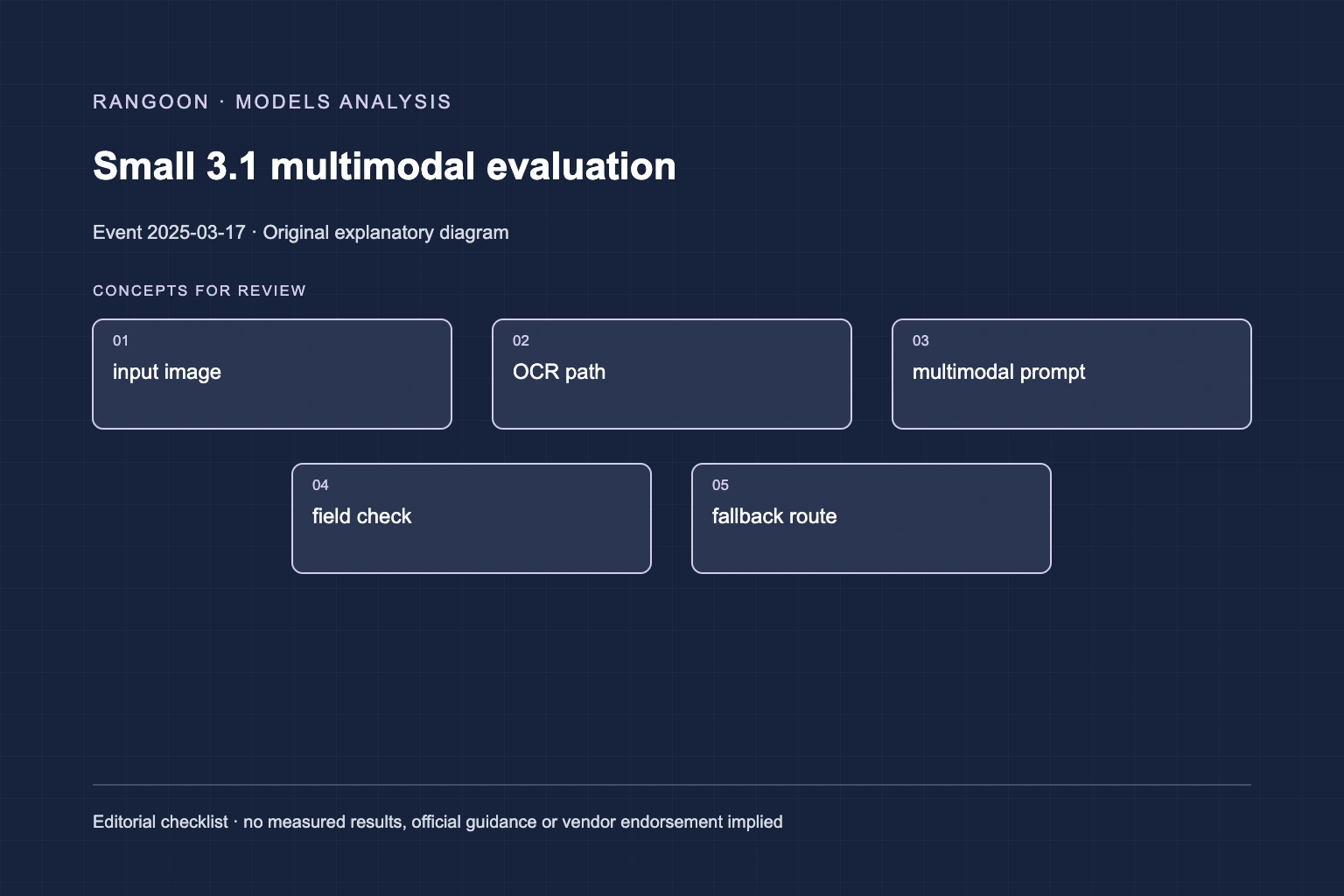
Key takeaways
- On March 17, 2025, Mistral announced Mistral Small 3.1, an update to its small-model line that described multimodal understanding and a 128K context window.
- For multimodal work, specify accepted image types, resolution, orientation, pages, OCR handling, prompt format, and required citations or coordinates.
- The March 2025 release documents Mistral’s stated Small 3.1 features. It does not prove current API behavior or accuracy on any untested image corpus.
What Mistral updated[source 1][source 2]
On March 17, 2025, Mistral announced Mistral Small 3.1, an update to its small-model line that described multimodal understanding and a 128K context window. The event is an update with specific claimed features, not proof that every image, document, or mixed-media task will behave consistently in a given serving stack.
The Mistral Small 3.1 documentation separately identifies the model version and declared features. It supplies a stable record for the artifact while the launch post supplies the dated release claim. It does not establish an organization’s image pre-processing, file-size limits, OCR quality, or retention controls.
Editorial analysis: define the input contract
For multimodal work, specify accepted image types, resolution, orientation, pages, OCR handling, prompt format, and required citations or coordinates. An image model’s apparent success on a clean screenshot may not generalize to scans, charts, rotated pages, or dense tables.
Test text-only, image-only, and combined prompts independently. This identifies whether a failure is in visual extraction, cross-modal reasoning, instruction following, or response formatting, and it helps a team choose a targeted fallback.
Editorial analysis: use task-native visual fixtures
A useful fixture set contains the actual document types users supply: receipts, diagrams, forms, photographs, dashboards, and ambiguous images. Score fields, references, units, and uncertainty statements, not just a fluent description of the picture.
Keep test images permitted and versioned. If a benchmark image changes or is replaced by a cleaned version, record the difference; otherwise reported model progress may be a fixture change.
Editorial analysis: retain the conversion path
Record image transformations, OCR versions, chunking, prompt templates, and output schemas. The model identifier alone cannot explain a visual result because pre-processing often controls what information reached the model.
Mistral’s dated update can guide a candidate evaluation. It should never be converted into a blanket statement that a workflow has reliable document understanding.
Editorial analysis: retain the release boundary
The March 2025 release documents Mistral’s stated Small 3.1 features. It does not prove current API behavior or accuracy on any untested image corpus.
A practical hypothetical visual test uses a scanned invoice with a rotated page, faint stamp, handwritten correction, and a table split across two images. Ask for fields with confidence labels and coordinates or source snippets where the workflow supports them. A model may correctly describe the document but transpose a unit, attribute a handwritten note to the wrong field, or merge rows. These are input-contract failures, not merely language failures. Compare the visual result with a text-only OCR baseline and a human-reviewed reference. This analysis does not claim that Mistral Small 3.1 handles or fails these inputs; it defines the evidence needed before a product makes that claim.
For extracted values, compare normalized output with the original image crop. That extra link lets a reviewer find whether a mistake began in visual recognition or in later interpretation, especially when handwritten corrections alter a tabular value.
Sources
- Mistral: Mistral Small 3.1 (March 17, 2025)
- Mistral Docs: Mistral Small 3.1
Continue reading
Related reading
 News analysisMistral Small 3 made latency a claim to measure in the target stack3 min read
 News analysisTencent released Hunyuan-A13B under a territory-limited community license, separating open weights from universal permission3 min read
 News analysisQwen2.5-Coder’s family release made coding-model selection a size-and-harness decision3 min read