OpenAI made ChatGPT for Clinicians available to verified U.S. clinicians
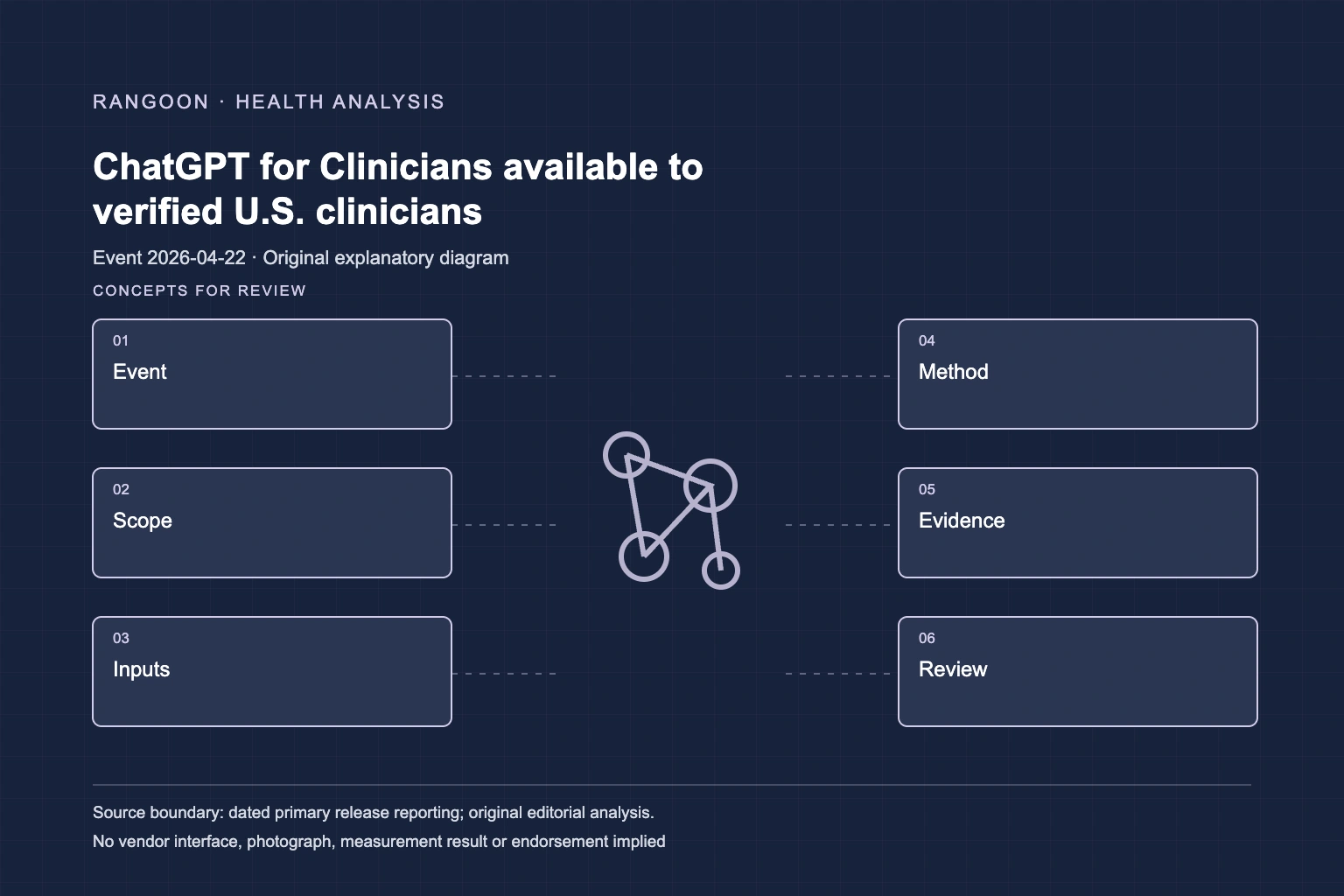
OpenAI announced ChatGPT for Clinicians on April 22, 2026, offering a clinician-focused workspace for verified U.S. physicians, NPs, PAs and pharmacists.
Historical reporting: OpenAI dates the ChatGPT for Clinicians announcement to April 22, 2026. The public help record was freshly read for eligibility and feature context; it explicitly says the tool supports, rather than replaces, professional judgment.
Key takeaways
- The event concerned verified individual U.S. clinicians, distinct from organization-wide healthcare deployment.
- OpenAI described clinical search, citations, documentation and research support within a clinician-focused workspace.
- Verification, access and retrieval features do not establish a diagnosis, treatment decision or clinical outcome.
The April record named an individual-clinician availability model[source 1][source 2]
On April 22, 2026, OpenAI announced ChatGPT for Clinicians as a product for verified individual clinicians in the United States. The company named physicians, nurse practitioners, physician assistants and pharmacists as the initial audience. This is a distinct availability and identity boundary from a hospital’s centralized deployment. The event does not show that every eligible person enrolled, that a health system adopted the product or that any clinical task was completed correctly. It establishes OpenAI’s stated launch scope and must not be read as medical advice or a replacement for a licensed professional’s judgment.
The help record describes the clinical-workflow features[source 1][source 2]
OpenAI’s help page says the product supports clinical work including evidence review, documentation and medical research, and describes trusted clinical search with citations, pre-built skills and starter prompts. It also identifies the verification pathway through a valid NPI and a license checked by a third party. These are concrete access and workflow claims. They do not validate a particular citation, local policy, patient record or recommendation. A product can expose a search or drafting function while the quality of a real use depends on the input, retrieval set, user review and care setting.
Individual eligibility does not settle organizational governance[source 1][source 2]
The help record distinguishes ChatGPT for Clinicians from ChatGPT for Healthcare, which it describes as a centralized organizational product. That distinction is consequential: an individual account and a managed enterprise environment can have different administration, data connections and governance. The public sources do not provide a blanket approval for sharing protected information or a result from a specific clinical deployment. They also do not establish outcome improvements for patients. The historical analysis records a clinician-focused launch and eligibility process, while leaving legal, organizational and clinical responsibilities to their own evidence and rules.
The status change was verified access to a defined product[source 1][source 2]
OpenAI’s April announcement changed the public availability picture by offering a clinician-focused product to verified U.S. users. The source-specific details are the role set, verification gate and listed research, documentation and clinical-search functions. Those facts can inform a product timeline, but they do not answer whether a model output is appropriate for care. The help page’s support-not-replace framing is the relevant limitation. The archive therefore treats the event as a workflow-product launch, not as a clinical finding, medical recommendation or proof of healthcare performance. The source’s NPI and license checks define admission to the product, not the truth of a response or the appropriateness of a downstream care action. That is why access status and clinical evidence remain separate. The April announcement is also not evidence that a clinician consulted a particular source, accepted a summary or changed a patient plan. Those are use-specific observations that the public launch record does not contain.
Sources
Continue reading