GPT-5.2 separated work modes without making their results interchangeable
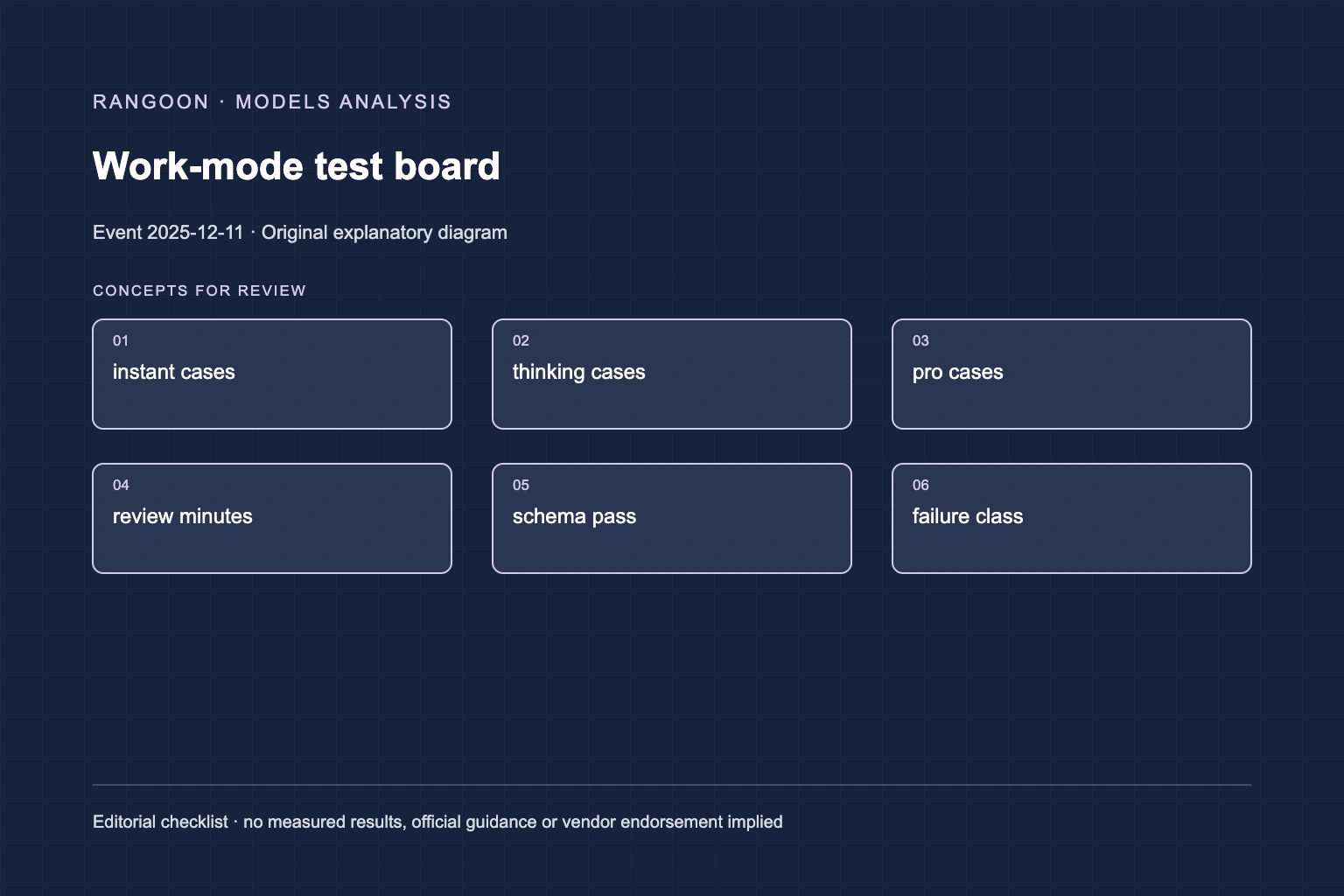
OpenAI introduced GPT-5.2 on December 11, 2025, describing Instant, Thinking, and Pro variants for different kinds of work.
Historical reporting: OpenAI introduced GPT-5.2 on December 11, 2025. This is not a statement about current plans, access, pricing, or relative performance.
Key takeaways
- Variant labels require workload-specific acceptance criteria.
- A higher-effort route may alter latency and review needs.
- Release claims need their stated evaluation conditions preserved.
Release record[source 1][source 2]
OpenAI introduced GPT-5.2 and described Instant, Thinking, and Pro variants within the GPT-5 series. The launch page and the release notes both date the event, while serving different purposes: one states the vendor’s product narrative and the other records its application release. A retrospective should not translate either document into a timeless performance ranking.
Technical design[source 1][source 2]
The relevant engineering question is more concrete: which variant, configuration, and task produced an observed result? Variants framed around everyday work, deeper reasoning, or difficult questions can have different latency, token use, retry behavior, and failure patterns. A team should therefore avoid a single score that blends short classification, long-document synthesis, code generation, and tool-bearing workflows.
Operating boundary[source 1][source 2]
Build separate fixtures for each decision that matters. For example, extraction needs schema validity and field-level accuracy; research needs source traceability and uncertainty handling; code needs tests and change review; tool use needs authorization and postcondition checks. Record wall-clock time and human review time beside answer quality.
Evaluation evidence[source 1][source 2]
Those fields reveal whether a promising output improves the whole operation. The December event also makes version drift visible. A later system might share a family label yet differ in training, routing, policy, or available capabilities.
Historical implication[source 1][source 2]
Historical launch pages are evidence about that date, not proof of continuity. Keep evidence labels honest: vendor-documented, locally measured, or unknown. If a provider publishes benchmark results, retain task name, scorer, tool condition, and date instead of importing the number into a product requirement.
Local fixtures should include adversarial inputs, missing context, contradictory documents, malformed tool responses, and an instruction to perform an action that policy must block. These tests protect against a narrow success metric overwhelming operational controls. Before an upgrade, define the rollback condition and hold a comparison set out of tuning.
Afterward, inspect not only aggregate success but also the changes in the error distribution. The historical lesson is not that one work mode is universally best. It is that a multi-variant release turns model choice into a measurable operating decision.
Teams need explicit variant selection, reproducible tests, and a record that distinguishes a December 2025 announcement from present-day deployment facts. Keep the unchanged comparison cases after launch as well as the new cases. They reveal whether an improvement in one work mode displaced a previously reliable behavior elsewhere.
A release decision is stronger when both gains and losses are visible to the same reviewer. Keep these materials with the release decision so a later reviewer can assess the original evidence without assuming that current provider documentation describes the same state. The comparison should be repeatable by a colleague who did not participate in prompt tuning, using preserved fixtures and a clearly named scoring rule. That makes the final recommendation inspectable and avoids making a broad model-family claim from a limited set of tests.
Sources
- OpenAI: Introducing GPT-5.2 (December 11, 2025)
- OpenAI Help: ChatGPT release notes (December 11, 2025)
Continue reading