o3 and o4-mini made tool-conditioned evaluation impossible to ignore
OpenAI released o3 and o4-mini on April 16, 2025, describing reasoning models that could use ChatGPT tools including web search, code, files, and images.
Historical reporting: OpenAI released o3 and o4-mini on April 16, 2025. No current tool availability, safety classification, or benchmark result is inferred.
Key takeaways
- A model score with tools differs from a model-only score.
- Tool inventory and tool results belong in an evaluation receipt.
- Reasoning capability does not grant authority to act.
Release record[source 1][source 2]
OpenAI released o3 and o4-mini on April 16, 2025, describing reasoning models that could use and combine tools in ChatGPT, including web search, Python, file analysis, image analysis, and image generation. The launch announcement and system card are distinct primary records. The first describes the release and its stated capabilities; the second documents OpenAI’s safety evaluation context.
Technical design[source 1][source 2]
Their combination supports a historical account of a tool-enabled reasoning release. It does not prove that an arbitrary agent, connector, or later product setting will use tools reliably. Tool access changes an evaluation’s meaning.
Operating boundary[source 1][source 2]
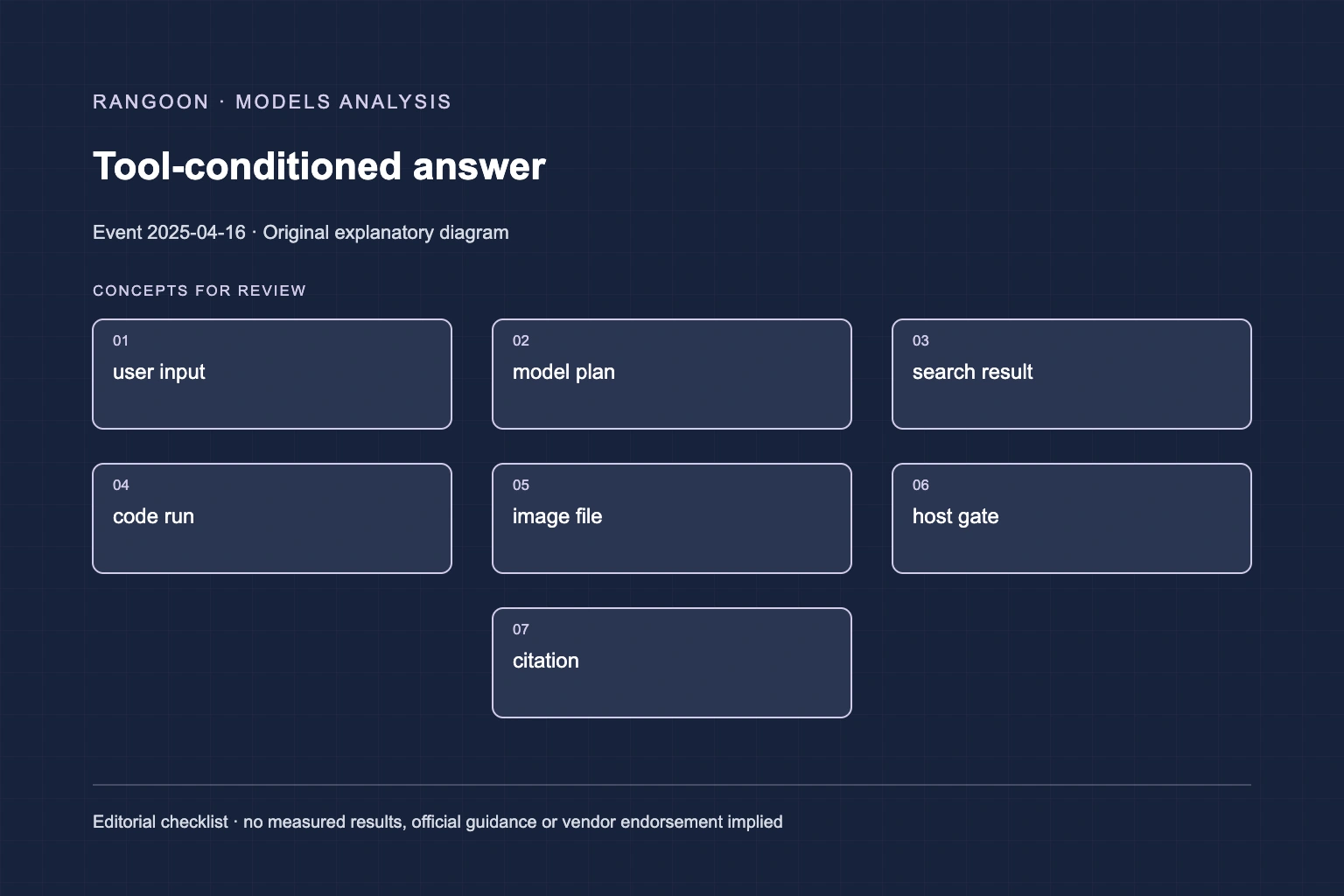
A correct answer reached after a search request, a code execution, or image transformation includes information and state outside the base model. Tests must record tool versions, permissions, network state, source availability, input files, and returned results. Without that receipt, a later reviewer cannot tell whether a model improved, a retrieval corpus changed, a tool failed open, or an external page supplied the decisive fact.
Evaluation evidence[source 1][source 2]
The April release is a useful prompt to separate reasoning from execution. A model can propose a command or use an available tool, but the host must still validate arguments, restrict scope, inspect the result, and decide whether a side effect is permitted. Success metrics should therefore include prevented unsafe actions and correctly surfaced uncertainty, not only task completion.
Historical implication[source 1][source 2]
For visual tasks, retain the image source, transforms, and evaluation protocol; for code tasks, retain repository revision, tests, and sandbox boundary; for web tasks, retain retrieval date and citation checks. These details are often more material than a headline benchmark. An operator can begin with a small synthetic fixture suite, then introduce controlled read-only tools before evaluating a wider action surface.
Compare model-only, tool-assisted, and human-reviewed outcomes separately. That avoids calling an orchestration gain a raw model gain. The event remains historically specific: OpenAI announced o3 and o4-mini in April 2025 under its own stated conditions.
The lasting implementation lesson is that tool-bearing models require a fuller evidence trail. The model response is only one component of a result; the tool policy, returned data, and action gate complete the system behavior. When a tool result becomes material to an answer, store its provenance alongside the answer rather than only in an interface transcript.
This lets a later reader distinguish model reasoning from external evidence and repeat the relevant check after the source has changed. This is especially important for compound tasks, where an answer may be correct only because an external service supplied the decisive calculation, source, or transformation. A tool-enabled assessment is credible only when it says what tools were present, what data they returned, and what host policy prevented an unsafe call. Use this receipt for every failed as well as successful run, because hidden dependency failures are often the most useful evidence for improving the system boundary.
Sources
- OpenAI: Introducing o3 and o4-mini (April 16, 2025)
- OpenAI: o3 and o4-mini system card (April 16, 2025)
Continue reading