OpenAI’s April Preparedness Framework update made evaluations, safeguards and disclosure separate controls
OpenAI updated its Preparedness Framework on April 15, 2025, revising its severe-harm risk evaluation, safeguards, governance and disclosure approach for frontier capabilities.
Historical reporting: OpenAI published an updated Preparedness Framework on April 15, 2025. Its announcement says the update sharpened focus on severe-harm risks, added stronger requirements around risk minimization and clearer guidance for evaluation, governance and disclosure, plus future-facing research categories. The contemporaneous Version 2 PDF is the framework record. A framework defines a process and stated thresholds; it does not by itself establish a particular model’s risk level, mitigation effectiveness or deployment outcome.
Key takeaways
- The April update was a framework revision: it described a process for handling severe-harm risks, not a blanket result for a released model.
- OpenAI distinguished measurement, safeguards, governance and disclosure, so an evaluation score alone could not stand in for deployment evidence.
- Future-facing research categories signaled areas to investigate; they were not proof that a model had demonstrated those capabilities or risks.
The April publication updated a process for evaluating severe-harm risks[source 1][source 2]
On April 15, 2025, OpenAI published Version 2 of its Preparedness Framework and an accompanying announcement. OpenAI described it as a process for tracking and preparing for advanced AI capabilities that could introduce severe-harm risks. The announcement said the update narrowed its focus to the risks it considered most important, strengthened what it meant to sufficiently minimize risks in practice and made evaluation, governance and disclosure guidance clearer. This is a process-level event. It does not mean that every OpenAI model was newly evaluated on every category that day, nor does it provide a general safety certification. The dated framework establishes how the company said it intended to connect capability assessment, mitigation and release governance at that time.
Evaluation, mitigation, governance and disclosure were not interchangeable artifacts[source 1][source 2]
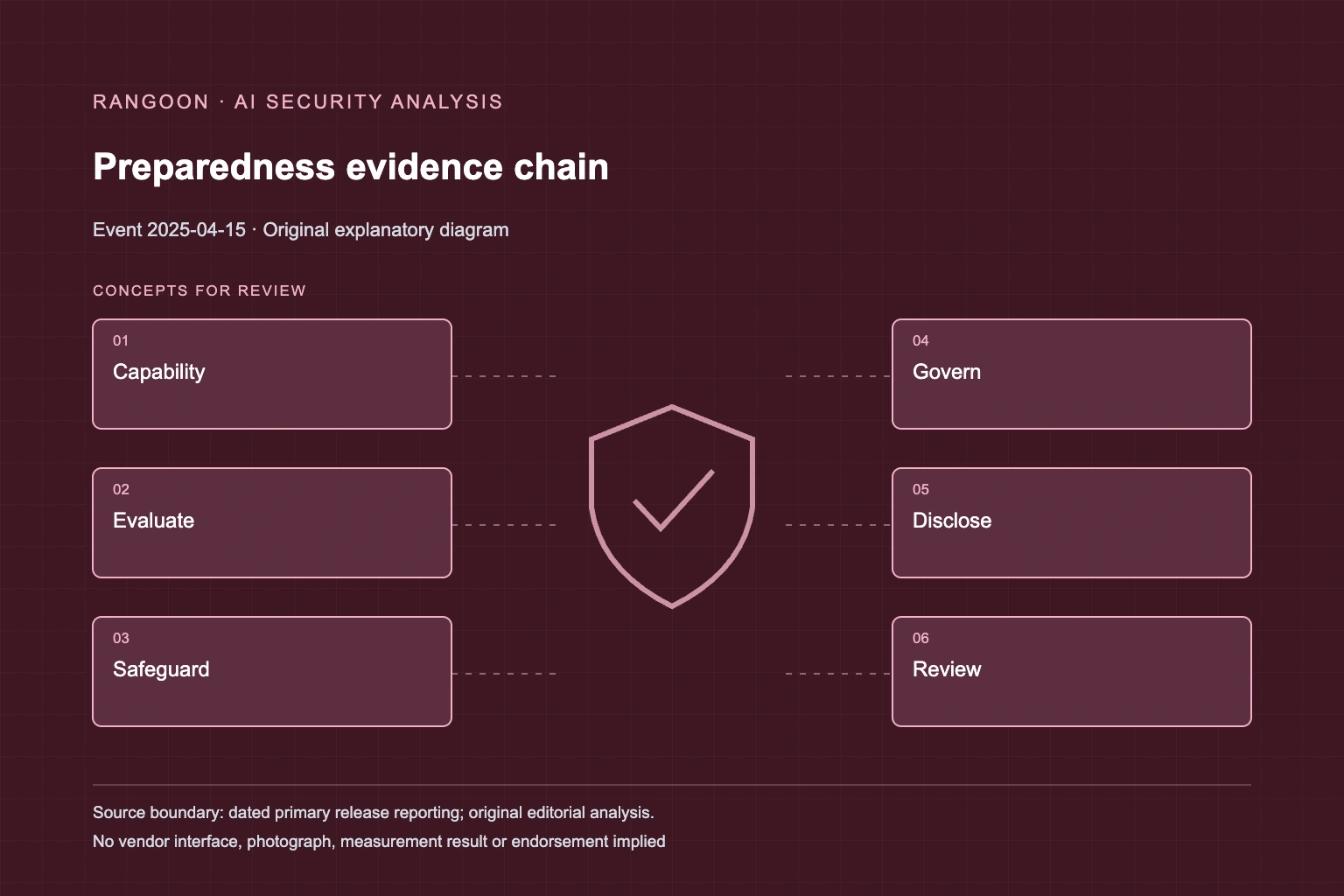
OpenAI’s announcement separates several jobs that are sometimes collapsed into the word “safety.” Evaluation attempts to measure a relevant capability or risk. Safeguards and mitigation address what a system is allowed to do or how it is constrained. Governance establishes who reviews evidence and which conditions matter for a decision. Disclosure gives external readers a record of what was assessed and what limitations remain. A score or a successful test can contribute to that chain, but it does not replace the rest. The framework’s significance lies in making those links explicit in a stated process. It does not prove that any particular safeguard will work in a different deployment, that an unpublished test covers all misuse paths, or that the named process makes a system safe by itself.
Future-facing research categories were signals to investigate, not demonstrated model properties[source 1][source 2]
The April update introduced research categories intended to help OpenAI investigate emerging capabilities before they became central deployment risks. This is a useful distinction for historical reporting. A research category can guide evaluation design without being an assertion that a current model has a high-risk capability, can evade controls or can act autonomously in a particular environment. Treating a category label as a result would overstate what the framework says. Evaluation results need their own model version, conditions, benchmark method, mitigation context and publication date. The framework supports reporting that OpenAI planned to watch a broader set of possible future concerns. It does not support projecting a future category backward into a factual claim about an existing product or an individual user session.
A preparedness framework can organize evidence without replacing deployment-specific review[source 1][source 2]
For operators, the practical value of a framework is often traceability: a team can connect a stated risk area to tests, safeguards, decision owners and public documentation. That structure does not erase context. A model’s behavior depends on version, tools, permissions, deployment architecture, monitoring and the tasks it is allowed to attempt. A framework cannot infer those facts from an abstract category, and its stated thresholds need direct evidence when someone claims they were met. The historical conclusion is bounded: OpenAI revised its stated preparedness process. Claims about a specific system require its own dated evaluation and deployment record.
Sources
- OpenAI: Our updated Preparedness Framework (April 15, 2025)
- OpenAI: Preparedness Framework, Version 2 (April 15, 2025)
Continue reading