OpenAI’s March agents release made response state and tracing first-class design choices
OpenAI launched the Responses API and Agents SDK on March 11, 2025, pairing built-in tools with code-first orchestration and tracing for agentic applications.
Historical reporting: OpenAI announced Responses API and Agents SDK building blocks on March 11, 2025. This story does not prescribe current API use or assert current feature parity.
Key takeaways
- Responses joined tool use and state management in one API primitive.
- The Agents SDK made orchestration and tracing explicit implementation concerns.
- Tool execution needs independent permission and result validation.
The March launch paired an API primitive with an orchestration SDK[source 1][source 2]
OpenAI announced new tools for building agents on March 11, 2025. Its post named the Responses API, built-in web search, file search and computer use, the Agents SDK for single- and multi-agent workflows, and integrated observability for tracing. OpenAI’s Assistants FAQ later records the same March 11 platform building blocks. The evidence supports a dated product launch. It does not establish what a later account, model, price plan, tool or policy permits.
The March release also matters as a product-surface transition: it presented Responses as a new primitive while the FAQ describes how Assistants feedback informed it. That is not a mandate to migrate every application on the announcement date. It is evidence that teams should separate API lifecycle planning from agent-behavior evaluation.
Stateful response items changed what an integration must record[source 1][source 2]
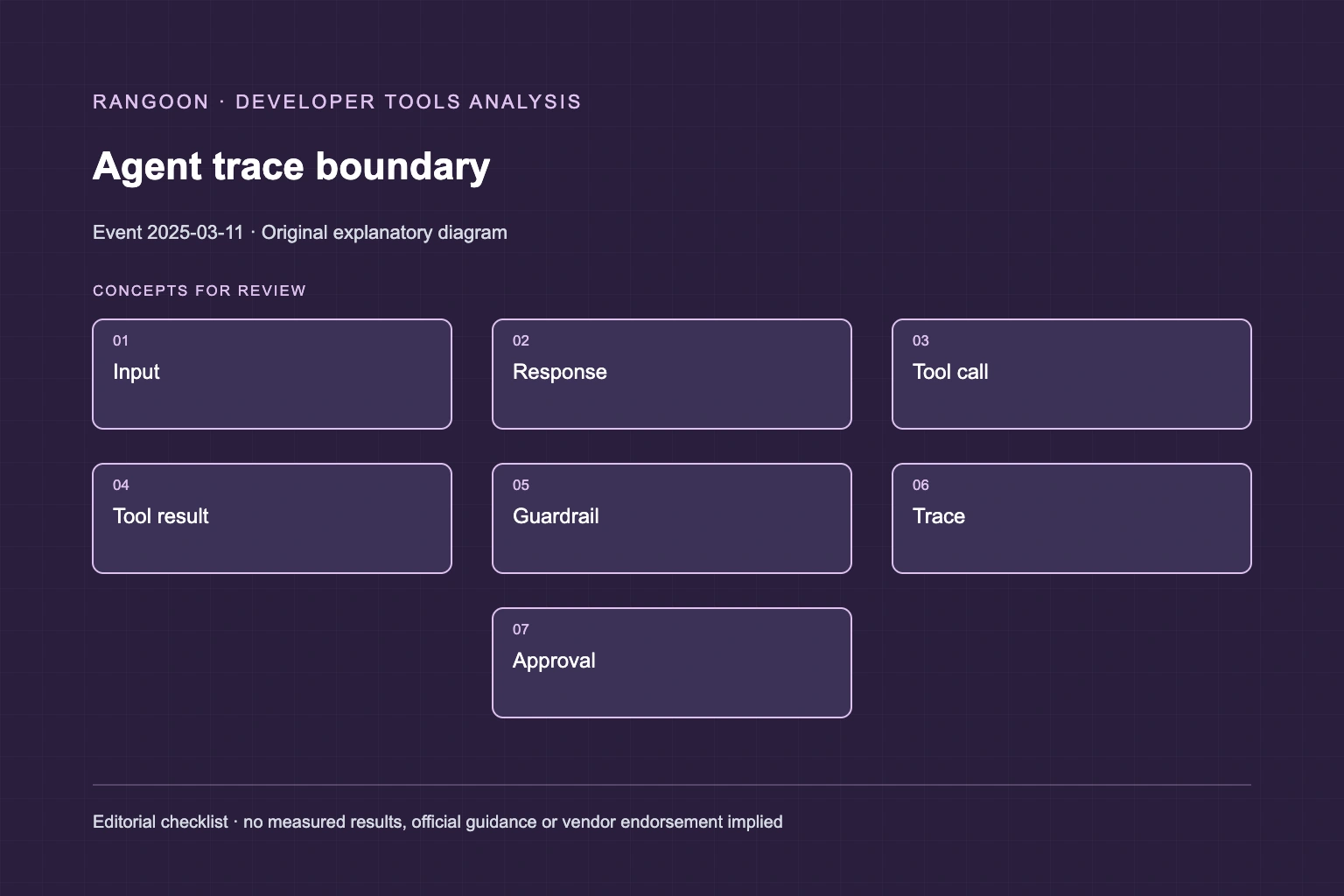
The announcement described Responses as combining Chat Completions simplicity with Assistants-style tool use and state management, using a unified item-based design and streaming events. The Agents SDK positioned handoffs, guardrails and tracing as code-level concerns. In practice, this means a transcript alone is incomplete: an audit record must also identify tool calls, input artifacts, output items, selected model, stored state and any guardrail decision. Each has a different failure mode and retention boundary.
Streaming introduces another record boundary. A user may observe partial text before a tool result, cancellation, safety decision, or final output item arrives. Product code should specify which events are displayable, which are internal, and when an interrupted stream is recoverable. Otherwise client rendering can misrepresent the actual run state.
Tools should be treated as untrusted action proposals[source 1][source 2]
Before enabling a tool, define allowed arguments, max scope, expected result schema, timeout, retry rule, user confirmation requirement and error presentation. Validate returned data before it becomes context for another model turn. Web-search snippets, file retrieval and computer actions can all be stale, malicious, incomplete or inappropriate for the task. A trace helps diagnose a failure; it is not a permission system and it cannot retroactively make an external action authorised.
For browser-oriented actions, capture target origin and page state before the action, then check a postcondition after it. A click receipt without the target URL or resulting form state is weak evidence. The same pattern applies to search: retain document identifiers and retrieval time instead of preserving only model paraphrase.
Analysis: measure agent runs at the handoff boundary[source 1][source 2]
For evaluation, use a fixture with a known answer, a permitted tool path, a tool failure and a case that must stop for human review. Measure whether the run selected the correct path, not only whether the final prose seems plausible. Version prompts, tool schemas, policies and model settings together. That makes it possible to separate a model regression from a changed retrieval result or an altered orchestration rule.
Trace sampling should be intentional. Store full records for failed and policy-sensitive runs, while defining a privacy-reviewed retention policy for routine successful traffic. This balances debugging value against the fact that stateful agent traces can contain user content and tool-returned data. The launch announcement itself does not resolve that tradeoff.
Sources
- OpenAI: New tools for building agents (March 11, 2025)
- OpenAI Help: Assistants API v2 FAQ (March 11, 2025)
Continue reading