OpenAI and Stripe paired Instant Checkout with a merchant-controlled commerce protocol
OpenAI introduced Instant Checkout and the Agentic Commerce Protocol on September 29, 2025, connecting chat shopping to merchant systems.
Historical reporting: OpenAI announced Instant Checkout and the Agentic Commerce Protocol on September 29, 2025. The maintained repository identifies a 2025-09-29 initial-release directory and later dated additions, which are treated as later context rather than launch features. This article does not claim that a merchant participates, that checkout is available in a place or account, or that a protocol integration guarantees payment, fulfillment, consumer protection, or regulatory compliance.
Key takeaways
- The launch separated conversational discovery from merchant acceptance, payment processing, fulfillment, and support.
- A checkout protocol needs authoritative cart state and lifecycle events, not a model-generated receipt.
- User confirmation and scoped payment tokens reduce one class of risk without settling inventory, return, or delivery disputes.
The launch joined a chat checkout surface to an open protocol[source 1]
OpenAI announced Instant Checkout and the Agentic Commerce Protocol on September 29, 2025. The announcement described the protocol as technology powering Instant Checkout and said OpenAI had co-developed it with Stripe and merchant partners. It also said orders, payments, and fulfillment remained in merchant systems, with ChatGPT passing information between the user and merchant.
That operational split matters because conversational selection is not itself an accepted order, a payment capture, or a fulfillment confirmation. It assigns durable commercial truth to the system that can accept the order and later report its state.
Checkout depends on a merchant-owned state machine[source 1][source 2]
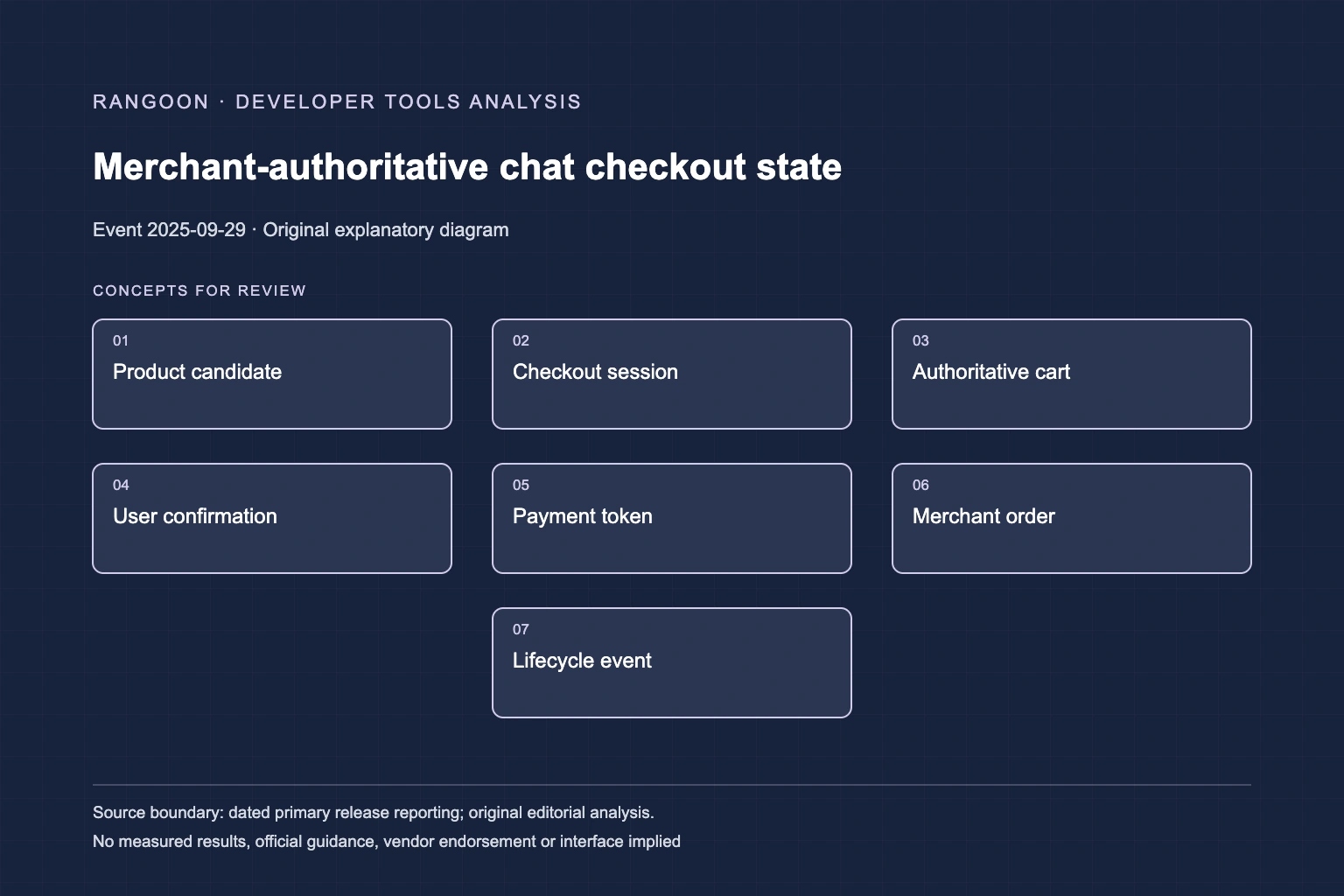
The maintained repository contains a dated 2025-09-29 initial-release directory. It separately lists later fulfillment, capability-negotiation, payment-handler, and extension additions under later 2025 and 2026 dates, so those areas are not evidence of September launch features. For an actual checkout flow, a merchant response needs to be authoritative about line items, price, taxes, shipping choices, availability, and errors at the point the merchant accepts it. A product card shown earlier in a chat is only a candidate input; the cart must be revalidated when address, inventory, promotion, or payment conditions change.
This avoids treating a fluent response as a durable commercial record. It also makes the merchant response a validation boundary, where unavailable goods or unsupported fulfillment paths can stop the flow explicitly.
Order changes require versioning and replay-safe event handling[source 1][source 2]
A commerce integration must associate a checkout session with a merchant order and distinguish a retry from a second purchase attempt. It needs versioned updates for cart mutations, a durable idempotency key for create or confirm operations, and authenticated lifecycle events for accepted, cancelled, fulfilled, or refunded states. A receiving surface should reconcile an event against its merchant order identifier before changing visible status, because webhooks can arrive late, repeat, or arrive out of order.
These are system-design requirements for dependable protocol use, not claims about the behavior of a named seller or payment processor. A reconciliation job can record the last event sequence it accepted so a delayed delivery cannot silently overwrite a newer cancellation or refund.
Confirmation narrows authority but does not erase commerce risk[source 1][source 2]
OpenAI said users explicitly confirm each step, encrypted payment tokens are limited to particular amounts and merchants, and only needed data is shared with permission. Those controls define a narrow authorization boundary, but a correct token does not prove stock accuracy, product suitability, shipment, refund resolution, or identity assurance outside the checkout contract. Merchant-of-record responsibilities also remain distinct from an agent interface’s ranking or recommendation behavior.
The dated launch should therefore be read as a protocol and product milestone, not as evidence of universal merchant interoperability or a completed policy framework. A clear incident trail needs to preserve which system displayed a choice, which system accepted it, and which system later changed order status. That separation supports a dispute review without relabeling a conversational recommendation as a merchant promise. It also keeps a support case attached to merchant evidence.
Sources
Continue reading