

Physical Intelligence’s π0 connected a vision-language backbone to continuous robot actions
Physical Intelligence introduced π0 on October 31, 2024, a generalist robot policy combining cross-embodiment data, language prompts, and flow-matched actions.
Historical reporting: Physical Intelligence introduced π0 on October 31, 2024 as a prototype generalist robot policy. The launch described a 3B vision-language-model starting point, a continuous-action flow-matching expert, and data from eight robot types. Public code and weights arrived in a separate February 2025 event; a current Apache-2.0 repository is later artifact context, not October availability proof.
Key takeaways
- π0 mapped images, text, and robot experience to low-level motor commands, so task success remained tied to its embodiment and sensor setup.
- The launch combined data across robot types and tasks, but difficult downstream skills still used task-specific post-training.
- October 2024 did not announce public weights or a public model license; those artifact conditions changed later.
The October event described a prototype for cross-robot control[source 1]
Physical Intelligence introduced π0 on October 31, 2024 as its first generalist robot policy. The company described a model spanning images, text, and actions, intended to control several robot forms through direct prompting or later specialization. That made the event about a robot-control policy rather than a chat model with a robot demonstration attached: the output was low-level motor control that had to fit each robot’s physical joints, cameras, and control interface.
The launch called π0 an early prototype, a qualification worth retaining beside its ambitious general-purpose framing. A policy that works across several trained embodiments is not automatically portable to every arm, mobile base, gripper, or workcell. Calibration, action representation, observation timing, workspace geometry, contact dynamics, and emergency controls remain part of any robot deployment even when one model family supplies the learned policy.
The training mixture paired web-scale semantics with robot experience[source 1][source 2]
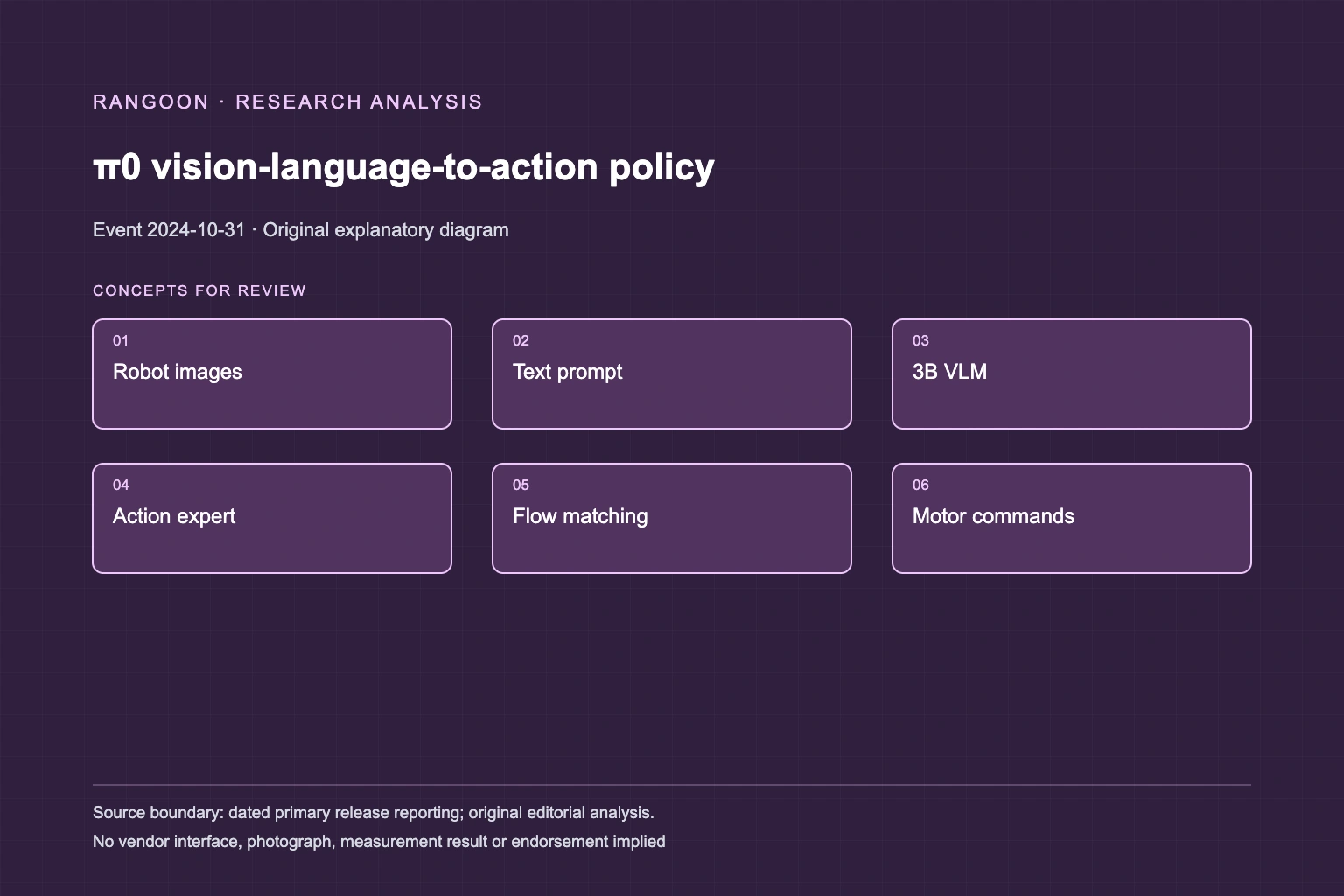
The announcement says π0 used internet-scale vision-language pretraining, open robot-manipulation data, and Physical Intelligence data from dexterous tasks on eight robots. It named single-arm, bimanual, and mobile systems in that mixture. This combination was meant to give the policy semantic language and visual priors alongside examples of physical interaction, addressing a robotics data shortage that cannot be solved by web text alone.
The company started from a 3B-parameter vision-language model and adapted it for dexterous control. Its technical paper describes adding an action expert that produces continuous actions through flow matching, with motor commands at up to 50 Hz. Those mechanics explain the model’s division of labor: the vision-language backbone can relate a prompt to a scene, while the action component must generate a timely, embodiment-specific trajectory. Neither component removes uncertainty from grasping deformable, occluded, or moving objects.
Prompting and post-training covered different kinds of task claims[source 1][source 2]
Physical Intelligence presented π0 as usable by prompt for a range of tasks, while also describing fine-tuning for demanding downstream work. Its examples included table bussing, bagging groceries, folding laundry, and assembling boxes. In the laundry example, post-training was used for a multi-stage workflow involving a dryer, hamper, table, and folding. That is an important boundary: an observed successful clip can reflect a specialized policy and particular task data, not a zero-shot capability of the original generalist checkpoint.
The launch compared its own models with prior policies on five tasks using a normalized partial-credit rubric. Those scores are supplier-reported results on the company’s selected tasks and evaluation setup. They can show why the team considered its architecture promising, but they do not independently establish reliability for a different workspace, object inventory, collision policy, or unattended operating period.
The original research event preceded public model artifacts[source 1][source 3]
The October announcement described π0 research and demonstrations but did not state that public weights or a public license were available then. Physical Intelligence later announced an open-sourcing event on February 4, 2025, and its current official OpenPI repository displays an Apache-2.0 license. Those later artifacts matter for someone evaluating code access today, but they should not be used to rewrite the terms of the October event.
Even a public repository would not turn a robotics policy into a safety guarantee. A user still needs the exact checkpoint, supported robot transforms, training-data assumptions, sensor preprocessing, actuator limits, and a controlled evaluation plan. Public code can make experimentation more inspectable; it does not prove that a policy will handle a novel environment, recover from every contact event, or satisfy local safety requirements.
Sources
Continue reading
Related reading
 News analysisPhysical Intelligence’s π*0.6 used deployment experience and corrections as VLA training inputs3 min read
 News analysisπ0.5 tested a single VLA on home-cleaning tasks outside its training scenes3 min read
 News analysisGemini Robotics made the controller boundary visible in physical AI3 min read