

Qdrant Cloud Inference put embedding generation, storage and indexing behind one API call
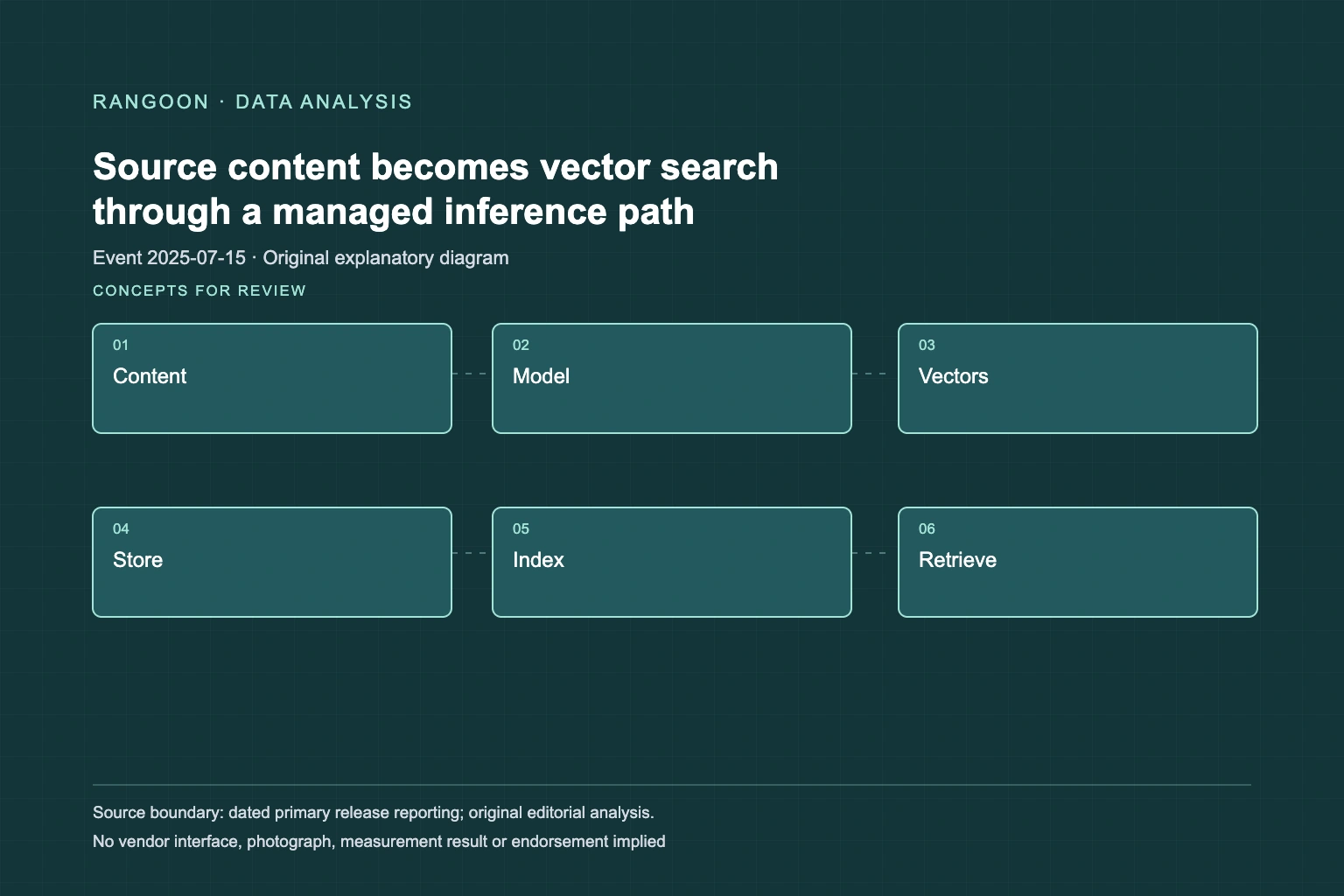
Qdrant launched Cloud Inference on July 15, 2025, combining model inference, vector storage and indexing in a managed retrieval workflow.
Historical reporting: Qdrant announced Cloud Inference on July 15, 2025, saying a single API call could generate, store and index embeddings for text and images in Qdrant Cloud. The product documentation provides implementation context. The launch’s claims about simpler pipelines and reduced network hops are provider claims; they do not prove model choice, retrieval quality, data residency, cost or latency for a specific corpus.
Key takeaways
- Cloud Inference combined embedding and vector-database steps in one managed workflow.
- A single API surface does not remove model, chunking or relevance choices.
- Managed inference changes data-flow and billing questions alongside developer ergonomics.
Qdrant announced Cloud Inference on July 15, 2025[source 1]
Qdrant’s dated launch post says Cloud Inference became available on July 15, 2025. The service is described as generating, storing and indexing embeddings in a single API call for text and images. That is substantive retrieval-platform news because it moves a pipeline boundary: an application can send source content into one managed surface instead of separately coordinating an embedding provider and vector-database write. The event does not establish that an organization’s content was migrated, that every embedding model was supported, or that a particular answer became more accurate. The public claim is about the managed workflow Qdrant announced, not a measured outcome for all RAG applications.
The release collapsed several pipeline stages without eliminating their design choices[source 1][source 2]
A typical retrieval pipeline may select a model, transform source text, create vectors, write them to storage, build an index and later query the collection. Qdrant’s release says Cloud Inference combines generation, storage and indexing, reducing the number of service boundaries an application must connect. That can simplify operations, but it does not decide how content should be chunked, which embedding model matches a domain, how a collection is filtered or how relevance is evaluated. Those choices still determine what a search system retrieves. The managed service can change the implementation path while leaving application semantics and evidence requirements in place.
Embedding inside the retrieval service makes data flow a visible deployment concern[source 1][source 2]
The launch highlights fewer separate inference services, manual pipelines and network transfers. Those are architecture claims about where content travels before it becomes searchable. For an adopter, the practical questions include which content is sent for inference, which model is selected, how data is retained, what region processes it and how usage is billed. None is answered solely by the phrase “single API call.” A managed integration can reduce glue code while adding a provider boundary that should appear in a system diagram and an incident plan. Qdrant’s post describes its product intent and onboarding offer; it does not serve as proof of a customer’s compliance posture or an authorization decision for private content.
Retrieval quality remains an application measurement after managed embedding is enabled[source 1][source 2]
Cloud Inference can make vectors easier to produce, but an embedding vector is not itself evidence that the right source will be retrieved for a user request. A useful evaluation still requires a representative corpus, query set, expected evidence, filters and relevance metric. It should also inspect failure cases such as stale documents, language variation, long files, images and conflicting sources. The release covers text and image input, which broadens the ingestion surface but does not guarantee equivalent performance across modalities. Comparing a managed path with a prior pipeline needs the exact models, chunking rules, index settings, corpus revision and cost window recorded. Otherwise a model or data change can be incorrectly attributed to the API integration.
Sources
Continue reading
Related reading
 News analysisQdrant 1.13 joined GPU indexing with collection-level operational limits3 min read
 News analysisPinecone made Assistant generally available with chat, context and document-format additions3 min read
 News analysisMongoDB acquired Voyage AI and outlined a retrieval roadmap for its database platform4 min read