

Qwen2.5-Omni put multimodal streaming on a joined input-output path
Qwen released Qwen2.5-Omni on March 27, 2025, describing one model that processes text, images, audio and video while streaming text and speech.
Historical reporting: Qwen’s March 27, 2025 announcement released Qwen2.5-Omni and linked its paper, code and model artifacts. Qwen describes an end-to-end Thinker-Talker architecture and real-time streaming; vendor performance statements are not independent latency, safety or quality evidence for another voice, video or tool workflow.
Key takeaways
- Qwen2.5-Omni combined multimodal perception with text and speech generation, so input and output safety policies cannot be designed in isolation.
- Streaming reduces waiting time only when interruption, partial output, buffering and downstream action boundaries are explicit.
- Audio and video timestamps need retained provenance because a transcript alone may lose timing and speaker context.
The March event paired open artifacts with an end-to-end architecture claim[source 1][source 2]
On March 27, 2025, Qwen announced Qwen2.5-Omni as a flagship end-to-end multimodal model. The post said it accepted text, images, audio and video and generated streamed text and natural speech, with availability through Hugging Face, ModelScope, DashScope and GitHub. The Qwen model card identifies the released Qwen2.5-Omni-7B artifact as an any-to-any model under Apache 2.0, which is a distinct artifact from a hosted demonstration or an API product.
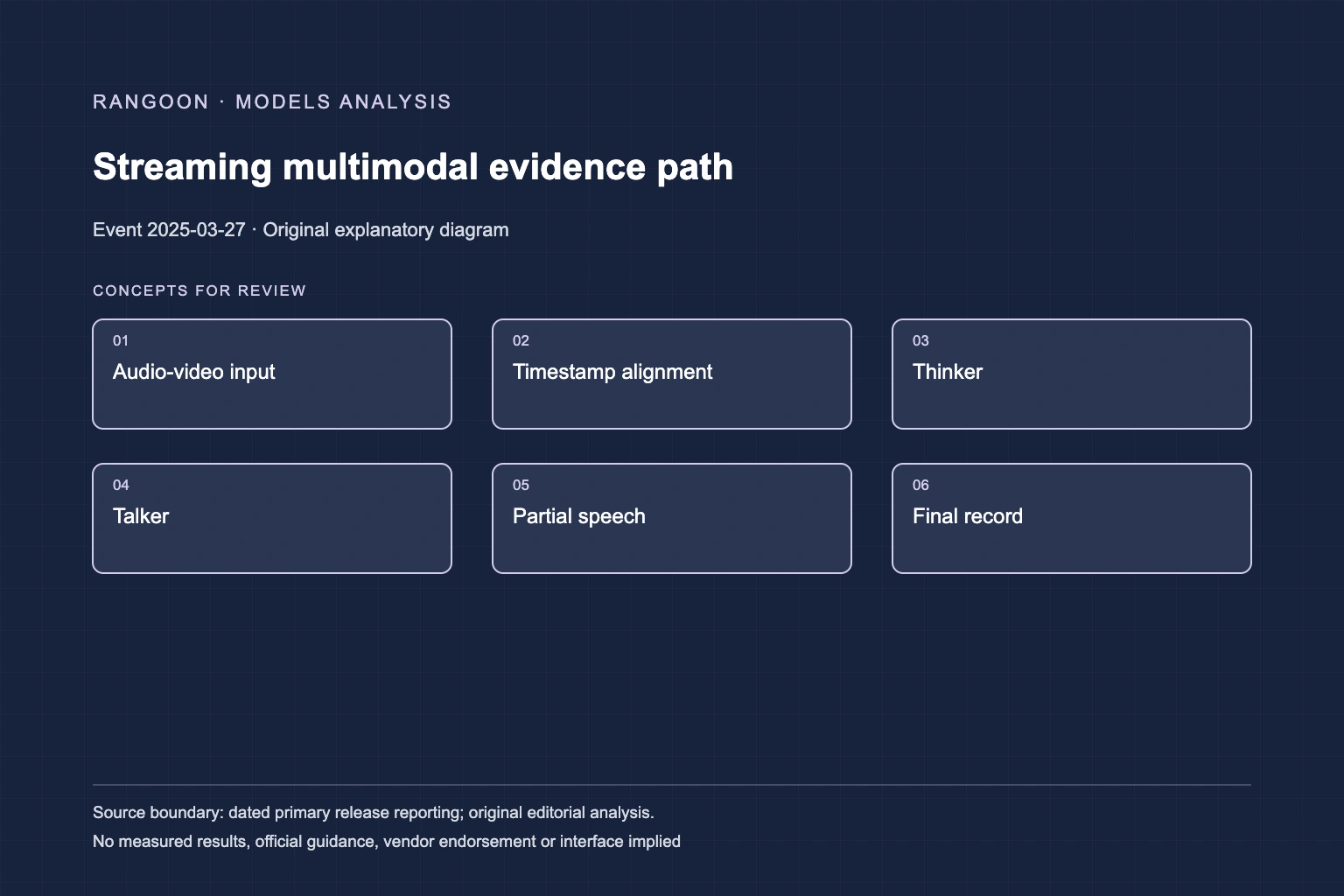
Qwen described a Thinker-Talker arrangement: a decoder-side Thinker receives representations from audio and image encoders, while a dual-track autoregressive Talker receives the Thinker’s representations and historical context to produce speech. It also named TMRoPE for aligning video timestamps with audio. The release therefore joins perception and speech output in one model path while leaving product-level session controls outside that path. These statements describe the model boundary and intended timing treatment; an adopter still chooses codecs, chunking, voice rendering, device permissions and retention policy.
Streaming makes partial output part of the product contract[source 1][source 2]
A streamed response is not equivalent to a completed response delivered early. Once text or speech reaches a person or another system, cancellation, barge-in, correction and replay may each have different effects. A production integration should define when an utterance becomes visible, when it becomes actionable, how an interrupt discards queued audio, and whether a transcript records draft segments, final segments, or both.
Audio output creates a second interface with its own failure modes: a listener can hear a partial instruction before a later qualification, an accessibility device can transform it, and a network retry can duplicate it. A safe design assigns immutable response identifiers, sequence numbers and finality states, then prevents speech from directly committing a sensitive action. It should also define whether a regenerated segment supersedes, appends to, or invalidates a prior audible segment. This is engineering analysis of streaming systems, not a statement that Qwen2.5-Omni has any particular transactional guarantee.
Multimodal evaluation needs timing and provenance, not a transcript alone[source 1][source 2]
Audio-video tasks depend on which frames, samples and timing offsets reached the model. A test fixture should record the original asset hash, decode path, sample rate, frame rate, chunk boundaries, timestamps, prompts, model revision and output mode. That evidence lets a reviewer distinguish a model inference problem from a media-ingestion error, such as dropped audio, an incorrect time base or a delayed camera frame.
Qwen reported comparative multimodal results in its announcement and model card, including streaming and speech claims. Treat those as supplier-reported results under supplier-selected benchmarks, not a capacity or quality promise for a call center, captioning system or accessibility flow. Local acceptance tests should include noisy audio, overlap, silence, consent boundaries, interrupted playback and task-specific error handling before a combined model is allowed to mediate a consequential exchange. Evaluation should separately score recognition, reasoning, response sequencing and human comprehension so one aggregate result cannot mask a harmful failure.
Sources
Continue reading
Related reading
 News analysisQwen released Qwen3 Embedding and Reranking models with dual-encoder and cross-encoder retrieval paths3 min read
 News analysisNVIDIA announced Canary-Qwen-2.5B as an open ASR and language-model combination3 min read
 News analysisMeta introduced SAM Audio with text, visual and temporal prompts for source separation3 min read