

Qwen3 made hybrid thinking a workload-control question
Qwen released Qwen3 in April 2025 with dense and mixture-of-experts models plus thinking modes. This retrospective focuses on explicit workload controls and evaluation scope.
Historical retrospective: Qwen published its Qwen3 launch post on April 29, 2025, and the QwenLM repository records the series release on that date. This article does not make current performance, access or deployment claims.
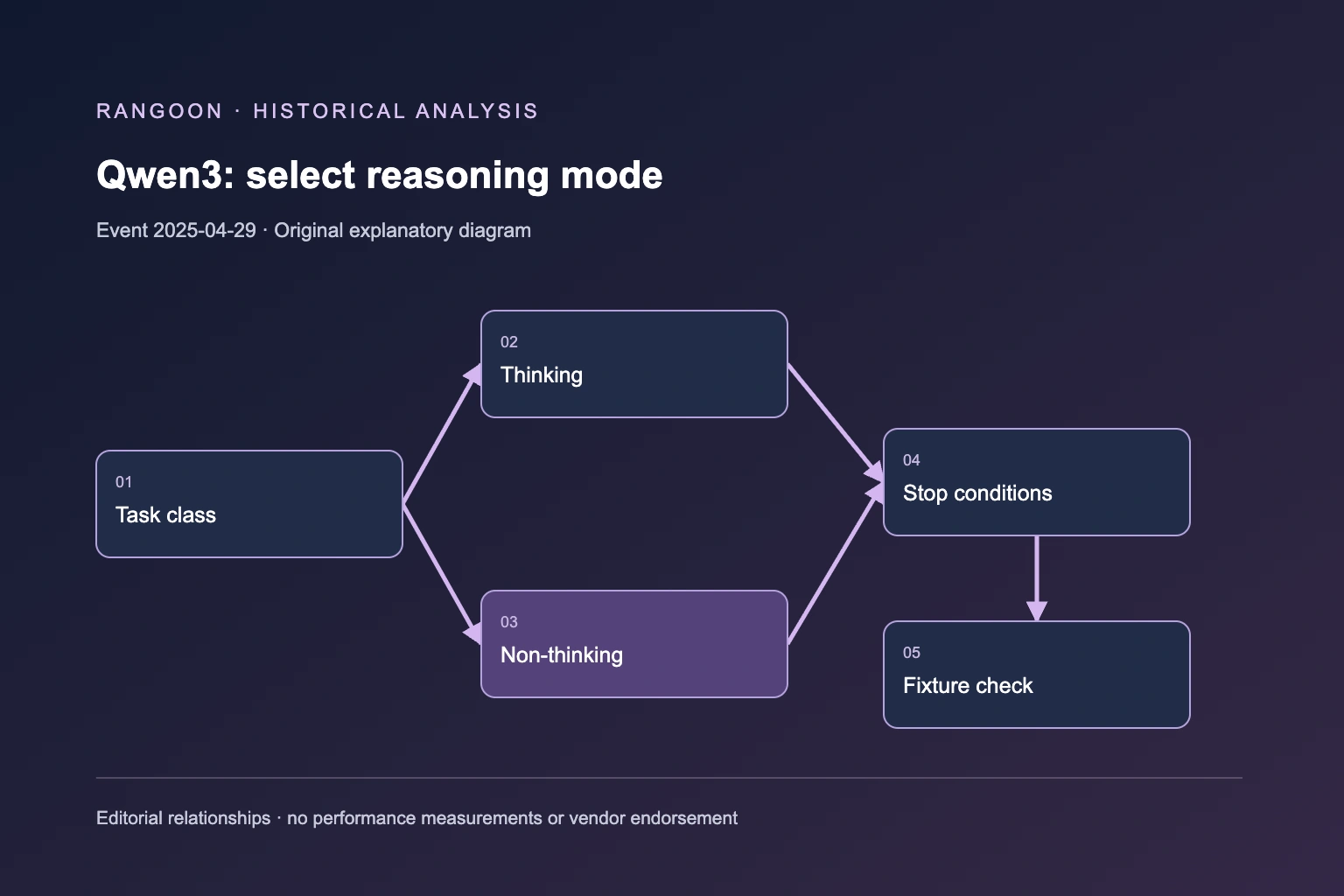
Key takeaways
- Thinking and non-thinking modes create a workload choice that should be visible in evaluation evidence.
- A model-series post and an official repository corroborate the release date while serving different technical roles.
- Benchmark comparisons do not replace a local test of latency, schema and action boundaries.
Qwen3 paired a new series with hybrid reasoning[source 1][source 2]
On April 29, 2025, Qwen announced Qwen3 as a new model series, including dense and mixture-of-experts releases. Its launch post described a hybrid approach that lets users switch between thinking and non-thinking modes for different tasks. The official QwenLM/Qwen3 repository also records that the Qwen3 series was released on April 29. These are historical primary records of a dated launch, not proof of current endpoints, supported versions or present-day benchmark results.
The release framing makes a useful operational point: a model family can expose distinct execution modes for distinct workloads. Those modes should not be treated as interchangeable in logs or tests. A response generated under one mode may have different latency, token use, output form or tool-call behavior from the same prompt under another. The right comparison is therefore between identified configurations, not between memories of a model name.
Mode selection belongs beside the workload contract
A workload contract can make the choice explicit. It names the task class, model artifact or endpoint, selected mode, context limit, prompt revision, tool schema, timeout and expected output. For a classification or extraction task, a lower-latency configuration may meet the contract. For a hard planning task, a team may choose a different mode only after testing whether additional reasoning changes the actual acceptance criteria. Neither option is universally better without a defined job.
This record prevents a misleading aggregate result. If a report combines runs from different modes without identifying them, an apparent quality change might actually be a configuration change. It also helps an operator investigate cost or latency variation without guessing. Mode is one input among many, so the record should retain the service wrapper, tool availability and policy constraints as well. The goal is traceable scope, not a claim that a model's internal reasoning can be fully observed.
Historical lesson: test actions at their real boundary
A bounded evaluation starts with fixtures chosen for the work the system will actually do. Include valid inputs, ambiguous requests, malformed structured data, incomplete context, tool errors and any case where an output could propose a consequential action. Specify expected schemas and stop conditions before running the candidate. Compare not only answer quality but also whether the output remains within allowed action scope and whether a failure stays visible instead of becoming an invented result.
Benchmark claims in a release post may help select a candidate for review, but they are not local acceptance evidence. An adoption record should preserve source provenance, exact configuration, result summary, unresolved cases and rollback path. If the candidate later changes or a deployment shifts, rerun the fixture set and record the difference. Qwen3's 2025 hybrid-mode framing remains a useful historical prompt to keep mode choice visible, while avoiding any inference about the current state of the series.
Sources
- Qwen: Qwen3, Think Deeper, Act Faster (April 29, 2025)
- QwenLM: Qwen3 repository release history (April 29, 2025)
Continue reading
Related reading
 News analysisQwen3-235B-A22B-Instruct-2507 made mode selection an artifact choice3 min read
 News analysisTencent released Hunyuan-A13B under a territory-limited community license, separating open weights from universal permission3 min read
 News analysisQwen released Qwen3 Embedding and Reranking models with dual-encoder and cross-encoder retrieval paths3 min read