Stability AI released Stable Video 4D 2.0 for single-video multi-view generation
Stability AI released Stable Video 4D 2.0 on May 20, 2025, pairing a single object video with a 12-frame, four-view generation design and an explicit license boundary.
Historical reporting: Source 0 is the dated official Stable Video 4D 2.0 release. Source 1 is Stability AI's published model card, used for technical configuration and limits rather than event-date proof.
Key takeaways
- Stability AI dated the Stable Video 4D 2.0 release to 2025-05-20.
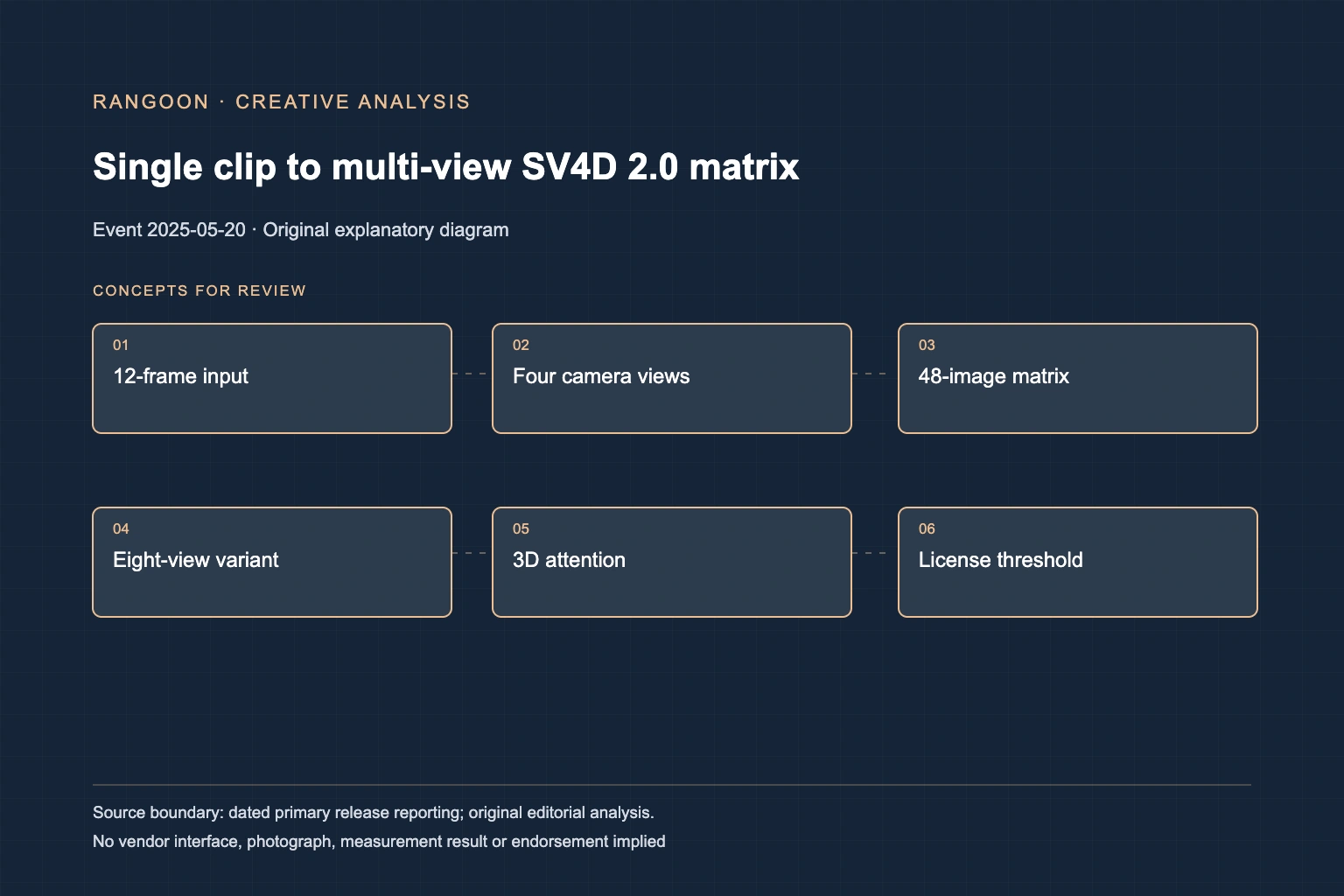
- The released model turns one object-focused video into a four-view, 12-frame image matrix, with an eight-view variant also described.
- The model card sets a revenue-based commercial-license threshold and says factual depictions of people or events are out of scope.
A model release with a defined reconstruction target[source 1]
On May 20, 2025, Stability AI announced Stable Video 4D 2.0, or SV4D 2.0. The release was about a narrow video-to-4D problem: start with a single object-centric clip and synthesize views of the moving object from angles the camera did not record. Stability described the result as useful for dynamic 4D assets, including game sprites, film assets and virtual-world material. That is different from ordinary text-to-video generation. The system begins with observed motion and asks the model to infer missing viewpoints, where occlusion and changing pose make the task hard. The release said its training moved from static 3D assets to motion and used 3D attention to combine spatial and temporal features. Stability also said the model had been trained on synthetic data, while retaining knowledge from pre-trained video models for real-world footage. Those are supplier descriptions of the release method and behavior, not an independent measurement of production quality.
Four cameras in the output, twelve frames in time[source 2]
The accompanying Stability AI model card makes the operational shape more concrete. Given a 12-frame reference video at 576 by 576 pixels, its principal configuration generates 48 images: 12 frames across four user-specified camera views. Those images form four short videos of the same moving object. A separate eight-view model generates five frames across eight views. For longer sequences, the card says the system uses generated frames as conditioning views and continues sampling autoregressively. That arrangement explains why the release emphasized spatio-temporal consistency rather than a single attractive still. It also gives a meaningful boundary for evaluation: a four-view grid and an eight-view variant are named configurations, not a promise that every input yields clean geometry. The release page itself notes that artifacts can still appear with dynamic motion, especially in a task built from unseen views.
The technical record names data, weights and a license condition[source 1][source 2]
The model card says SV4D 2.0 training used rendered objects from Objaverse-XL and an enhanced rendering process intended to look more like real-world image distributions; it also says objects were filtered through license review and a curated subset. That is useful provenance context, but it is not a list of every downstream-rights question a production may face. The May release linked weights on Hugging Face, code in Stability AI's generative-models repository and a technical paper. It said the model was available under the Community License. The model card supplies the important qualification: organizations or individuals with annual revenue of at least US $1 million need an enterprise commercial license for commercial use of the model, derivatives or outputs. A reader should therefore separate the availability of weights from permission for a particular commercial deployment.
Novel views are not factual footage[source 1][source 2]
SV4D 2.0 is best understood as a reconstruction-oriented generation release, not a camera system. Its card explicitly says it was not trained to make factual or true representations of people or events and treats that use as out of scope. It also recommends that developers test their own use cases and add mitigations. That statement matters for a feature whose point is to construct unrecorded views: visual continuity can be useful for concepting or asset work without establishing what happened outside the input camera's field of view. The May announcement's benchmark comparisons and quality claims remain Stability AI's analysis. The historical record supports a dated release, a named model configuration, linked distribution channels and stated license terms. It does not establish that a generated angle is evidentiary, that a scene is free of artifacts, or that a particular output can be used without reviewing the relevant license and project requirements.
Sources
Continue reading