

Ultralytics released YOLO26 with optional NMS-free real-time vision inference
Ultralytics released YOLO26 on January 14, 2026, adding a unified vision family with an optional end-to-end detection route that omits NMS.
Historical reporting: Ultralytics announced YOLO26 on January 14, 2026, and its same-day v8.4.0 release records the named model release. Its documentation describes the unified task family, optional one-to-one end-to-end head, DFL-free regression, training recipe and licensing. Performance, accuracy and speed figures are Ultralytics or paper-reported measurements tied to stated models, hardware and configurations. They do not prove a particular camera, dataset, exported runtime, NMS setting, device or deployment will reproduce those results.
Key takeaways
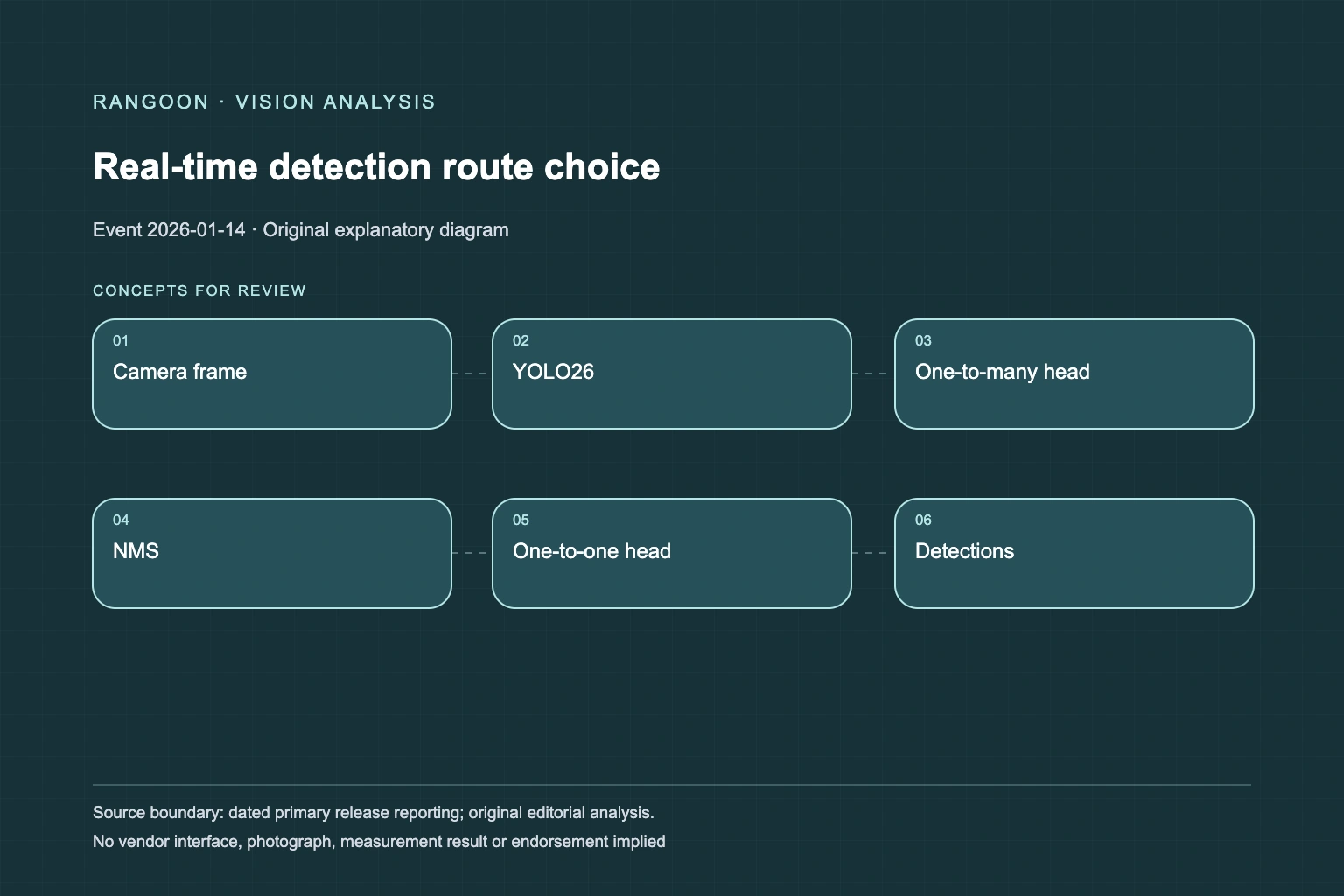
- YOLO26 introduced an optional one-to-one detection head intended to produce predictions without a separate NMS pass.
- Ultralytics presented a shared model family across detection, segmentation, depth, classification, pose and oriented-box tasks.
- Its reported speed and accuracy measurements remain configuration-specific vendor and paper results, not a deployment guarantee.
Ultralytics announced YOLO26 on January 14 as a new real-time vision family[source 1][source 2][source 3]
On January 14, 2026, Ultralytics announced YOLO26 and published the accompanying ultralytics v8.4.0 model release. The company framed the family for edge and low-power environments and described five size variants: nano, small, medium, large and extra large. Its announcement identifies object detection, instance segmentation and image classification, while the documentation lists a broader task family including semantic segmentation, monocular depth estimation, pose estimation and oriented bounding boxes. The dated event is a software and model-family release. It does not mean every supported task uses identical weights, executes on every target device or carries the same speed-accuracy balance. A workload involving a fixed camera, moving video stream, satellite image or factory inspection line needs task- and deployment-specific tests.
The headline architecture change was an optional detection path that can omit post-inference NMS[source 1][source 2][source 3]
Ultralytics says YOLO26 has a one-to-one detection head that can produce predictions without a separate non-maximum-suppression pass when nms=False. It also documents a one-to-many path that uses NMS for accuracy. This is an important operational distinction, because NMS is a post-processing decision for overlapping detections rather than a generic synonym for object detection. Removing it can simplify an export graph and reduce a step in the serving path, while changing which predictions are retained and how results compare with an NMS-based route. The January release therefore documents an option, not a blanket instruction to disable NMS. A user should fix the model variant, task head, confidence rule, input size, tracker and output contract, then compare end-to-end behavior on representative scenes before selecting a route.
YOLO26 paired a lighter detection head with new training and task-specific design claims[source 3]
The YOLO26 documentation describes DFL-free regression, a lighter detection head, MuSGD optimization, Progressive Loss and Small-Target-Aware Label Assignment. It also says the family has task-specific heads and losses for segmentation, pose and oriented detection. These design names explain why the release should be treated as a new model and training recipe rather than a simple model-file rename. They do not create a direct architectural trace for every exported inference graph. Quantization, graph compilation, hardware delegate, input preprocessing and model scale can each change practical behavior. The documentation also distinguishes released weights from architecture-only P2 and P6 YAML variants. An engineering report should retain that boundary: a configuration file can describe a potential scaled model, while a released checkpoint is a specific artifact with its own training and evaluation history.
Ultralytics’ benchmark and licensing statements were useful constraints, not proof of an application result[source 1][source 2][source 3]
Ultralytics documents COCO accuracy and TensorRT latency ranges across its detection scales, and reports up to 43 percent faster CPU ONNX inference for YOLO26n than YOLO11n on a named Intel Xeon comparison. Those are concrete vendor and paper claims with a model, framework and hardware context. They do not establish latency for a different processor, camera decode path, batch policy, model export, image size or downstream action. The documentation also says code, models and documentation are available under AGPL-3.0 and Enterprise licenses. That makes licensing a separate adoption question from technical performance. A team should confirm the applicable artifact and commercial terms, then measure precision, recall, calibration, latency, power and failure modes on the intended system. The release reports a model option; it does not certify a finished vision application.
Sources
- Ultralytics: YOLO26 press release (January 14, 2026)
- Ultralytics GitHub: ultralytics v8.4.0 YOLO26 Models Release (January 14, 2026)
- Ultralytics Docs: YOLO26 model family
Continue reading
Related reading
 News analysisAI21 positioned Jamba 1.6 for private enterprise deployment, while keeping context and benchmark claims testable3 min read
 News analysisTencent published the Hunyuan-MT technical report for multilingual translation models3 min read
 News analysisPaddleOCR 3.0 put OCR, document parsing and extraction into one versioned release3 min read