

Voyage introduced voyage-3-large with Matryoshka dimensions and quantized embedding options
Voyage AI introduced voyage-3-large on January 7, 2025 as a 32K-context general-purpose multilingual embedding model with configurable dimensions and quantization choices.
Historical reporting: Source 0 is Voyage AI’s dated voyage-3-large launch record. Source 1 is current Voyage documentation and is used for later model-catalog context only. The cited evaluation and storage comparisons are Voyage’s stated measurements, not universal retrieval, cost or current-availability facts.
Key takeaways
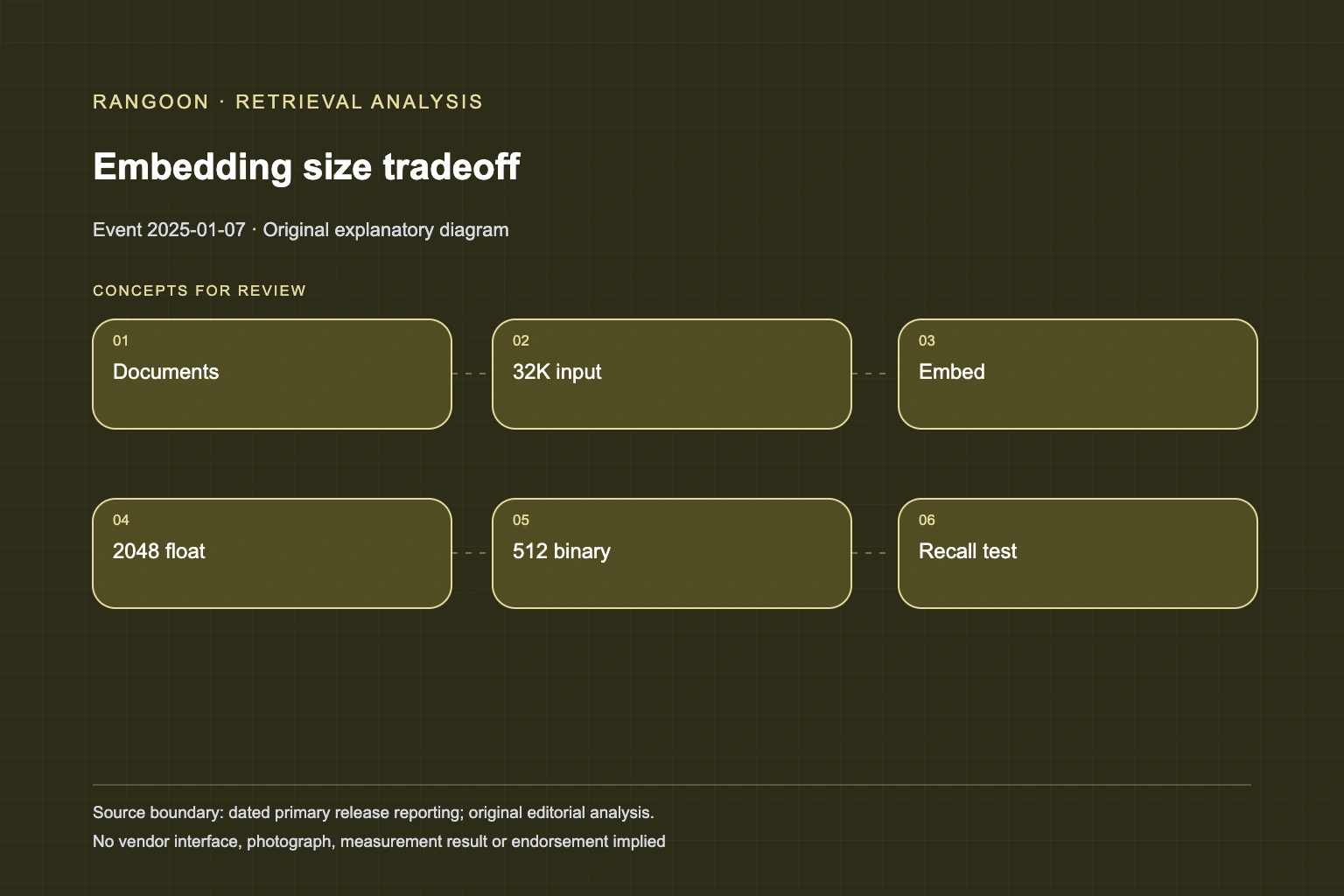
- Voyage announced voyage-3-large on January 7, 2025 as a general-purpose multilingual embedding model with a 32K-token context window and 2,048, 1,024, 512 or 256 dimensions.
- Voyage attributed its flexibility to Matryoshka learning and quantization-aware training, offering float, signed or unsigned int8 and binary representations for retrieval indexes.
- Current documentation lists voyage-3-large as an older model with 32K context and multiple dimensions; it cannot establish its original price, access, benchmark rank or suitability for a particular dataset.
Voyage framed a large model around retrieval choices[source 1]
Voyage AI announced voyage-3-large on January 7, 2025. Its launch page called the model a general-purpose and multilingual embedding model and stated a 32K-token context length. It described four selectable vector dimensions: 2,048, 1,024, 512 and 256. That makes the event more than a single quality assertion. It presented a family of index-design choices, where representation size could be adjusted for a retrieval workload. The page also compared its measurements across 100 datasets and eight domains, including code, law, finance, multilingual, long-document and conversation categories. Those comparisons are Voyage’s own evaluation claims. They establish what the supplier reported at launch; they do not prove the same gain on a different corpus, an organization’s access to the model, or correctness of an answer generated after retrieval.
Dimension and bit width were explicit storage controls[source 1]
Voyage attributed voyage-3-large’s variable dimensions and precision options to Matryoshka learning and quantization-aware training. The launch listed 32-bit floating point, signed and unsigned 8-bit integer, and binary quantization. Its examples compare a 1,024-dimension int8 setting against a 2,048-dimension float setting, then compare binary 512-dimensional vectors against a different supplier’s float vectors. These are useful descriptions of the vendor’s storage-quality tradeoff exercise. They are not a formula for every vector database. Vector byte size is only one part of operating cost; index construction, metadata, replication, filtering, query volume and recall target also matter. Before reducing dimensions or precision, an operator should retain baseline queries, relevance labels and latency constraints and verify that the lower-cost representation does not create unacceptable misses.
Cross-domain averages did not replace a local test[source 1]
The launch says Voyage measured normalized discounted cumulative gain at ten results across 100 datasets. It names technical documentation, code, law, finance, web reviews, long-context material and conversations, while its multilingual category spans 62 datasets and 26 languages. That breadth offers context for the company’s comparative claims, but it also shows why a single average is not a deployment certification. A legal retrieval index, a product-support archive and a multilingual code search can differ in vocabulary, query form, document length, access controls and cost of a missed result. Voyage’s own figures should remain attributed to its reported dataset mix, models and configurations. A responsible implementation evaluates the exact retrieval stage, with fixed queries and judgments, and checks results by language, document type and high-consequence failure pattern rather than copying a vendor average into product claims.
Current documentation marked later catalog position[source 2]
Voyage’s current Text Embeddings documentation lists voyage-3-large in its older-model section. It identifies 32,000 tokens of context and a default 1,024 dimensions with 256, 512 and 2,048 as options, calling it a previous generation for general-purpose and multilingual retrieval. That page is useful technical context because it ties the historical model name to a concrete API catalog entry. It is not launch-date proof and should not be read backward as a January 2025 recommendation, rate limit, price or entitlement. The archive event remains the January announcement. Teams reconstructing an old system should preserve the exact model name, dimension, input type, normalization, index engine and date of ingestion; later documentation can help interpret names but cannot substitute for contemporaneous deployment records.
Sources
Continue reading
Related reading
 News analysisVoyage’s 3.5 embedding release put dimensions and quantization beside retrieval scores3 min read
 News analysisMongoDB acquired Voyage AI and outlined a retrieval roadmap for its database platform4 min read
 News analysisxAI released Grok Code Fast 1 for coding agents, with partner trials and an API route kept separate3 min read