Zoom released AI Companion 2.0 as a cross-Workplace context and action surface
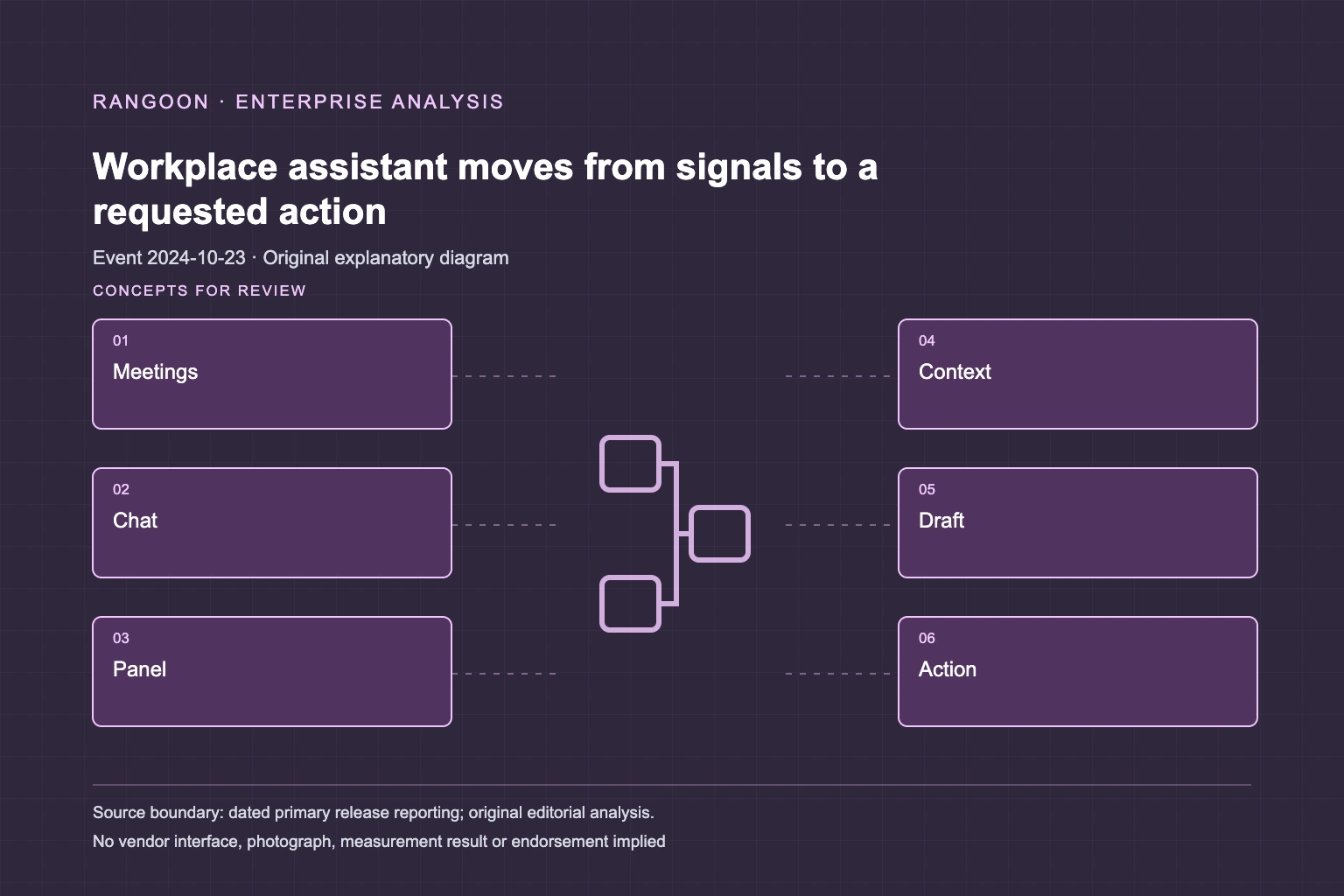
Zoom launched AI Companion 2.0 on October 23, 2024, adding a Workplace side panel intended to synthesize context and trigger work across Zoom interactions.
Historical reporting: Zoom launched AI Companion 2.0 on October 23, 2024. Zoom described a side panel spanning Zoom Workplace that could surface information, synthesize context and take selected actions. Its October 9 announcement supplies the earlier product and custom-add-on record. Productivity language is Zoom’s claim; neither source independently measures a customer outcome or establishes which features a particular account enabled.
Key takeaways
- The release placed an assistant across a workplace suite rather than inside one meeting feature.
- Context synthesis and action are different product behaviors with different evidence needs.
- The launch did not identify a customer’s data scope, settings or output quality.
Zoom dated the AI Companion 2.0 launch to October 23, 2024[source 1]
Zoom’s October 23 post says AI Companion 2.0 launched as the next generation of its workplace assistant. The company described a single surface for finding important information, synthesizing interactions and helping users take action across Zoom Workplace. That is a product-availability event, not a measurement of how much time an organization saved. The source establishes the stated features and date. It does not show that every Workplace plan received each capability on that day, or that a generated summary accurately represented a meeting, message or document for a particular user.
The side panel made cross-product context a named interaction model[source 1][source 2]
Zoom’s earlier October 9 announcement says AI Companion 2.0 would appear across Zoom Workplace through a side panel. That design matters because the assistant is not only a post-meeting transcript feature: it is positioned as a route through conversations, documents and other workplace signals. A shared panel can simplify access, while the quality of any result still depends on which services are connected, what content is available and how a request is interpreted. The launch record describes a product surface. It does not prove that a user has permission to view every item the assistant can reference or that separate sources were reconciled correctly.
Zoom paired the next-generation assistant with a separate customization offer[source 1][source 2]
The October 9 record also announced a custom add-on intended to tailor AI Companion to an organization’s needs. This separates two commercial and technical claims that can otherwise blur together: a broadly announced assistant and an additional customization layer. Customization can change instructions, organizational context or available workflows, so it is not evidence that the default experience behaves the same way as a configured one. The October 23 release report describes launch-day capabilities; the earlier announcement records Zoom’s plan for a distinct add-on. Neither source is a deployment receipt for an individual enterprise or a verification of a generated action.
A workplace assistant still needs source and action boundaries visible[source 1][source 2]
Zoom framed Companion 2.0 around expanding context, synthesizing information and taking action. Those verbs describe different stages. A system may retrieve an item, summarize it, draft a response or initiate an action, and each stage can rely on different inputs and permissions. The release is useful news because it identifies the cross-Workplace scope Zoom was bringing to the assistant. Adoption analysis needs additional evidence: enabled applications, administrator settings, user identity, data retention, requested action and a review path for consequential output. The vendor announcement does not supply those account-specific facts, so it should not be read as a claim that automation occurred in a customer environment.
Sources
- Zoom: AI Companion 2.0 launch (October 23, 2024)
- Zoom: AI Companion 2.0 and customization announcement (October 9, 2024)
Continue reading