

Zoox opened a Las Vegas public robotaxi service with designated pickup and drop-off points
Zoox announced its Las Vegas public robotaxi service on September 10, 2025, with rides requested through its app and access tied to selected destinations around the Strip.
Historical reporting: Source 0 is Zoox’s dated Las Vegas service announcement. Source 1 is Zoox’s live self-certification record, used only for purpose-built vehicle and certification context. Neither source proves universal availability, route coverage, safety performance, or future expansion.
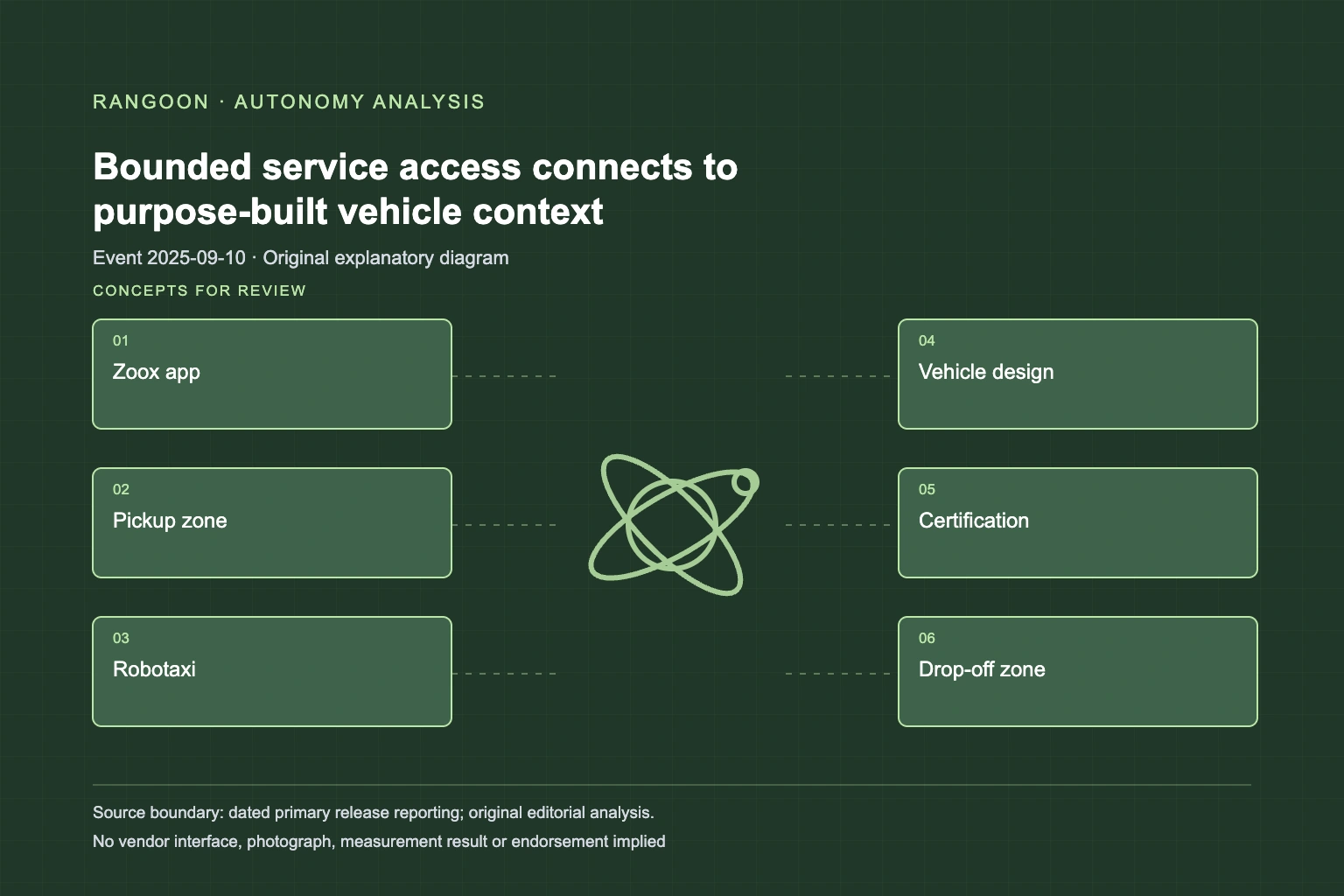
Key takeaways
- Zoox dated the public Las Vegas launch September 10, 2025 and described app-requested rides between selected destinations on and around the Strip.
- The announcement made pickup and drop-off zones part of the access model, and described in-app vehicle identification, arrival updates and support contact paths.
- The service announcement was a bounded operating claim, not proof of citywide coverage, guaranteed vehicle matching, or ride availability beyond the named service conditions.
A public service began around selected Strip destinations[source 1]
Zoox announced on September 10, 2025 that it had launched its robotaxi service to the public in Las Vegas. The dated company post described service on and around the Las Vegas Strip and said rides were available through the Zoox app for iOS and Android. It named several destinations and said pickup and drop-off would occur in each destination’s ride-hail zone. That is a concrete service design: passenger access depended on the listed destination network and designated curb locations, rather than an unrestricted promise of any-address pickup across Las Vegas. The announcement framed the vehicle as a purpose-built robotaxi and described a carriage-style cabin. It does not by itself establish a citywide geofence, service-hour guarantee, vehicle count, fare policy, passenger eligibility rule, or a statement that every app request would receive a match.
The announced access surface was bounded by destinations and support[source 1]
Zoox’s launch post said the app displayed a vehicle license-plate number, estimated pickup time, arrival updates and post-ride feedback options. It also said riders could contact remote Zoox support through the app or the Help button on the robotaxi rider screen. Those details establish an intended passenger interface around the September event. The same post says pickup and drop-off occurred in each destination’s ride-hail zone, making the location model part of the product rather than a minor convenience. An app request and a displayed estimate do not establish immediate dispatch, full address coverage, consistent wait times, accessibility outcomes, or a successful support resolution in every situation. The release is evidence of Zoox’s stated service workflow on the launch date; it is not an independently measured service-level agreement.
A live certification record explains the purpose-built vehicle context[source 2]
Zoox’s live self-certification record supplies technical and regulatory context for its purpose-built vehicle. It says the robotaxi was designed for riders and does not rely on a steering wheel, accelerator or brake pedal. The page says Zoox self-certified the vehicle to Federal Motor Vehicle Safety Standards and describes physical tests, computer simulations, engineering analyses and technical milestones used in that process. It also includes a later August 2025 update about an NHTSA exemption while preserving the original July 2022 publication date. This is not the September service-launch record and should not be treated as one. It explains the company’s vehicle and certification framing, not the exact vehicle configuration, permit status, operating domain or rider workflow for every Las Vegas trip.
A launch location was not a blanket mobility claim[source 1][source 2]
The historical event was an announced public service with a particular route and pickup model. Zoox’s own wording points to selected destinations and ride-hail zones, so coverage should be reported as bounded service rather than as unrestricted Las Vegas operation. Similarly, a purpose-built vehicle design and self-certification statement are product and compliance claims, not evidence that a vehicle can handle every weather condition, roadway, emergency or rider need. The announcement’s forward-looking language about scaling within Las Vegas and other markets should remain a plan, not a completed expansion. A careful archival account records the date, app-based access, named service geography and stated vehicle context. It leaves current operating areas, pricing, service hours, destination lists and local rules to contemporaneous service information.
Sources
Continue reading
Related reading
 News analysisWaymo opened a Mesa Driver-integration factory, while rider service still required vehicle validation and commissioning3 min read
 News analysisNuro, Lucid and Uber announced a robotaxi program with a planned future launch, not a passenger-service opening3 min read
 News analysisWayve launched GAIA-2 for controllable multi-camera driving scenarios, positioning it as an offboard training and validation tool3 min read