

Gemini 3.8 Live brings voice actions back to confirmation and scope
Google introduced Gemini 3.8 Live and Live Extended Thinking for voice workflows. Natural interruptions increase the need for transcript-aware confirmation and scoped tools.
Historical reporting: Google published this voice-model announcement on September 15 and updated it September 17, 2026; Rangoon reviewed it on October 4, 2026.
 Gemini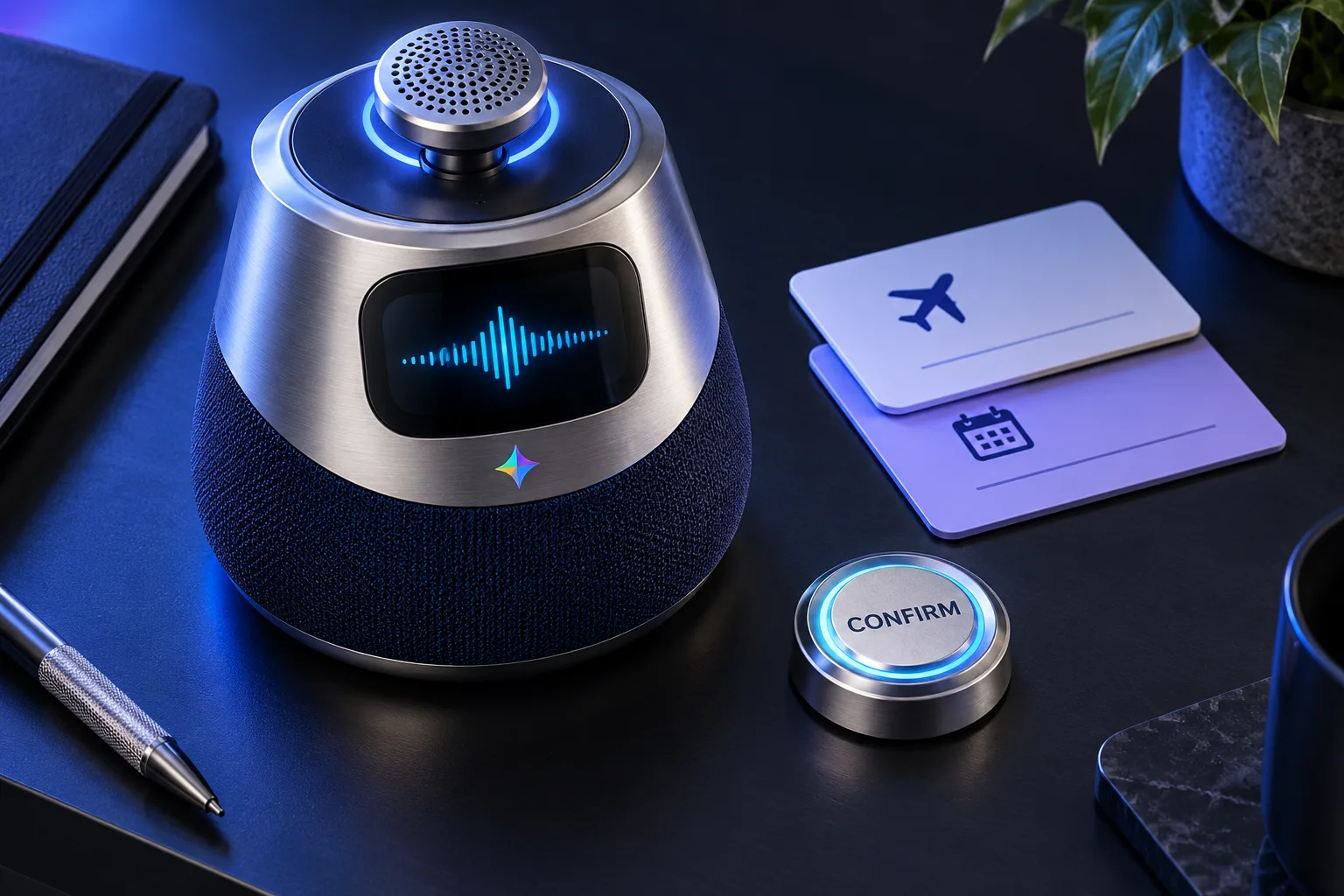
Key takeaways
- Google announced two voice-oriented models: Gemini 3.8 Live and Live Extended Thinking.
- Interruptions and ambiguous speech require confirmation before consequential tool calls.
- Voice interaction does not establish biometric identity or broaden a tool’s authority.
What Google announced[source 1]
Google published its Gemini 3.8 Live and Gemini 3.8 Live Extended Thinking announcement on September 15 and marked it updated September 17. It presented two voice-oriented models: Gemini 3.8 Live for fluid dialogue and visual grounding, and Live Extended Thinking for higher-complexity, multi-step reasoning while conversation continues.
Google described interruption handling, language transitions, visual input, and background tool or API calls as parts of the live-dialogue experience. This retrospective reports that product announcement. It does not claim speech authenticates a person, that a transcript proves intent, or that Rangoon has released a Gemini Live integration.
Editorial analysis: speech needs an action checkpoint
Live conversation is useful because a person can correct the system midstream. The same property creates ambiguity. A speaker can interrupt, revise a noun, change a quantity, refer to a prior subject, or speak while an earlier tool request is pending. A transcript token sequence is not enough evidence for a consequential action without a clear mapping from final confirmed wording to a bounded target and operation.
A practical voice workflow separates conversation from commitment. The assistant may summarize interpreted action in text or speech: target, operation, key parameters, and expected effect. The user confirms that exact summary through an authenticated session, then the system creates a fresh action request. If conversation changes afterward, the earlier request is invalidated or superseded rather than silently reused.
A bounded engineering example handles a request to update a record. The system transcribes and normalizes the candidate change, shows record identifier and proposed fields, obtains confirmation from the active authenticated session, and limits the tool to that update. It logs transcript span and confirmation record as context, while recognizing identity comes from session or approved identity mechanism, not a claim that voice is biometric proof.
- Convert live speech into an explicit reviewable action summary.
- Invalidate pending actions when an interruption changes scope.
- Use authenticated-session evidence for identity; do not infer it from voice alone.
Integration and evidence boundary
Rangoon’s launch architecture can model configuration, scoped connector operations, and evidence around an exact request. It does not claim a released Gemini 3.8 Live adapter, voice-identity service, or broad authorization created by speech. Provider capability, authentication, tool scope, and action authority remain separate questions.
LNSAT’s reference path is suited to the commitment point rather than conversational stream. It can evaluate a packet containing precise target, operation, parameters, and configuration evidence, require approval when policy calls for it, and retain a receipt. If an interruption leaves an external result uncertain, the record can remain unresolved until reconciliation instead of treating spoken intent as proof of completion.
The release points to a design discipline: make natural conversation easy, but make external effects narrow enough to inspect, confirm, authorize, and prove afterward.
Sources
- Google: Introducing Gemini 3.8 Live and 3.8 Live Extended Thinking (September 15, 2026)
Continue reading