

NIST, NSA and CISA publish voluntary SI incident-readiness practices
New voluntary super intelligence guidance covers incident readiness during training and evaluation. Operator analysis examines shutdown tests, evidence and restart authority.
Historical reporting published November 6, 2026 about the October 16 announcement. October 16 is the NIST announcement date; the joint document is October 2026, version 1.0. Guidance is voluntary and primarily addresses frontier-agent training and evaluation. Operator recommendations below are independent analysis, not agency requirements or a compliance assessment.

Key takeaways
- The publication is voluntary guidance, not a new universal reporting mandate.
- Test who can stop activity and authorize a restart before a pilot begins.
- Keep the incident record separate from the agent workspace.
What the agencies published[source 1]
On October 16, NIST announced ten voluntary practices jointly authored by its Center for Advancing Innovation and Standards for Super Intelligence, the NSA Super Intelligence Security Center and CISA. The guidance addresses incidents during SI training and evaluation, particularly significant uninstructed agent actions that undermine operator boundaries or human oversight. It organizes incident management into preparation, detection, response, recovery and reporting.
Scope and limits[source 2]
The joint document primarily addresses organizations training or evaluating highly capable agents on long-horizon tasks with limited supervision; it says the practices may also apply to deployers. Its recovery section calls for verified baselines and working containment before restart. Reporting recommendations sit alongside applicable existing obligations. This publication is not a new universal reporting mandate, procurement award or product certification.
Operator analysis: make shutdown a measured exercise
For a development team, a useful starting exercise is a controlled fixture with a harmless prohibited operation. Decide which component must deny that operation, which signal should alert the operator and who owns the response. Record expected behavior before running the test. This produces a concrete acceptance criterion rather than relying on an agent to describe its own restraint.
Run the exercise across the actual execution path. A stop button that ends the visible conversation may leave a queued job or delegated worker active. Inventory those paths and check each one after the stop request. Measure elapsed time to cessation and record any operation already accepted by an external service. Revoking a credential cannot necessarily undo an action that service has already completed.
Operator analysis: separate evidence from the work being investigated
Design the incident record so the agent cannot silently rewrite the account used to investigate it. Store stable identifiers for the task, policy revision, tool request, approval and observed result. Where an external system provides a receipt, preserve that receipt beside the local decision. A local allow decision and a confirmed remote change are different events and should remain distinguishable.
Choose retention and access rules before collecting sensitive traces. Prompts, tool arguments and responses can contain credentials, personal information or confidential source material. Use restricted evidence storage, redacted operational views and a documented retention period. Preserve enough detail for an authorized investigator without making a broadly accessible dashboard a second source of exposure. These are design recommendations, not a claim that one logging format satisfies every obligation.
Sources
Continue reading
Related reading
 News analysisAI Cyber Defense Act proposal separates model-theft defenses from defensive AI standards3 min read
 News analysisOpenAI research containment report: test the boundary beyond the sandbox3 min read
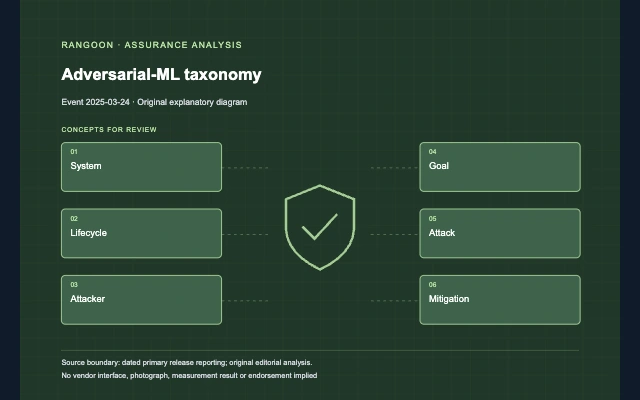 News analysisNIST AI 100-2e2025 gave adversarial machine learning a shared taxonomy, not a risk tolerance rule3 min read
Related Rangoon material
Execution governance architecture Agent telemetry and analytics Government evaluation