Anthropic donated Agent Skills to AAIF: treat open governance as a new supply-chain input
Anthropic moved its Agent Skills standard to the Agentic AI Foundation. Teams still need version, provenance and install-time controls for every skill.
Historical reporting: Anthropic's October 22 announcement is the primary source for the donation, stated project scope and proposed governance work. Its adoption and installation figures are company-reported. The event does not establish common runtime behavior, security review, licensing terms or support commitments across implementations.
Key takeaways
- A foundation transfer can clarify stewardship, but it does not make an individual skill safe to install or run.
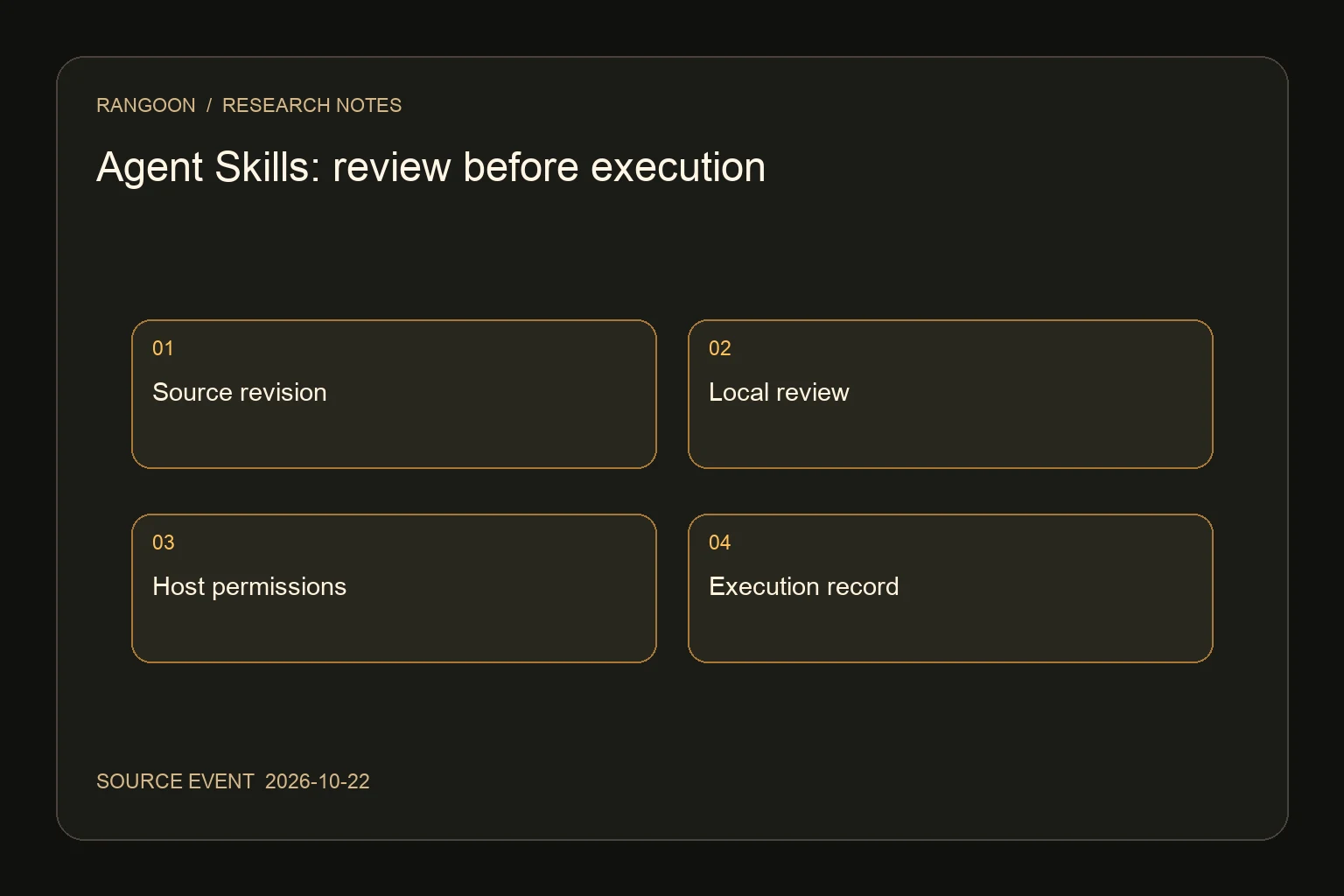
- Teams need a pinned skill inventory, declared contents and review evidence before a capability enters an agent workflow.
- Specification governance and execution authority remain separate operational concerns.
The announced transfer covers project stewardship, not every implementation[source 1]
Anthropic announced on October 22 that it would donate Agent Skills to the Agentic AI Foundation under the Linux Foundation. The company describes a skill as a folder centered on a SKILL.md instruction file with supporting scripts or reference material. Its announcement says the transfer includes the standard's name and logo, GitHub organization and agentskills.io domain, while participation in AAIF is not required to use or contribute to the standard. Anthropic also proposed work on versioned releases, a formal proposal process and security guidance. These are governance commitments and proposals from the announcement, rather than proof that every existing skill follows a single release or security policy.
Anthropic says more than 70 platforms had integrated Agent Skills and gives publication and installation totals. Those figures describe the company's view of adoption at the announcement date. They do not prove that a listed host implements every field identically, that all published folders are reviewed, or that a consumer receives a consistent result when a skill invokes local scripts, network tools or external services.
Analysis: make a skill inventory before treating it as reusable capability
A portable folder is useful because it makes instructions, references and helpers visible as a unit. That visibility should become an intake gate, not a reason to skip review. Record the skill name, source location, immutable revision, declared files, publisher identity, license and hashes for executable material. Compare those inputs during updates so a changed helper or reference cannot quietly acquire broader behavior under an unchanged display name.
Read a skill as both documentation and potential supply-chain content. A prose instruction may direct an agent to access tools; a helper may parse data or make network requests. Classify each file by what it can affect, then restrict execution to a disposable test context until it has a defined owner and acceptance evidence. A registry page, popularity count or foundation affiliation is useful discovery metadata, not a substitute for that record.
Analysis: separate specification change from operating approval
Foundation governance can make a specification's change process easier to inspect: a release identifier, proposal record and maintainer decision are each useful artifacts. Operators still need a second decision for their own environment. That decision should say which version is allowed, which inputs and tools are permitted, who may update it and where execution evidence is retained. It must remain possible to reject a valid upstream release for a particular workflow.
This separation also helps when multiple agent hosts consume the same skill. Test the target host's loader, path resolution, script handling and tool permissions against bounded fixtures. Preserve test results with the exact host and skill revisions. A standard can describe an interchange format; it cannot by itself prove what an arbitrary client will execute or authorize. Document withdrawal steps too, so an urgent upstream revocation can be acted on without guessing which workflows consumed a revision.
Sources
- Anthropic: Donating Agent Skills to the Agentic AI Foundation (October 22, 2026)
Continue reading