Anthropic launched a Claude directory for one-click connector discovery
Anthropic's July 14, 2025 directory announcement grouped remote and local Claude connectors behind one-click connection or installation, with remote services limited to paid plans.
Historical reporting: Source 0 is Anthropic's dated July 14, 2025 Claude connectors-directory announcement. Source 1 is a current official connector guide, used only for present authentication, per-user permission inheritance, organization controls and remote-MCP context. It does not establish July 2025 capability or plan state.
Key takeaways
- Anthropic's July directory launch gave web and desktop users a discovery surface for named remote services and local desktop applications, with remote connectors limited to paid plans at launch.
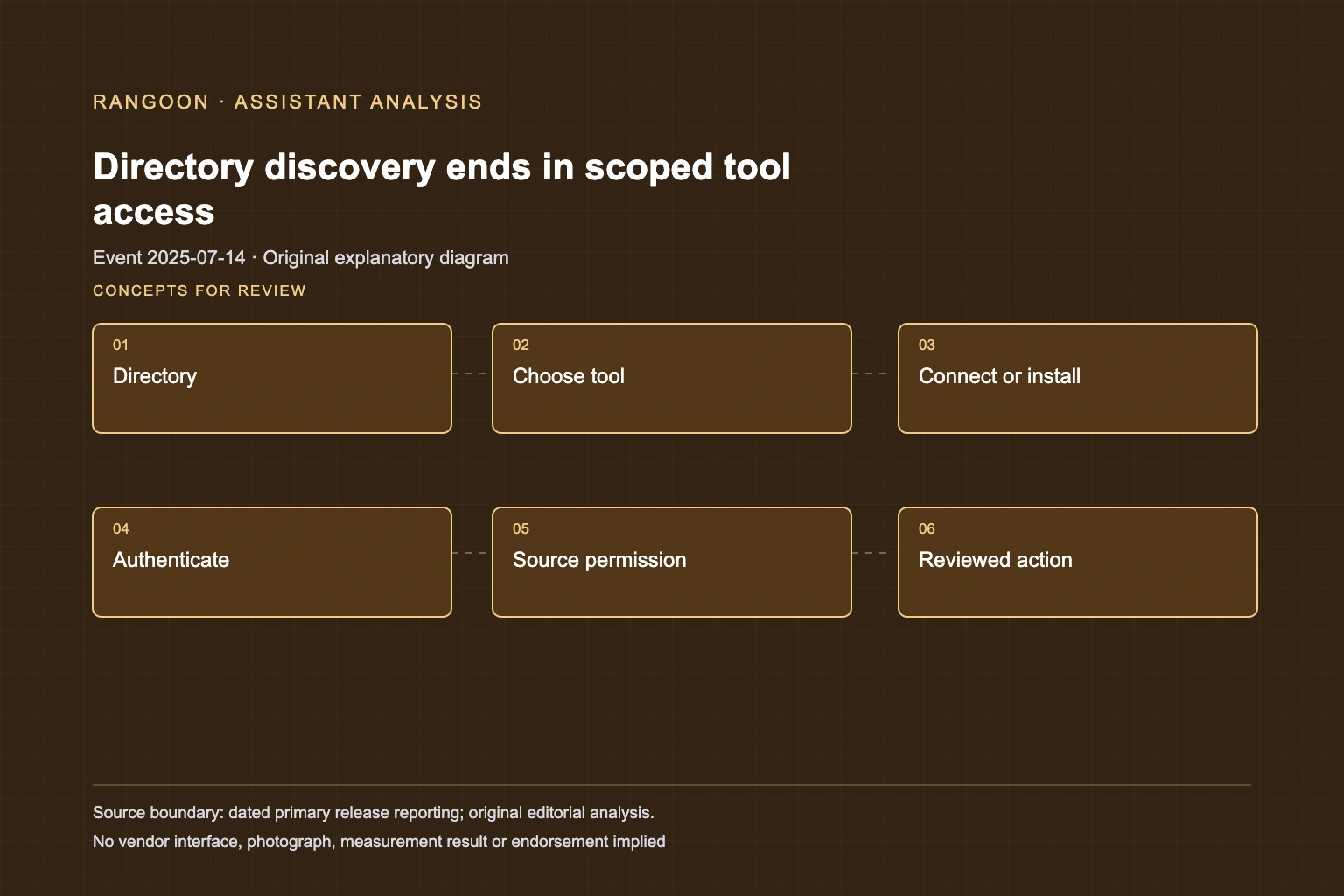
- The release's one-click language still included authentication for remote connectors and installation for desktop extensions; discovery did not itself grant data access.
- Current connector guidance explains inherited provider permissions and organization enablement, showing why a directory entry is separate from a user's authorized tool access.
The directory made connector discovery a first-class Claude surface[source 1]
Anthropic announced a directory of tools that connect to Claude on July 14, 2025. The dated post said people could explore and try the directory's tools with a single click, and named partner connectors for remote services such as Notion, Canva and Stripe alongside local desktop applications such as Figma, Socket and Prisma. The product claim was not that Claude suddenly had universal access to those services. It was that the assistant had a new discovery and setup surface for connecting to selected tools, data and context. The announcement said the directory was available to all Claude users on web and desktop, while local desktop extensions belonged in the Claude Desktop app and remote apps and services were for paid-plan users. Those stated access boundaries are the historical fact. They do not prove a particular connector existed for every account, country or provider configuration.
A directory listing led to authentication or installation, not automatic authority[source 1]
The launch post gave two different verbs for the setup path: a person would click Connect to authenticate a remote tool, or Install for a desktop extension. That distinction is operationally important. A cloud service can require account authorization, while a local extension can depend on a desktop application and the local system. Anthropic illustrated the difference through examples: a connected Linear service could supply actual tickets for release notes, and a Stripe connector could surface customer or payment information. Those examples show why the boundary cannot be reduced to a prompt. The announcement does not establish which data a person was allowed to see, whether the connector could write, what consent screen appeared, or whether generated release notes were ready to publish. A useful implementation record must retain the chosen connector, account or installation context, permissions, requested action and reviewed result separately.
Connected context improved relevance without proving correctness or permission[source 1]
Anthropic framed the directory as a way for Claude to work with the same tools, data and context as a user, rather than asking that person to restate project details in every conversation. That framing captures the potential value of a connector: it can bring a task closer to a source system. It does not make every retrieved record authoritative for the current decision, and it does not make a generated action correct. A Linear ticket may be stale, a Figma file may not be approved, and a payment record may need handling rules beyond a conversational request. The July page named partner services and intended use cases, but it did not offer a reliability study, an organization-wide authorization rule, or a guarantee that a connected system would return complete data. The historical analysis can recognize a new assistant interface while preserving the separate questions of source quality, access control, auditability and human review.
Current guidance describes permissions and organization gates after the launch[source 1][source 2]
Anthropic's current connector guide says Claude inherits a person's permissions from the connected service: a person unable to open a source file, channel or record cannot reach it through the connector. It separately cautions that a shared credential can reach what that credential can access. The guide describes reviewing capabilities and permissions during connection, individual authentication after a Team or Enterprise owner enables a connector, and current remote-MCP configuration choices. These are current product operations, not evidence of the July 2025 setup or directory contents. They do show why a listing and an enabled organization feature are distinct from a person's usable access. The dated announcement established a directory, named examples and paid remote-connectors boundary. Present guidance supplies a sharper control model for a later deployment, where source permissions, shared credentials, write capability and administrator enablement should be reviewed before Claude acts on connected data.
Sources
Continue reading