

Adobe made Firefly Video public beta inside a new Firefly app, while its safety language remained Adobe’s claim
Adobe released a new Firefly app and put the Firefly Video Model into public beta on February 12, 2025, adding text-to-video and image-to-video workflow controls.
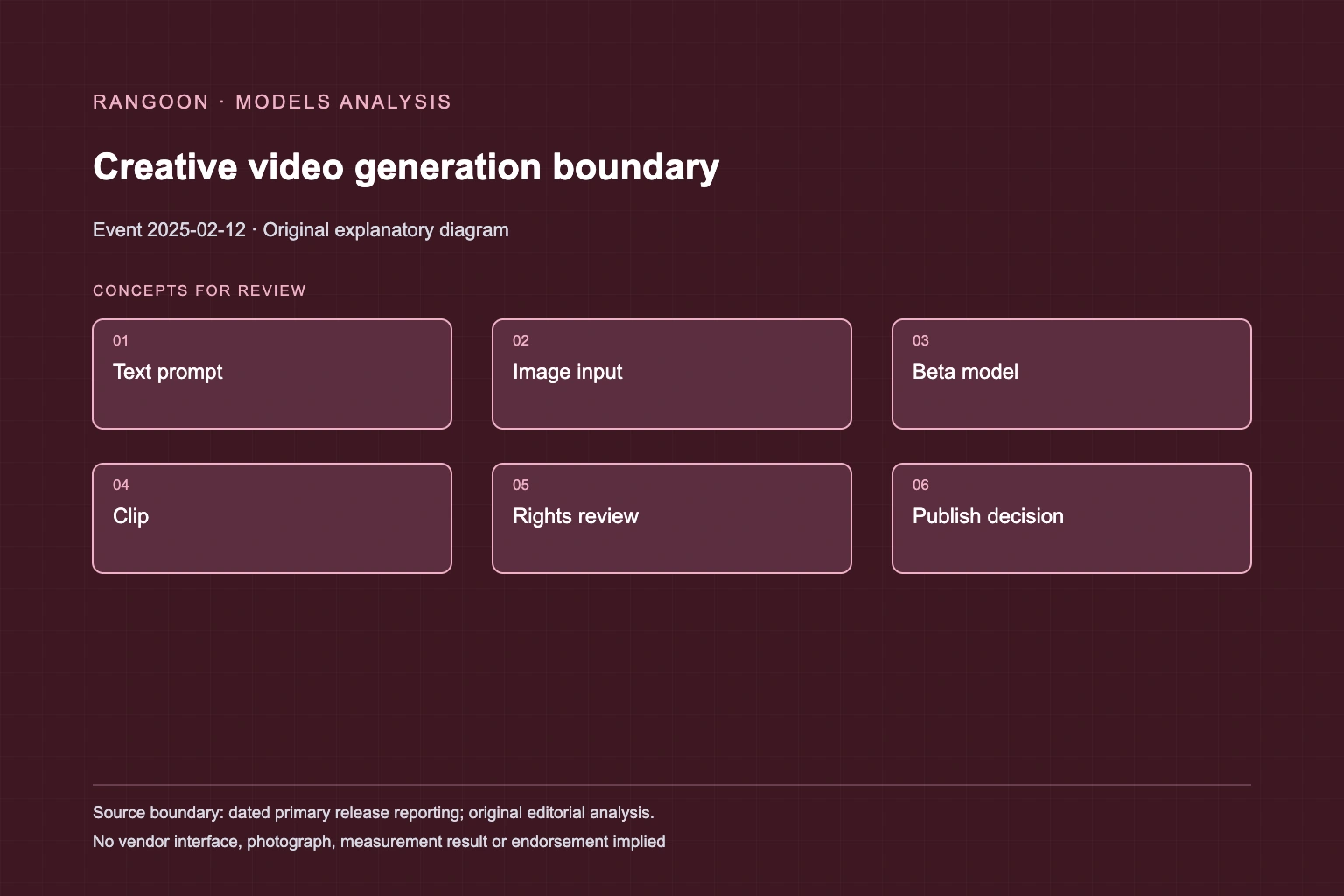
Historical reporting: Adobe released a new Firefly app on February 12, 2025 and said the Firefly Video Model was available in public beta. Adobe described text-to-video, image-to-video, camera-angle and integration workflows, and marketed the model as IP-friendly and commercially safe. Those terms are Adobe’s product claims; they do not establish training-data rights for every item, copyright immunity, ownership of a particular output or a legal conclusion for a user. A current Generate Video FAQ supplies later interface context and is explicitly not used to back-project later device, prompt or model-selection rules into the February launch.
Key takeaways
- The February event was a public-beta product release inside Adobe’s new Firefly application.
- Adobe’s IP-friendly and commercially safe wording was a vendor claim, not a blanket legal assurance for every generation or input.
- Later help pages describe evolving workflow details and do not alter the beta status or controls announced in February.
Adobe released a new Firefly destination with video generation in public beta[source 1]
On February 12, 2025, Adobe announced a new Firefly application and said its Firefly Video Model was available in public beta. The company framed the app as a place to work across image, vector and video generation, rather than as a standalone video endpoint with a fixed, perpetual feature list. Public beta is a distinct release state: users could access a released product surface, but the label also signals that the model and workflow were still subject to change. The event supports reporting that Adobe added its own video model to the Firefly app. It does not prove that every Creative Cloud customer, geography, device, plan or production workflow had identical access or behavior on that date.
Text and image inputs were presented as creative controls, not factual evidence[source 1][source 2]
Adobe described a workflow that could turn an image into video, generate from a text prompt and allow users to specify style or camera angle. These are creative-input mechanisms: they can guide a clip’s look, motion and composition. They do not make a result a factual video record, remove the need to review a depiction or give a user rights to material they upload. A text prompt can describe an intended scene without proving that the generated scene occurred, and an image input can be subject to its own permissions and privacy constraints. The February release was therefore news about a new generative control surface. Any claim about suitability for a campaign, newsroom, client delivery or regulated setting needs evidence beyond the model’s available controls.
Adobe’s commercial-safety language needed careful attribution[source 1]
Adobe called the Firefly Video Model IP-friendly and commercially safe in its announcement. That language is relevant because it shows how Adobe positioned the release to creative professionals, but it remains the company’s characterization. It does not by itself disclose or prove rights for each training item, clear every user input, guarantee ownership of an output or settle copyright questions in a particular jurisdiction. Legal and contractual outcomes can depend on the account terms, source material, output use, local law and facts of a dispute. Historical reporting can accurately state that Adobe made the claim without repeating it as an unconditional legal conclusion. The public-beta announcement did not create a general immunity from claims or a substitute for rights review.
Later help guidance records a changing product surface, not February launch conditions[source 1][source 2]
Adobe’s later Generate Video FAQ describes text-to-video and image-to-video access on desktop and selected mobile devices, prompt limits and the need for users to have rights to uploaded images. It is useful contemporary documentation for operational questions, but it is dated after the February 2025 launch and belongs to an evolving product surface. It cannot establish that every listed device, prompt limit, model selector or restriction was present at public-beta release. The narrow historical conclusion is that Adobe launched the Firefly Video Model in public beta within a new Firefly app and described creative controls around it. Pricing, regional availability, later integrations and the legal effect of any marketing language remain separately dated and separately governed matters.
Sources
Continue reading
Related reading
 News analysisRunway’s Gen-4 focused its March release on keeping visual references coherent across shots3 min read
 News analysisGoogle put Veo 2 behind VideoFX’s waitlist before its later cloud release3 min read
 News analysisAdobe put Firefly’s image, video and partner-model choices behind one creative app4 min read