

Runway’s Gen-4 focused its March release on keeping visual references coherent across shots
Runway introduced Gen-4 on March 31, 2025, presenting an image-and-text video model aimed at carrying characters, locations and objects across generated scenes.
Historical reporting: Runway introduced Gen-4 on March 31, 2025, describing an image-and-text workflow intended to preserve visual characteristics of characters, objects and locations across shots without additional fine-tuning. Runway’s current help article identifies Gen-4 as an older model generation and documents image input, 5- or 10-second durations and web/iOS availability; it is later operational context, not proof that every current option or price existed at launch. Runway’s statements about consistency, physics and quality are vendor descriptions, not a guarantee for a production sequence.
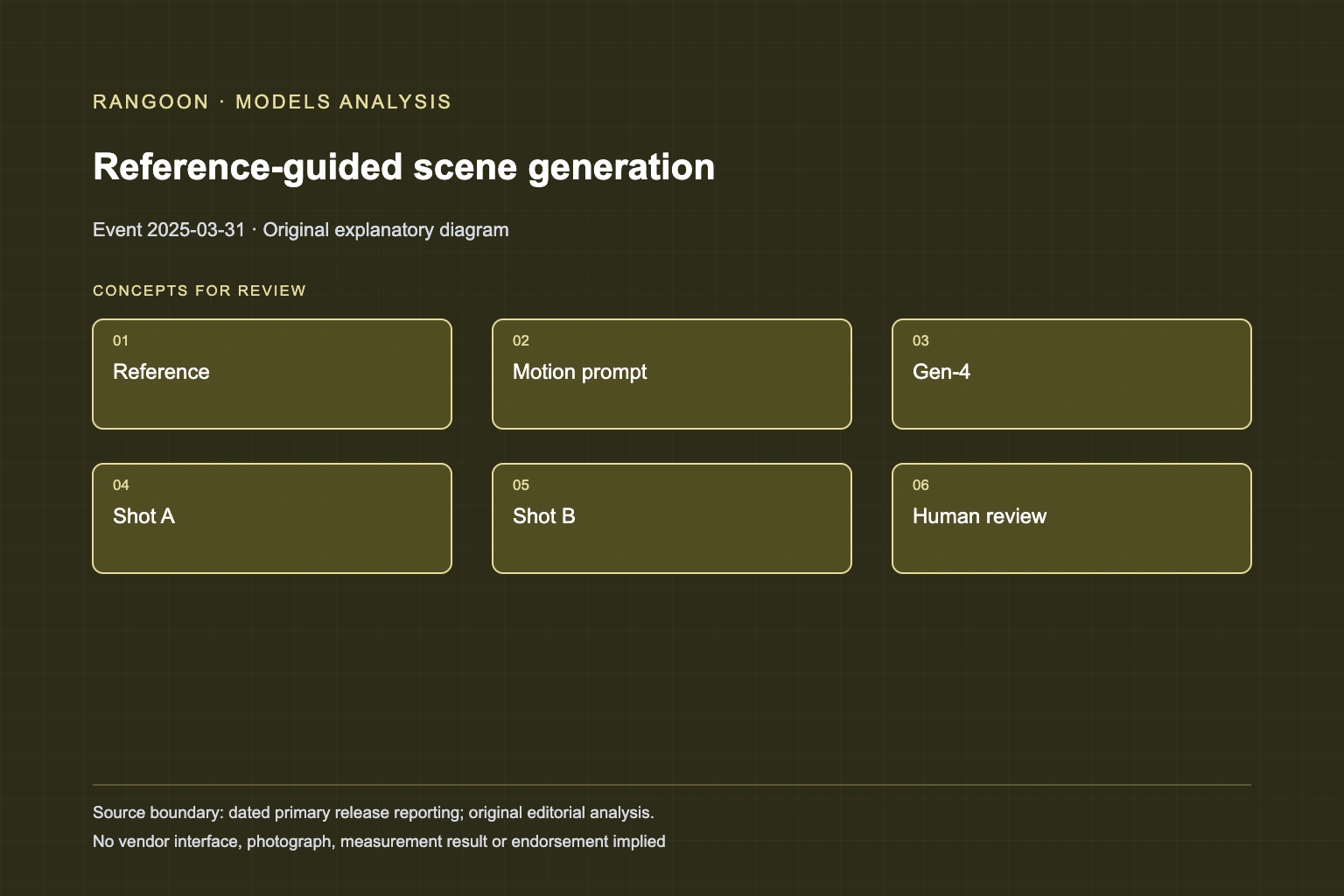
Key takeaways
- Runway framed Gen-4 as a reference-guided video model for repeated visual elements across scenes.
- The launch described a generative workflow, not a promise that a character or object would remain error-free in every output.
- Current help documentation is later context and cannot rewrite the March 2025 release terms.
Gen-4 was introduced as a consistency-oriented video workflow[source 1]
On March 31, 2025, Runway introduced Gen-4 as a video-generation model built around what it called world consistency. Its public description emphasized the ability to use visual references with written instructions to create images and videos featuring recurring characters, locations and objects. That is a meaningful change in the workflow a vendor was offering: a reference can serve as a control point across more than one generated shot. It does not mean a story has a persistent database of character identity, that every camera angle will match perfectly or that a production no longer needs human review. The event establishes Runway’s stated product direction and the reference-plus-instruction interface, not a completed filmmaking pipeline.
Visual references gave direction without replacing editorial decisions[source 1][source 2]
Runway said Gen-4 could take a reference image and preserve its style, subject, location or other visual characteristics while generating new views. In practical terms, that separates an asset-selection question from a motion-description question: the image communicates an initial look while the text can focus on action and composition. It does not resolve whether a team holds rights to use the reference, whether an output is suitable for a brand, or whether a scene accurately represents a real person or event. A reference-guided model can also produce variations, omissions or artifacts. The launch was news about a technical control surface, not evidence that those editorial, legal or quality-review decisions had become automatic.
Runway’s quality language remained a supplier characterization[source 1]
Runway described Gen-4 as capable of realistic motion, prompt adherence and improved handling of visual physics. Such descriptions help explain why the company positioned the release for media, VFX and storytelling tasks. They are not an independently verified statement that a generated object obeys physical rules or that footage will survive continuity review. Apparent motion quality can vary with a scene’s complexity, prompt specificity, image reference and output selection. A still, a demonstration reel and a repeatable production sequence are different kinds of evidence. The March page supports a clear attribution: Runway claimed that its model could make scenes more controllable and coherent. It does not prove that claim for an unpublished customer workflow.
Current specifications describe an older model after the release event[source 1][source 2]
Runway’s current help material calls Gen-4 an older generation and lists an image requirement, 5- and 10-second outputs, selected aspect ratios and web and iOS availability. Those details are useful operational context for understanding the model family, but the documentation itself warns readers to look elsewhere for the latest capabilities. It should therefore not be treated as a March 2025 launch ledger or as a promise that a particular plan, price, API route or model lifecycle is unchanged. The historical record supports a more modest conclusion: Runway announced Gen-4 with a consistency-focused reference workflow. Availability, billing, supported surfaces and model replacement need separately dated evidence.
Sources
Continue reading
Related reading
 News analysisAdobe made Firefly Video public beta inside a new Firefly app, while its safety language remained Adobe’s claim3 min read
 News analysisRunway added Gen-4 Image Turbo to its developer platform3 min read
 News analysisGoogle put Veo 2 behind VideoFX’s waitlist before its later cloud release3 min read