Aeneas made ancient-text parallels an inspectable AI research aid
Google DeepMind introduced Aeneas on July 23, 2025, reporting a model for contextualizing ancient Latin inscriptions through textual and historical parallels.
Historical reporting: Google DeepMind announced Aeneas on July 23, 2025 alongside a Nature paper. Model suggestions are historical-research aids, not authoritative dates, restorations or replacements for epigraphic judgment.
Key takeaways
- Aeneas was presented as an aid for finding contextual parallels in ancient inscriptions.
- Text restoration and dating remain conditional interpretations requiring source and expert review.
- A ranked parallel is evidence to inspect, not proof of a historical conclusion.
The release placed contextualization beside restoration[source 1][source 2]
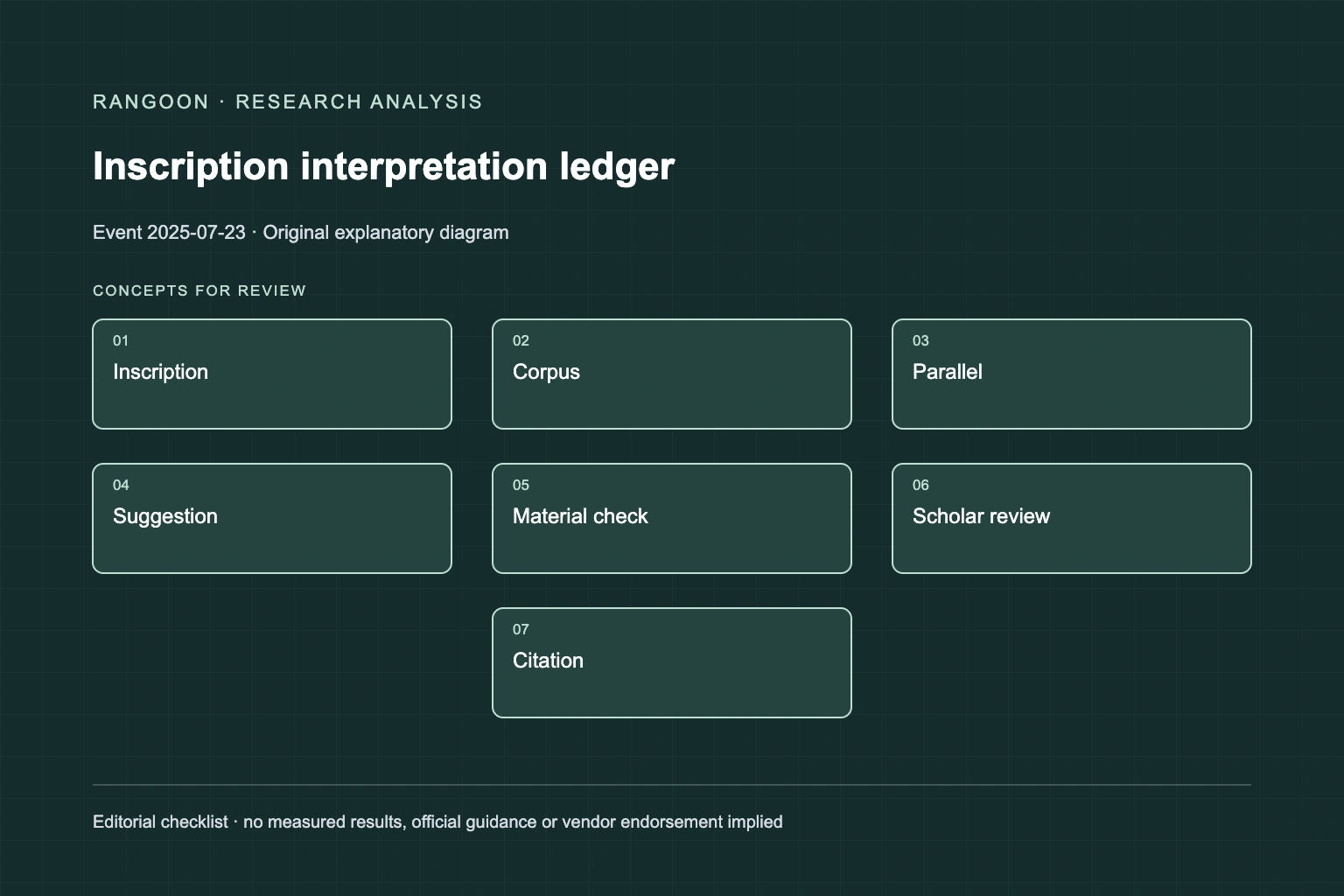
Google DeepMind introduced Aeneas on July 23, 2025, describing an AI model for contextualizing ancient inscriptions through textual and historical parallels. The announcement accompanied a Nature paper developed with academic collaborators. The model’s outputs can help a historian locate comparable wording, estimate contextual relationships or explore damaged text. They do not make an inscription’s missing letters certain, settle a disputed date or eliminate the need to inspect provenance, material context, language conventions and alternative readings. Historical interpretation remains conditional on the surviving evidence.
Parallels are useful only when a scholar can inspect their relevance[source 1][source 2]
A retrieval or contextualization model can rank documents with shared linguistic patterns, names, titles or places. Such a list can speed a search through a large corpus, but rank order is not a proof of influence, authorship or chronology. Corpus coverage, transcription quality, damaged text, metadata and representational choices all matter. The paper is the right source for its reported tasks and evaluations. A historical workflow should preserve the exact query, corpus version, returned parallels and human rationale for accepting or rejecting a suggestion.
A restoration suggestion is an interpretation, not recovered text[source 1][source 2]
Ancient inscriptions can be incomplete, context-poor or transmitted through later copies. A model may propose a fluent completion that fits common formulas while obscuring a rare local usage or an uncertain letter trace. Responsible presentation should label proposed text, confidence and alternatives, and cite the material evidence separately. No generated output should be displayed as if it were directly observed on stone. This article makes no claim about a particular inscription’s final interpretation. It preserves the gap between computational assistance and the scholarly argument that examines evidence and uncertainty.
Evaluation should include ambiguous and out-of-corpus cases[source 1][source 2]
Assess a contextualization system on inscriptions with held-out provenance, date or restoration annotations, while asking independent experts to judge whether retrieved parallels are genuinely useful. Include short fragments, formulaic texts, inconsistent metadata and examples from regions or periods weakly represented in the corpus. Record cases where the model produces a persuasive but unsupported suggestion. A study should also compare the time saved against the quality of the resulting interpretation, because faster retrieval is valuable only if it preserves the evidence trail required for historical review.
Analysis: humanities AI earns trust through inspectable citations[source 1][source 2]
Aeneas demonstrates a productive role for AI in historical research: expanding the set of comparable sources a scholar can inspect. Every generated connection should remain a proposal with a readable route back to the corpus. The Nature paper describes input from both transcribed text and images, so a scholarly review must also distinguish a model’s textual parallel from the physical condition and provenance of the inscription. A ranked parallel does not become an authoritative ancient voice, and it does not remove the interpretive, linguistic and material expertise needed to publish a historical claim.
Historical-machine-learning output becomes scholarly evidence only when a reader can inspect the original inscription, the candidate parallels and the reasoning that joins them.
Sources
- Google DeepMind: Aeneas and ancient inscriptions (July 23, 2025)
- Nature: Contextualizing ancient texts with generative neural networks (July 23, 2025)
Continue reading