RFdiffusion2 made enzyme-backbone generation a testable design hypothesis
The Institute for Protein Design introduced RFdiffusion2 on April 10, 2025, reporting a model for generating enzyme backbones from minimally specified reaction chemistry.
Historical reporting: the Institute for Protein Design introduced RFdiffusion2 on April 10, 2025 and linked a bioRxiv study. Designed enzyme structures are research candidates; activity, selectivity and stability require separate experiments.
Key takeaways
- RFdiffusion2 was reported as a protein-design model conditioned on reaction and active-site information.
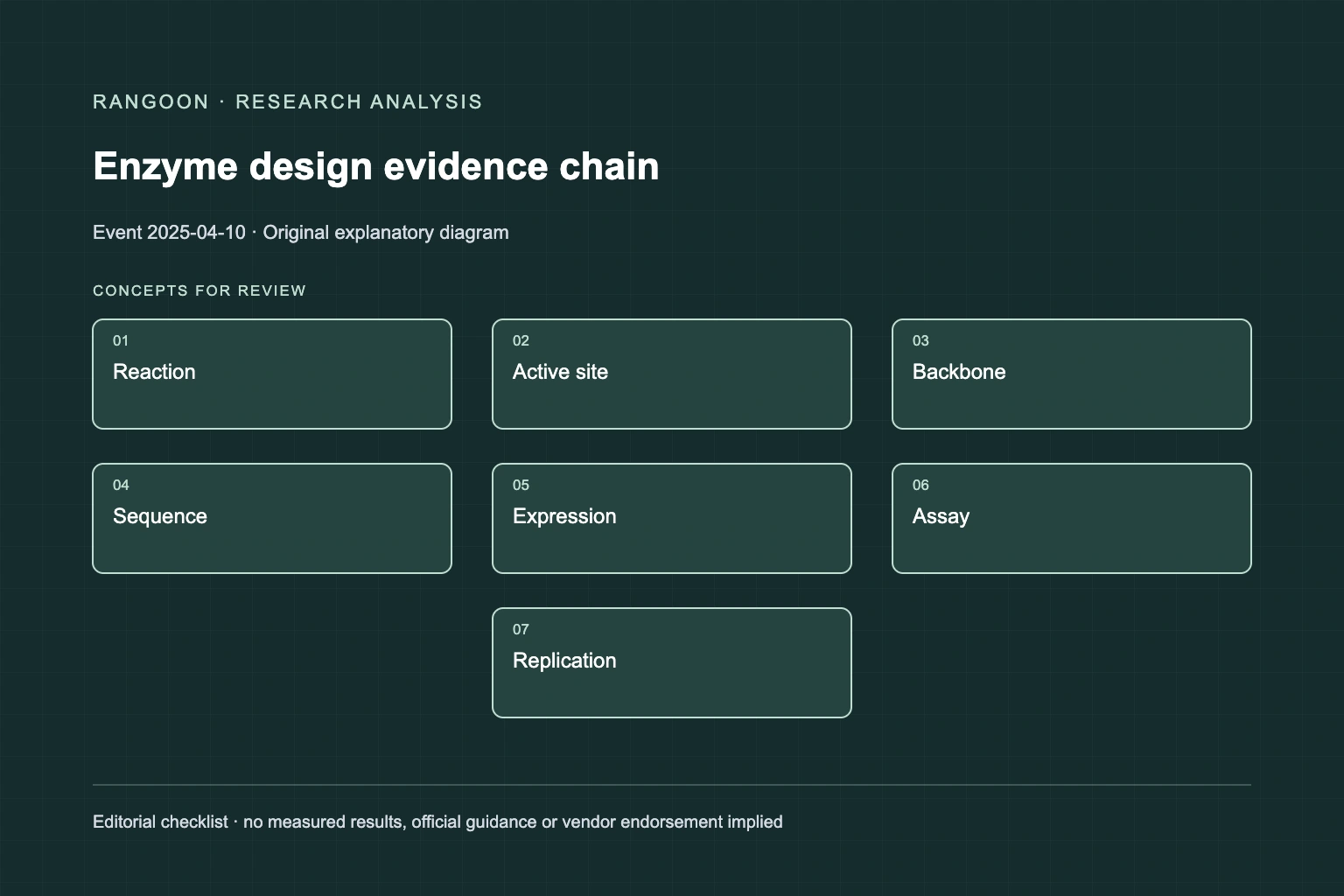
- A generated backbone must pass sequence, expression, activity and stability evaluation.
- Model designs are not validated industrial enzymes or therapeutic products.
The release focused on active-site scaffolding[source 1][source 2]
The Institute for Protein Design introduced RFdiffusion2 on April 10, 2025, describing a deep-learning model for generating enzyme backbones around chemically specified active sites. The announcement links to a bioRxiv publication and reports laboratory tests for selected designs. This is an event about a design method and a set of stated experimental results. It does not say that every generated backbone folds, that a structure implies catalytic activity, or that an active enzyme will retain selectivity and stability under the conditions required by an industrial or biomedical application.
Chemical constraints guide a proposal rather than prove function[source 1][source 2]
The reported method uses reaction information to construct protein backbones with candidate catalytic arrangements. That is a different task from predicting a pre-existing structure: a design system must satisfy geometry, sequence compatibility, folding and chemical behavior together. Each stage can introduce error. A model may place a plausible motif while a later sequence-design step changes the context, or a protein may express but lack useful activity. The paper and project materials support inspection of the stated method; they do not make a molecular image a measurement of reaction rate, substrate scope or stability.
Functional enzyme evidence comes from a matched assay[source 1][source 2]
Activity claims require an assay that names substrate, concentration, temperature, pH, controls, replicates and detection method. A structure prediction or confidence score cannot replace those observations. Selectivity and durability can also change under impurities, co-solvents or repeated cycles. For sensitive applications, broader safety and process review is separate again. This article does not provide enzyme-design instructions. It preserves the reporting boundary between a computationally generated candidate, an initial laboratory signal and a validated claim about a protein’s useful function.
Design evaluation should retain unsuccessful candidates[source 1][source 2]
Predefine the target transformation and acceptance threshold, then evaluate a representative sample of generated candidates, including those with lower model scores. Record construct sequence, expression yield, purification, assay conditions, negative controls and all inactive outcomes. Compare performance with an established baseline where one exists, and repeat promising results with independent preparations. If a model is updated, rerun a fixed holdout panel rather than comparing only hand-selected successes. This gives researchers a way to distinguish better candidate ranking from selective reporting.
Analysis: protein design needs a chain of evidence, not one render[source 1][source 2]
RFdiffusion2 illustrates a productive but bounded role for generative models: they can propose experimentally testable molecular arrangements. The evidentiary chain remains proposal, sequence realization, expression, assay, replication and context-specific validation. That is original editorial analysis. The April 2025 release and its linked study support a method and reported experiments; they do not establish that any untested output is functional or appropriate for a real product. Publishing inactive designs and assay conditions is as important as displaying a successful structure, because it defines what the method did not solve.
Protein-design claims become stronger when the laboratory records what did not work, because inactive candidates reveal whether a generator improved selection rather than presentation.
Sources
- Institute for Protein Design: Introducing RFdiffusion2 (April 10, 2025)
- bioRxiv: Atom-level enzyme active-site scaffolding using RFdiffusion2 (April 10, 2025)
Continue reading