Ai2 released Molmo 2 with open video-grounding models, data and checkpoints
Ai2 released Molmo 2 on December 11, 2025, adding 4B, 8B and fully open 7B video-language variants with pointing and tracking artifacts.
Historical reporting: Ai2 released Molmo 2 on December 11, 2025 as an open video-and-multi-image model family. The launch names 4B, 8B, and Olmo-based 7B variants, new datasets, and research-and-education use. The official code repository lists released pretraining, SFT, and long-context checkpoints. Ai2’s benchmark and peer comparisons are publisher results, not independent validation or a claim that every training stage was open on launch day.
Key takeaways
- Molmo 2 separated 4B, 8B, and fully open 7B variants by capability and openness.
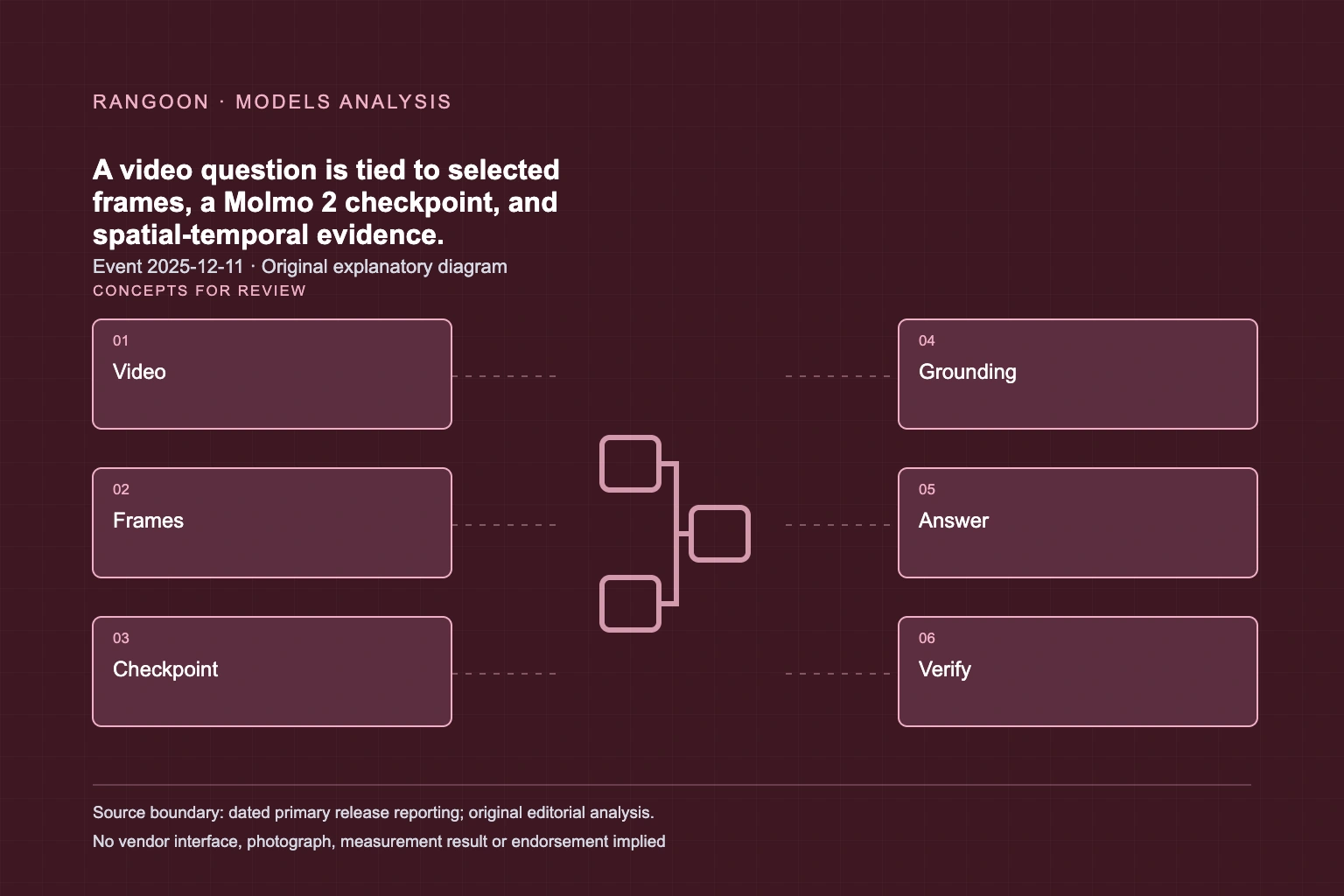
- Video pointing and tracking require temporal evidence, not only a fluent caption.
- Published checkpoints make artifact provenance inspectable without proving local performance.
Ai2 released Molmo 2 on December 11, 2025[source 1]
Ai2 announced Molmo 2 on December 11, 2025 as a model family for single images, multi-image inputs, and video. The release names an 8B Qwen 3-based model, a 4B efficiency-oriented variant, and Molmo 2-O at 7B using an Olmo language backbone. It also reports new datasets and evaluation tools for grounded video work. This is a dated release of model variants and supporting artifacts. It does not establish that a particular video system can identify an event correctly, process every clip length, or meet a required latency or safety target. Those conditions depend on the selected model, frames, and application pipeline.
The Olmo-based 7B variant makes end-to-end openness a separate property from model size[source 1]
Ai2 describes Molmo 2-O at 7B as a fully open end-to-end option, including the language model, vision encoder, and training checkpoints. The 4B and 8B variants use Qwen 3-based language components. This is an important release distinction: “Molmo 2” is a family name, while openness and underlying components vary by variant. A user should identify the exact model rather than borrowing a property from a sibling checkpoint. The blog also states research and educational use under Ai2’s guidelines, so availability does not settle a downstream organization’s use decision. Weights, datasets, code, and permitted use should each be checked from their applicable record.
The official repository exposes checkpoints at pretraining, SFT and long-context stages[source 2]
Ai2’s Molmo2 repository lists pretraining, supervised fine-tuning, and long-context SFT checkpoints for the 4B, 8B, and O-7B variants. That artifact structure helps a researcher distinguish a base-style checkpoint from a post-trained checkpoint. It also creates a reproducibility obligation: a result reported with long-context SFT should not be attributed to a pretraining artifact, and an evaluation should record the checkpoint identifier. The repository includes training and configuration material, but a published implementation is not a claim that a local run matched the publisher’s data pipeline or compute environment. It provides inspection and starting points, not automatic replication.
Ai2’s video-grounding claims need temporal fixtures and publisher-method boundaries[source 1][source 2]
Ai2 reports video pointing, counting, tracking, and question-answering comparisons for Molmo 2, including performance against open and proprietary peers. The release’s key contribution is not merely that it can summarize video; it says the model can return spatial and temporal grounding evidence. That claim should be tested with fixtures that identify the required frame range, object identity, occlusion, re-entry, and acceptable uncertainty. A model can produce a plausible count while pointing to the wrong time or object. Ai2’s benchmark results are meaningful source material under its stated methods, but they do not independently validate a security camera, industrial feed, or user-uploaded clip. Local evaluation should retain clip provenance, sampling policy, checkpoint, and expected evidence locations.
Sources
- Ai2: Molmo 2 launch (December 11, 2025)
- Ai2: Molmo2 official code and checkpoints
Continue reading