Ai2 released olmOCR as an open 7B vision model for PDF extraction
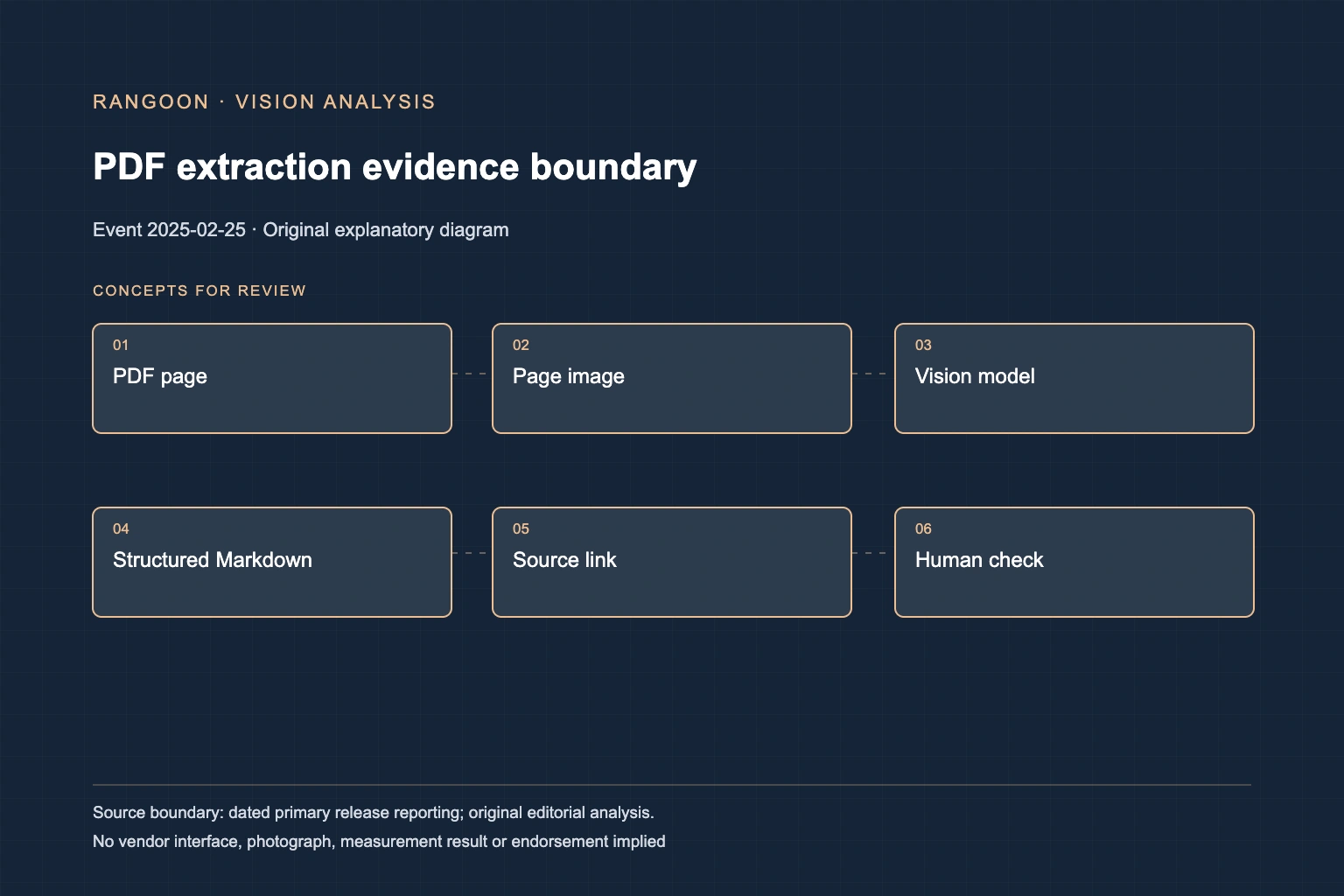
Ai2 released olmOCR on February 25, 2025, pairing a fine-tuned 7B vision-language model with an open PDF-to-Markdown pipeline.
Historical reporting: Ai2 announced olmOCR on February 25, 2025 as an open PDF and document-image extraction toolkit built on Qwen2-VL-7B-Instruct. The dated announcement describes its stated training data, evaluation and inference backends; the public repository records Apache-2.0 licensing and the project purpose. Ai2’s cost, benchmark and preference figures are supplier-reported results under its stated workloads and comparisons. They do not prove accuracy, cost, licensing fit, privacy handling or throughput for another document corpus, hardware stack or deployment.
Key takeaways
- Ai2 released olmOCR as an open vision-language pipeline intended to turn complex PDFs and document images into structured Markdown.
- The release joined model weights, training data, code, a benchmark and vLLM or SGLang pipeline support, making system integration part of the event.
- Ai2’s quality and cost figures are results from its own evaluation and should be checked against a target collection before production use.
Ai2’s February release put a 7B vision-language model behind PDF extraction[source 1]
On February 25, 2025, Ai2 introduced olmOCR as a toolkit for converting PDFs and document images into clean, structured plain text. The announcement identifies Qwen2-VL-7B-Instruct as its base model and says the project was fine-tuned for document processing. It describes Markdown output intended to preserve reading order along with elements such as headings, tables, equations and handwriting. That is a specific response to the fact that a PDF can retain page geometry without retaining a useful semantic order. The historical event is an open toolkit release, not proof that every PDF can be recovered without mistakes. Scans, unusual fonts, multi-column layouts, embedded figures and metadata errors remain input-dependent problems that a downstream workflow must examine.
The release combined model artifacts with an inference pipeline instead of presenting a model in isolation[source 1][source 2]
Ai2 said the first olmOCR release included a demo, model weights, fine-tuning data, a technical report and an optimized inference pipeline. Its repository describes the project as a toolkit for linearizing PDFs for language-model datasets and training, and records an Apache-2.0 license. The announcement also names vLLM and SGLang as supported inference engines and says the pipeline can scale from one GPU to larger installations. Those pieces matter separately: weights identify a model artifact, a data release identifies training material, and a pipeline defines part of the operational path from a PDF to text. A deployment still needs pinned revisions, a defined input policy, error handling, output validation and retention rules. Open source code does not settle whether a particular document may be processed or redistributed.
Ai2’s comparison figures described a named human-evaluation setup, not a universal OCR ranking[source 1][source 2]
Ai2 reported pairwise human judgments on outputs from 2,017 sampled PDFs, with 452 meaningful comparisons from 11 researchers. The announcement says olmOCR was preferred in stated comparisons with Marker, GOT-OCR 2.0 and MinerU, and identifies its plan to release further quantitative benchmarks. Those figures are useful because Ai2 identified both competitors and a comparison method. They remain Ai2 results: sampling, prompt and model revisions, preprocessing, scoring instructions, failure filtering and document mix can change a result. A document collection dominated by invoices, engineering drawings, legal exhibits, non-English pages or handwritten forms may not look like Ai2’s test set. A responsible evaluation records the actual corpus, accepted fields, reading-order tolerance, table criteria, abstention behavior and human correction cost before it treats a reported preference as deployment evidence.
Structured text can support downstream retrieval while retaining a need for source and layout checks[source 1][source 2]
Ai2 framed clean extracted text as a foundation for language-model training and data-intensive applications. That makes document conversion an evidence boundary: a downstream search or retrieval system may quote text produced by the extractor even when a heading, column order, minus sign, table cell or footnote was read incorrectly. The original PDF or image should remain available for review when a document supports a consequential answer. Teams can test page-level correspondence, numeric fidelity, table reconstruction and citations against the source page rather than only scoring fluent Markdown. They can also separate extraction from interpretation, so a generated answer does not conceal what the OCR stage actually saw. The February release supports a news account of an open Ai2 extraction toolkit. It does not certify every transformed document as an authoritative record.
Sources
Continue reading