

Ai2 introduced the OlmoEarth platform for open Earth-observation models and planetary-analysis tooling
Ai2 introduced the OlmoEarth platform on November 4, 2025, pairing open Earth-observation model work with tools intended for planetary insights.
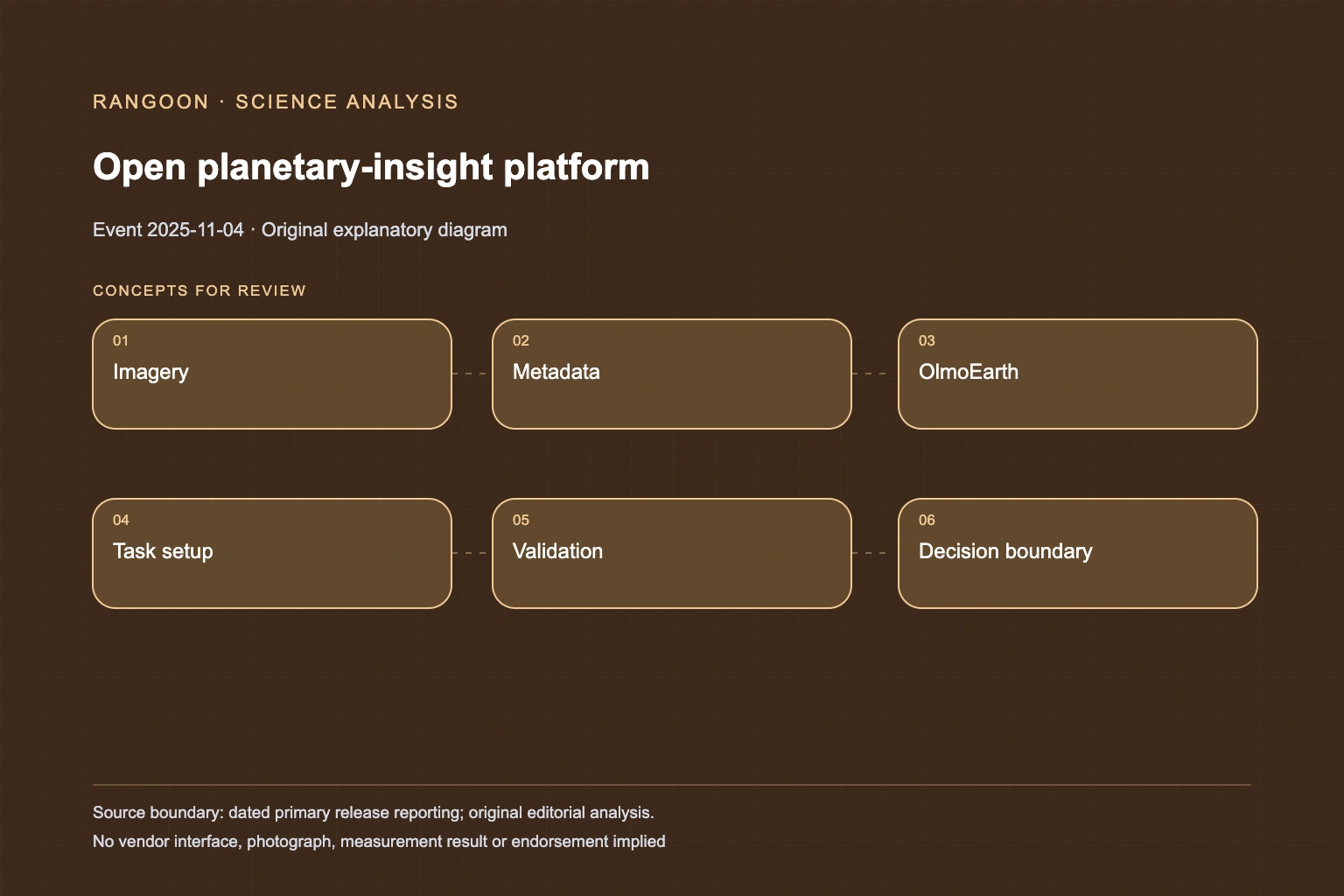
Historical reporting: Ai2 announced the OlmoEarth Platform on November 4, 2025 as open infrastructure for planetary insights. Its public pretraining repository provides the technical artefact. The sources establish platform and model-material availability; they do not establish that the platform is an operational Earth-observation service, that all model outputs are scientifically validated, or that any particular environmental decision used it.
Key takeaways
- Ai2 introduced the OlmoEarth platform on November 4, 2025.
- The associated repository provides a public technical artefact for model work.
- Platform access remains separate from validated environmental decisions or operational service use.
Ai2 released a platform framing for planetary insight tools and models[source 1]
Ai2 announced the OlmoEarth Platform on November 4, 2025, describing it as open infrastructure for planetary insights. The wording presents a platform: a combination of model work, technical resources and intended analysis pathways rather than one completed environmental service. That distinction makes the release newsworthy without inflating it. A platform can let researchers and developers evaluate Earth-observation methods, but a public announcement does not show that its outputs have been accepted in a named monitoring programme or policy process. Ai2’s release establishes what it made available and the planetary-analysis direction it proposed. It does not establish that a model reading is the correct explanation of an environmental change, that a user has deployed it at scale, or that the platform provides authoritative forecasts or measurements.
The repository provides a concrete technical artefact with its own reuse conditions[source 2]
Ai2’s OlmoEarth pretraining repository gives users a public technical artefact to inspect when assessing the platform. Code and documentation can clarify intended inputs, workflows and model organisation better than a launch post alone. They still leave practical work for a user. Reuse may require compatible imagery, geographic metadata, compute, version control and evaluation data. A repository does not guarantee that another team’s local data distribution matches the conditions used for model development, or that a task reaches useful accuracy without adaptation. The artefact is strong evidence of availability; it is not a global benchmark report. The archive treats it as such, documenting access to technical materials while reserving claims about applied performance for task-specific evaluations.
Planetary insights require validation across data sources, locations and questions[source 1][source 2]
Earth-observation models can summarize patterns across very large image collections, but outputs must be interpreted against the data-generating process. Spatial coverage, cloud and seasonal effects, sensor changes, labels and the chosen task all influence a result. Ai2’s platform announcement does not provide an exhaustive map of error or uncertainty for every environmental topic. It also does not say that a platform user can infer causal change from a representation without ground evidence and domain analysis. These are normal scientific limits, not a reason to ignore the release. They define what a careful reader can claim: OlmoEarth made open infrastructure available for researchers to test and extend. The reliability of an application remains a separate empirical question, especially when results inform environmental reporting or management choices.
Open platform availability does not demonstrate a completed public or operational outcome[source 1][source 2]
The launch creates a dated record of an open Earth-observation platform and technical resources. Neither primary source documents a completed operational installation at a public agency, a verified alerting workflow, a policy decision or an independently reviewed environmental result. They do not establish a single performance level for all imagery types, geographies and intended uses. The archive therefore avoids presenting OlmoEarth as an already deployed planetary decision system. It records what Ai2 introduced and where technical users could inspect related materials. Evidence of adoption, accuracy or practical benefit needs a subsequent record naming the application, the data and baseline used, the time frame and the observed result.
Sources
Continue reading
Related reading
 News analysisESA and IBM released TerraMind as a multimodal Earth-observation foundation model3 min read
 News analysisAlphaEarth Foundations framed mapping as reusable representation, not ground truth3 min read
 News analysisUltralytics released YOLO26 with optional NMS-free real-time vision inference3 min read