

AlphaGeometry 2 showed why a proof result needs an input boundary
The February 2025 AlphaGeometry 2 paper reported Olympiad geometry performance through neural proposal and symbolic proof search, with formalized inputs central to the result.
Historical reporting: the AlphaGeometry 2 preprint was posted February 5, 2025. Its later code repository supports inspection of implementation materials; reported Olympiad results are benchmark evidence, not a general claim about unrestricted mathematical reasoning.
Key takeaways
- The system combined neural construction proposals with a symbolic engine that can check deductions.
- Formalization is a material part of a theorem-proving evaluation, not clerical setup.
- A proof result should preserve problem version, translation, search budget and verifier output.
The paper reported a stronger geometry-specialist system[source 1][source 2]
On February 5, 2025, the AlphaGeometry 2 authors posted a paper describing an improved neuro-symbolic geometry system. It combined a language model trained on synthetic data with a symbolic deduction engine and a knowledge-sharing mechanism across search trees. The authors reported gold-medalist-level performance on their historical Olympiad geometry evaluation.
That result has a precise scope. It concerns the paper’s geometry language, problem corpus, translation and scoring method. It does not establish that the same system can read arbitrary natural-language mathematics, choose a useful formalism, or produce a checked proof for every theorem outside the evaluated domain.
Formal inputs were a core part of the evidence[source 1][source 2]
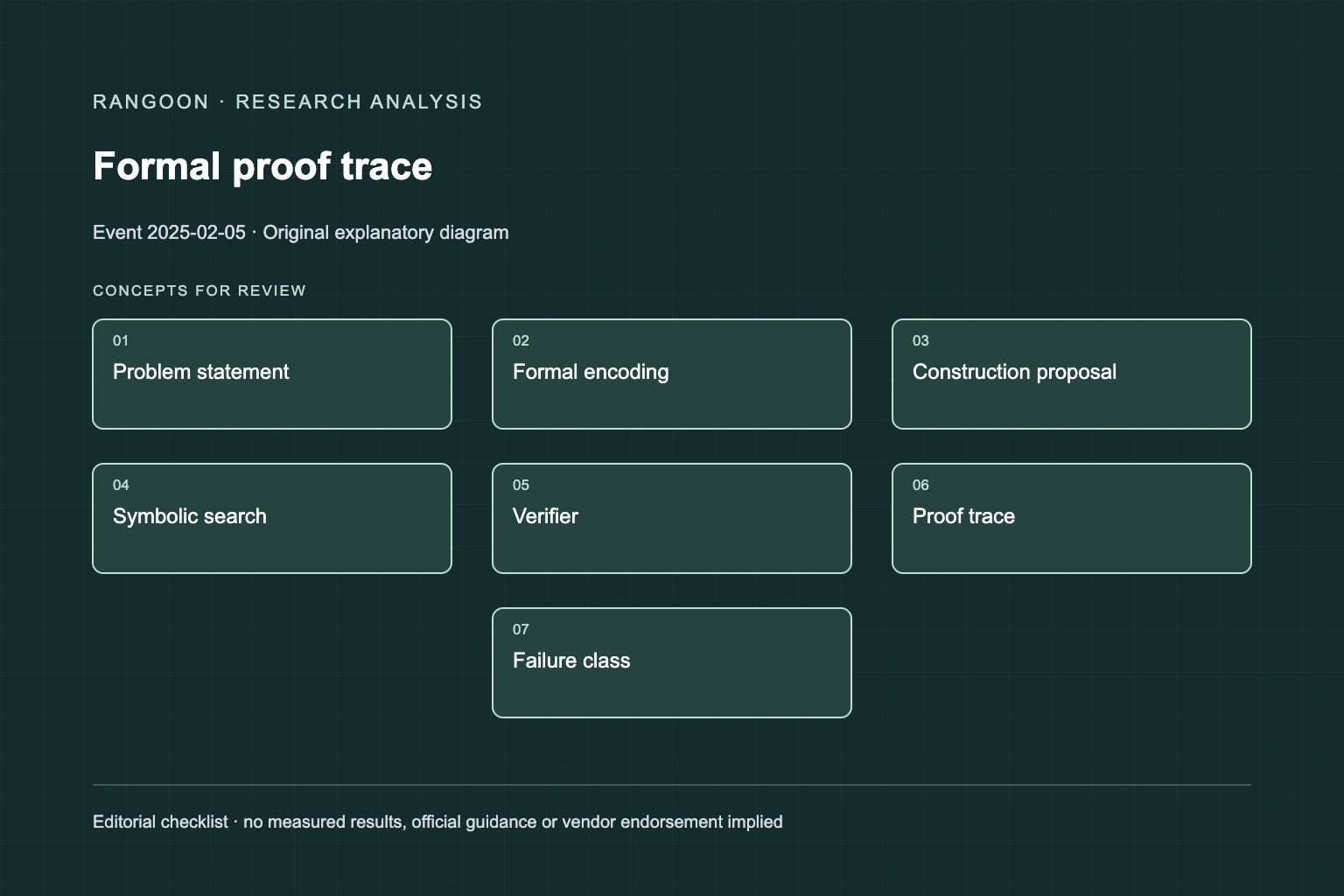
Geometry proofs need premises, constructions and a goal in a representation a symbolic engine can manipulate. The AlphaGeometry 2 materials describe an approach in which the neural component proposes useful constructions and symbolic search derives consequences. This division lets a verifier check an accepted derivation, but the proof remains conditional on the supplied formal problem.
A mistranslated diagram relation or omitted condition can make a correct proof answer the wrong question. Therefore the natural-language statement, diagram interpretation, formal encoding and final proof should be reviewed as a chain. The code release is useful for inspection, but reproducing a score still requires matching the data and evaluation protocol.
Analysis: review theorem proving as a trace, not a score[source 1][source 2]
For each solved item, retain the original question, formalized version, generated constructions, search limit, proof trace and independent verifier result. For each unsolved item, retain whether the failure came from translation, proposal, search depth or verification. This gives researchers a way to improve the right component rather than treating one aggregate score as diagnosis.
A blind review set should include malformed or ambiguous inputs, not only well-formed contest problems. Ask whether the system notices missing premises, requests clarification, or confidently proves a different statement. These are independent evaluation suggestions that complement, rather than reinterpret, the published benchmark.
Analysis: use proof systems to narrow claims[source 1][source 2]
A formally checked derivation is valuable because it narrows a claim: under these premises and rules, this conclusion follows. It does not certify the truth of unencoded real-world assumptions. In scientific or engineering use, attach the proof to the measurement, model or design assumptions it relies upon.
The February paper is a milestone in specialized mathematical reasoning. It is not evidence that a general assistant is a reliable theorem prover or that human mathematical judgment is unnecessary. Keep the input boundary visible when reporting results.
Analysis: Contest scoring also does not measure explanation quality, usefulness of partial lemmas or robustness to informal diagrams. A deployment review can ask separate questions: can a human read the proof, can a verifier reproduce it, and can the system identify an incomplete formalization? Keeping those dimensions separate prevents a specialized score from becoming a vague claim about mathematical reliability. Record the translation reviewer as well.
Sources
Continue reading
Related reading
 News analysisxAI released Grok Code Fast 1 for coding agents, with partner trials and an API route kept separate3 min read
 News analysisxAI introduced Grok 3 as an early preview, with Think variants in beta while training continued3 min read
 News analysisWayve launched GAIA-2 for controllable multi-camera driving scenarios, positioning it as an offboard training and validation tool3 min read