

xAI introduced Grok 3 as an early preview, with Think variants in beta while training continued
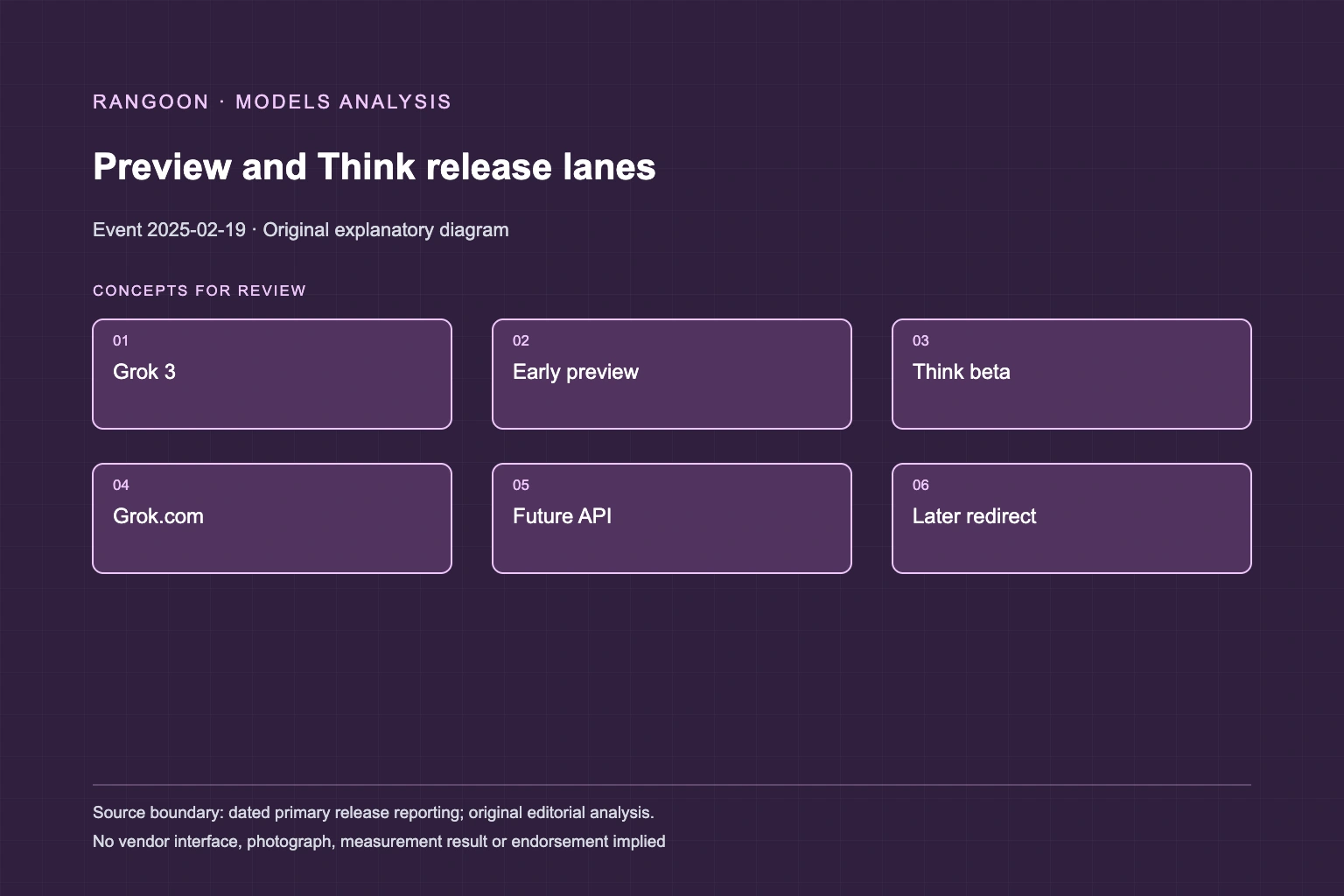
xAI announced Grok 3 and Grok 3 mini on February 19, 2025, calling Grok 3 an early preview and its named Think variants beta reasoning models.
Historical reporting: xAI introduced Grok 3 mini alongside Grok 3 on February 19, 2025, described Grok 3 as an early preview, and presented Grok 3 Think and Grok 3 mini Think as beta reasoning variants. The announcement said the models remained in training, described a staged rollout through Grok.com and X, and said API access would arrive in coming weeks. Its benchmark, compute and preference comparisons are supplier-published results with stated setups, not independent deployment proof. A 2026 xAI migration record later lists grok-3 among retired API slugs and redirects; that later service change is context only and does not rewrite the February preview event or its availability.
Key takeaways
- Grok 3 was an early preview; Grok 3 mini arrived alongside it, while the named Think variants were beta reasoning models.
- xAI separated consumer rollout from API plans, so the model announcement did not make every interface available at once.
- Benchmark and compute statements describe xAI’s tests and infrastructure claims, not a universal result for a customer workload.
The February announcement separated the Grok 3 early preview from beta Think variants[source 1]
On February 19, 2025, xAI introduced Grok 3 mini alongside Grok 3, described Grok 3 as an early preview, and named Grok 3 Think and Grok 3 mini Think as beta reasoning models. Its release said the models were still in training and would evolve with feedback, while it began a rollout to users on Grok.com and X. That distinction matters because a named base model, a reasoning variant and a consumer access route can each have different release status. The news was not simply that another model existed; it was that xAI exposed an early-preview Grok 3 alongside explicitly beta Think variants under a staged release. Neither label establishes a stable output, a permanent benchmark position or a production approval for a particular task.
Test-time reasoning was presented as a separate operating choice[source 1]
xAI described Grok 3 Think and Grok 3 mini Think as beta reasoning variants trained with reinforcement learning, where the system could spend additional time exploring and checking approaches. This makes a practical distinction between Grok 3’s early-preview base response and a response that consumes more test-time compute. It does not expose a general rule that more internal work produces a correct answer, or that a user can infer reliability from a displayed reasoning trace. The announcement’s examples and scores describe xAI’s release-era evaluation conditions. A team choosing a model still needs to measure latency, cost, tool behavior and answer quality against its own data and task, especially where a wrong answer has material consequences.
Consumer access and API release were different milestones[source 1]
The February post said Grok 3 was available to X Premium and Premium+ users on X and Grok.com, with higher limits and access to advanced capabilities for Premium+ users. It also said the standard and reasoning models would be released through xAI’s API platform in the coming weeks. Those statements draw a clear line between a consumer subscription surface and a developer interface. A subscription announcement does not itself establish an API model identifier, rate limit, pricing, data-handling arrangement or enterprise deployment. Likewise, an announced API plan is not evidence that a specific application had integrated the model. The historical event therefore supports staged consumer availability and an announced API direction, not a blanket availability claim.
A later retirement record is context, not a revision of the beta launch[source 1][source 2]
xAI’s later migration documentation lists grok-3 among API models retired on May 15, 2026 and says requests to that slug would be redirected to Grok 4.3. This later operational record is useful because it demonstrates that a model name and service target can change after an announcement. It cannot be read back into February 2025 to say Grok 3’s early preview or its beta Think variants used that replacement, had the later pricing or were already retired. Nor do xAI’s February benchmark, Chatbot Arena or Colossus-compute statements independently prove performance for a customer’s prompts, tools or traffic pattern. The dated conclusion is deliberately narrow: xAI introduced Grok 3 as an early preview, announced Grok 3 mini alongside it, named Think variants as beta, began a consumer rollout and described further API work as future delivery.
Sources
Continue reading
Related reading
 News analysisxAI released Grok Code Fast 1 for coding agents, with partner trials and an API route kept separate3 min read
 News analysisGrok 4’s July launch put tool use, subscriber access and an API on the same release record3 min read
 News analysisGrok 4 Fast combined quick and reasoning responses while xAI split API access into two models3 min read