

AMD showed Helios as an Open Rack Wide reference platform, keeping its 2026 volume expectation separate
AMD showed Helios on October 14, 2025, a rack-scale Open Rack Wide reference platform with volume deployment expected in 2026.
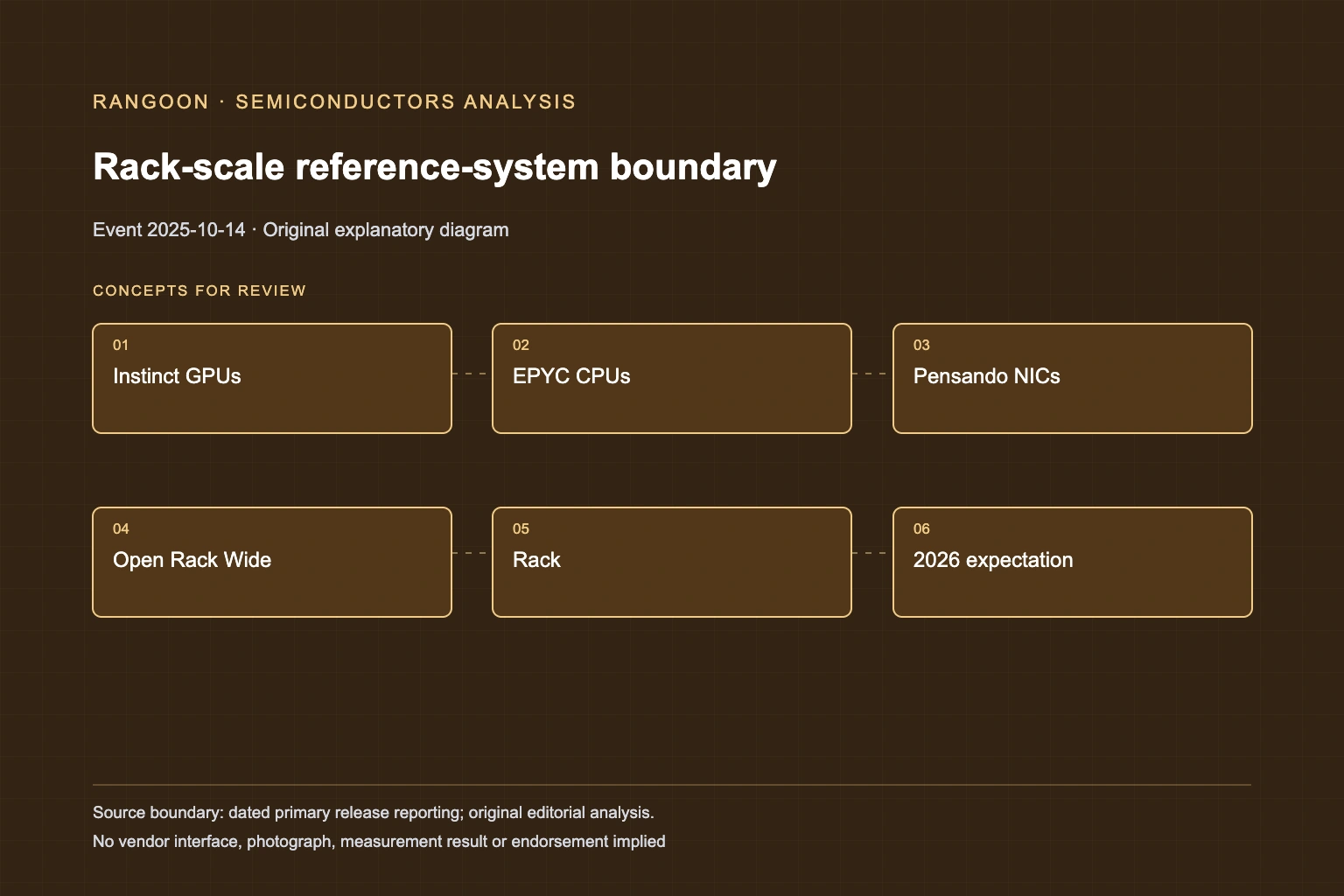
Historical reporting: AMD publicly showed Helios, its rack-scale AI reference platform, at the OCP Global Summit on October 14, 2025. AMD said the design was built on the Open Rack Wide specification introduced by Meta and joined AMD Instinct GPUs, EPYC CPUs and Pensando networking. A same-day AMD blog says Helios was being released as a reference design to OEM and ODM partners, with volume deployment expected in 2026. The sources’ performance, efficiency, scalability and future-deployment language is AMD’s description and includes forward-looking statements; it does not establish shipped racks, installed GPU counts, a final bill of materials, independent benchmark results, compatibility with every Open Rack implementation or a live provider service.
Key takeaways
- Helios was a publicly shown rack-scale reference platform, not evidence that a standardized AMD rack was already deployed in October 2025.
- AMD tied accelerator, CPU, networking and Open Rack Wide design into one system boundary, so hardware selection extended beyond the GPU.
- AMD’s same-day 2026 volume-deployment expectation must remain distinct from shipment, installation, service availability and workload proof.
Helios appeared publicly as a reference platform with deployment still ahead[source 1][source 2]
On October 14, 2025, AMD said it publicly showcased Helios for the first time at the OCP Global Summit. AMD called Helios a rack-scale AI reference platform; a same-day AMD blog said it was being released as a reference design to OEM and ODM partners, with volume deployment expected in 2026. Those facts give the event a precise boundary. A public static display and a reference design can show how a vendor intends to assemble components around a standard, but neither proves that a customer rack was shipping, installed, operating or available through a cloud service. The event was still significant because it moves the unit of discussion beyond a single accelerator card. It does not convert an expectation into current capacity. Procurement and architecture teams should preserve the announced date, the stated reference status and AMD’s volume expectation instead of compressing them into a claim that Helios was already a production platform.
AMD described a multi-component rack in which GPU, CPU and networking roles remained distinct[source 1]
AMD said Helios combined AMD Instinct GPUs, AMD EPYC CPUs and AMD Pensando networking technologies. That combination matters because large AI systems depend on host scheduling, memory movement, scale-up links, scale-out networking, storage paths, power distribution and serviceability as well as accelerator arithmetic. A rack-level label cannot tell a buyer which component will constrain a particular model or whether a design’s networking path fits its parallelism strategy. A batch-heavy training job, an interactive inference service and a retrieval pipeline can stress the same rack differently. The October release supports a description of the components AMD placed in its reference design. It does not establish exact card count, topology, firmware set, capacity, failure domain, physical-site readiness or a customer workload outcome. Those facts need system-specific documentation and measurement.
Open Rack Wide alignment described a standards direction, not automatic interoperability[source 1]
AMD said Helios aligned with the Open Rack Wide specification introduced to the Open Compute Project by Meta. A shared rack specification can make mechanical dimensions, service practices and ecosystem coordination more legible, but it does not guarantee that every component, cooling design, power shelf, cable path or management interface is interchangeable. The announcement frames Helios as part of AMD’s open-hardware approach from silicon through system to rack. That is a design and ecosystem claim, not a completed interoperability test. Operators still need to validate their selected chassis, power and cooling equipment, network fabric, firmware compatibility and maintenance model. Standards alignment is useful evidence for a planning conversation; it is not a substitute for a bill of materials, qualification result, installation procedure or support agreement for a specific facility.
AMD’s performance and deployment language remained forward-looking vendor statements[source 1][source 2]
AMD presented Helios as a platform intended to deliver performance, efficiency and scalability for next-generation AI workloads, and its release includes forward-looking-statement language covering product features, availability and deployment timing. The same-day blog says volume deployment was expected in 2026, rather than documenting an installed production system. That disclosure defines the right reading of the announcement. The release can guide a market map and identify an announced systems direction, but it cannot settle cost per token, training time, power draw, uptime, model support or delivery date for a buyer. Those results require a particular configuration, workload, software revision and operating environment. The historical conclusion is deliberately limited: AMD showed a rack-scale reference design tied to Open Rack Wide with an expected 2026 volume-deployment timeline. Until installations and benchmark methods are documented, the announcement should remain a roadmap record rather than a claim of deployed AI capacity.
Sources
Continue reading
Related reading
 News analysisIntel’s Crescent Island announcement made a future inference GPU a roadmap record, not available capacity3 min read
 News analysisAMD’s MI350 launch made memory, cooling and software part of the comparison3 min read
 News analysisAMD and OpenAI’s six-gigawatt agreement was a deployment plan, not installed capacity3 min read