

Intel’s Crescent Island announcement made a future inference GPU a roadmap record, not available capacity
Intel announced Crescent Island on October 14, 2025, a future inference GPU with 160GB LPDDR5X and expected H2 2026 sampling.
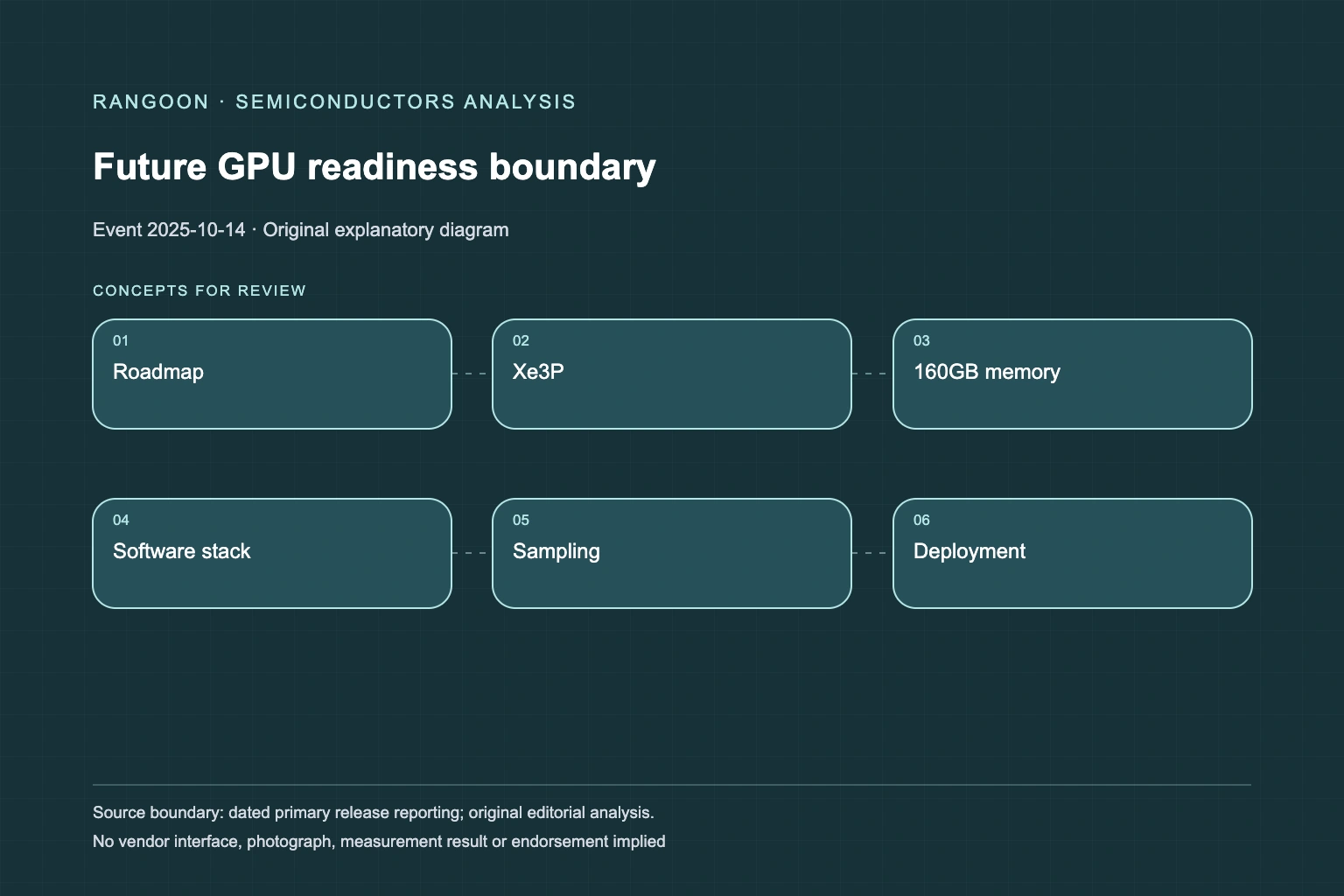
Historical reporting: Intel announced the code-named Crescent Island data-center GPU at the OCP Global Summit on October 14, 2025. Intel described an inference-oriented design with Xe3P microarchitecture, 160GB LPDDR5X memory and support for broad data types, while saying customer sampling was expected in the second half of 2026. An official Intel OCP keynote PDF names Crescent Island, 160GB LPDDR5X, Xe3P and an open-software-stack direction; it is technical conference context with no separately asserted publication date. Intel said its unified heterogeneous-AI software stack was then being developed and tested on Arc Pro B-Series GPUs for early optimization. The announcement describes a future product and Intel’s intended design; it is not proof of shipping hardware, available instances, final specifications, compatibility, performance, price or a delivered customer system.
Key takeaways
- Crescent Island was an October 2025 future-product announcement, with customer sampling expected in the second half of 2026 rather than current availability.
- Intel named Xe3P, 160GB LPDDR5X and inference-oriented design goals, but those announced attributes were not a workload result.
- Early software-stack work on Arc Pro B-Series GPUs was a development route, not proof that production Crescent Island support already existed.
The October event announced a code-named GPU and kept sampling in the future[source 1][source 2]
At the 2025 OCP Global Summit on October 14, Intel announced Crescent Island as an addition to its AI accelerator portfolio for data-center inference. The key date boundary was clear: Intel said customer sampling was expected in the second half of 2026. That makes the event a roadmap and design announcement, not evidence that a buyer could order hardware, start a cloud instance or measure a production system in October 2025. Roadmap language matters because hardware schedules, final board design, firmware, manufacturing, partner qualification and software support may change before sampling or general availability. The proper historical statement is that Intel publicly described a planned inference GPU and an expected sampling window. It is not that the product had deployed, that capacity existed or that inference customers had a new live option on the event date.
Xe3P and 160GB LPDDR5X were announced specifications, not an end-to-end serving result[source 1][source 2]
Intel described Crescent Island as using Xe3P microarchitecture, 160GB of LPDDR5X memory and a range of data types intended for inference workloads. These are material design statements because memory capacity, bandwidth, numerical formats and power behavior can influence which models and request patterns a card can serve. Yet a memory number alone does not establish usable model capacity. Weights compete with key-value cache, runtime allocations, batching buffers, communication and operating reserve; precision and software graph choices change that calculation. Intel also described an air-cooled enterprise-server orientation, but cooling posture is not a proof of rack density, facility fit or sustained throughput. The event records Intel’s stated design target and components. Any claim about tokens per second, latency, supported model size or cluster behavior still needs a tested system, software revision and workload specification.
Intel separated future hardware from software work being tested on another GPU family[source 1][source 2]
Intel said its open and unified software stack for heterogeneous AI systems was being developed and tested on Arc Pro B-Series GPUs to allow early optimization and iteration. That sentence prevents a common leap in hardware reporting: development work around one available family is not proof that the named future accelerator already has finished drivers, kernels, compilers, frameworks or customer workflows. A unified-stack direction can lower future portability cost, but support is still versioned by device, operating system, runtime, framework and model. An inference deployment also needs benchmark reproducibility, observability and a recovery plan for failed requests. The announcement does not state that these conditions had been completed for Crescent Island. It supports a narrower conclusion that Intel described a software-development route while it prepared a future data-center GPU.
An inference-oriented pitch did not settle cost, latency or availability for a real service[source 1]
Intel framed Crescent Island around high memory capacity, energy-efficient performance and "tokens-as-a-service" use cases. Those phrases identify the workload class Intel intended to target, but they do not determine a buyer’s economics. Inference cost depends on model architecture, context length, batch and queue policy, output length, utilization, host and network design, power price, service contract and failure handling. Latency may improve for one request mix while throughput or memory headroom constrains another. A code name and announced memory capacity are therefore planning inputs, not a completed procurement comparison. The October announcement is still useful: it tells operators to watch the product as a future heterogeneous-inference option. It does not justify substituting an expected product for currently benchmarked hardware or assuming that its sampling date establishes broad customer availability.
Sources
Continue reading
Related reading
 News analysisNVIDIA’s memory codesign post highlights a practical boundary between capacity and usable agent throughput3 min read
 News analysisIBM put Spyre’s commercial boundary on dates, host systems and card counts3 min read
 News analysisArm’s Lumex launch made on-device AI a CPU, GPU, system-IP and software-stack choice3 min read