

ROCm 7.0 turned a software-stack release into an accelerator compatibility event
AMD released ROCm 7.0.0 on September 16, 2025, making the software layer around supported accelerators, frameworks, drivers and operating systems the event.
Historical reporting: AMD’s ROCm release history records ROCm 7.0.0 on September 16, 2025. The corresponding 7.0.0 notes describe release highlights, support changes, component versions, known issues, and upcoming changes. A ROCm release is software availability; it does not itself prove a particular model, GPU, driver, framework, or workload is compatible.
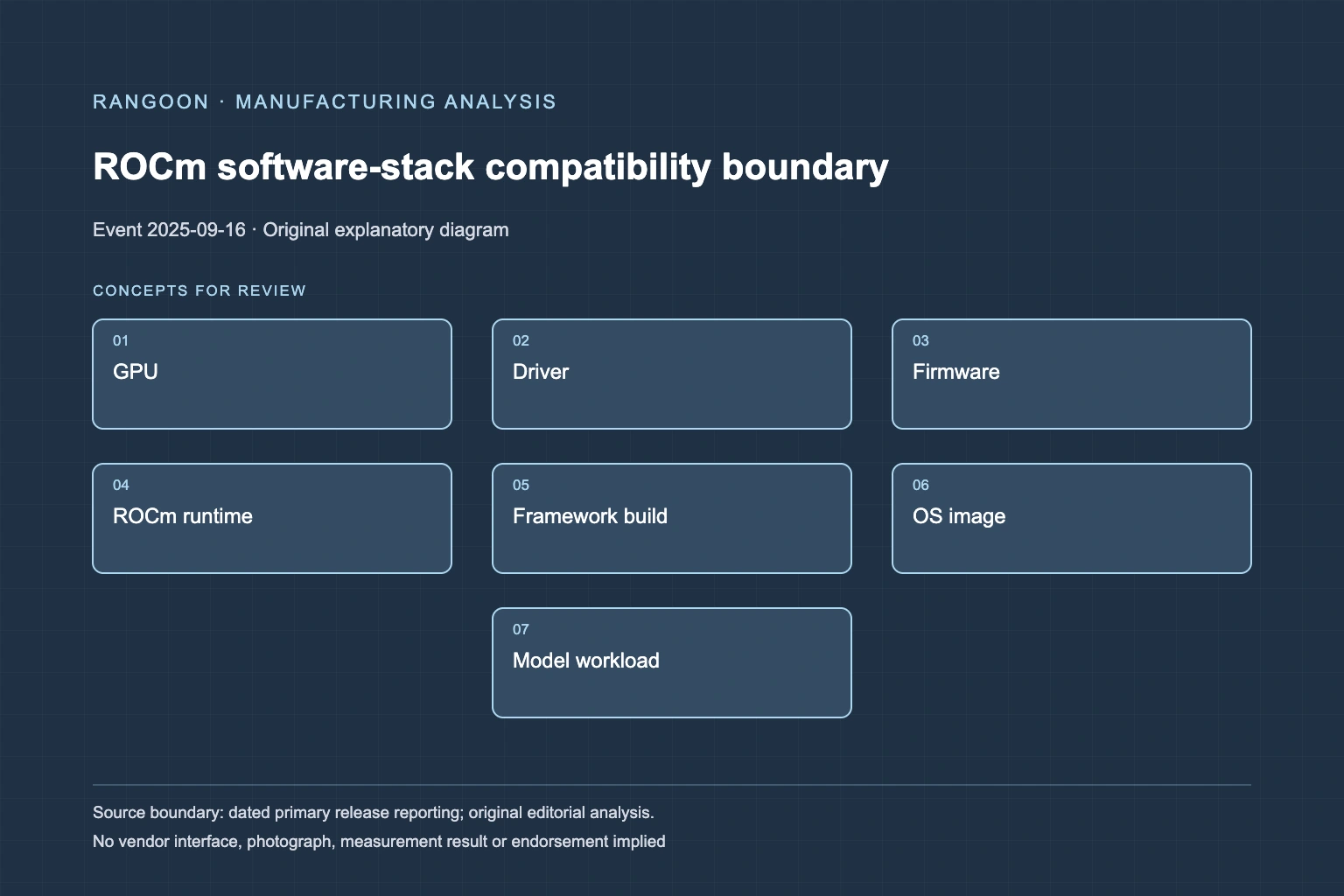
Key takeaways
- ROCm 7.0.0 was a dated software release, not a June hardware announcement.
- Its release notes made support matrices and component versions part of the practical accelerator interface.
- Open-source availability does not make every framework, operating-system, driver and hardware combination interchangeable.
The September event was ROCm 7.0.0, not an accelerator shipment[source 1][source 2]
AMD’s ROCm release history lists version 7.0.0 on September 16, 2025. ROCm is the software layer that connects AMD accelerator hardware with drivers, runtimes, libraries, compilers and machine-learning frameworks. That makes a major release a compute-industry event even though no new card has to change hands on its date. A model workload reaches hardware through this layered path, so a changed runtime or library can alter installation, compilation and supported execution without altering the accelerator itself. The release boundary matters because a model team can have the same silicon before and after a ROCm update while the supported software path, package versions, or known limitations differ.
The release notes describe a stack rather than one executable[source 2]
AMD’s 7.0.0 notes group changes under hardware, operating-system and virtualization support, user-space and driver or firmware dependencies, component versioning, resolved issues, known issues and upcoming changes. That structure is a technical reminder that “ROCm 7” is not one compatibility fact. A framework build can depend on a particular runtime; a virtualized environment can have separate support limits; and driver or firmware state can affect whether a package even exposes the intended device. The useful unit of comparison is therefore a complete stack combination, not the release name alone.
A newer runtime can expand one path while constraining another[source 1][source 2]
A software release can add framework support or improve a library while also changing installation assumptions, deprecating an interface, or documenting a known issue that affects a different workload. This is why accelerator choice is partly a software-portability question. A model that compiled or served under an earlier stack may encounter different kernels, package constraints or device discovery after an upgrade, even when its weights and prompt are unchanged. A team that uses a pinned training environment, custom kernel, container base, or serving engine must compare the new ROCm path with the one that produced its current artifacts. The tradeoff is not simply old versus new: it is whether the changed stack preserves model behavior and operational compatibility for the hardware and framework actually in use.
ROCm availability did not create a universal deployment result[source 1][source 2]
The 7.0.0 record establishes that AMD released this version on the September date and published its documented support and issue boundaries. It does not establish that every open-source project had adopted it, that a third-party wheel was built for it, or that a model’s output and throughput would match a different release. Nor does a supported operating system prove a given cloud image, cluster configuration, or workstation driver is ready. The news is the updated software contract around AMD compute, with compatibility remaining specific to the declared hardware and software path.
Sources
Continue reading
Related reading
 News analysisAMD showed Helios as an Open Rack Wide reference platform, keeping its 2026 volume expectation separate3 min read
 News analysisAMD said its Pollara 400 AI NIC became available for purchase3 min read
 News analysisAMD’s MI350 launch made memory, cooling and software part of the comparison3 min read