

MCP’s 2024 debut made connectors an architecture question
Anthropic introduced the Model Context Protocol as an open way to connect AI applications with data systems. The lasting engineering question was which connections should exist.
Historical reporting: Anthropic announced the Model Context Protocol on November 25, 2024. The protocol repository documents the contemporaneous 2024-11-05 specification release; analysis below is editorial.
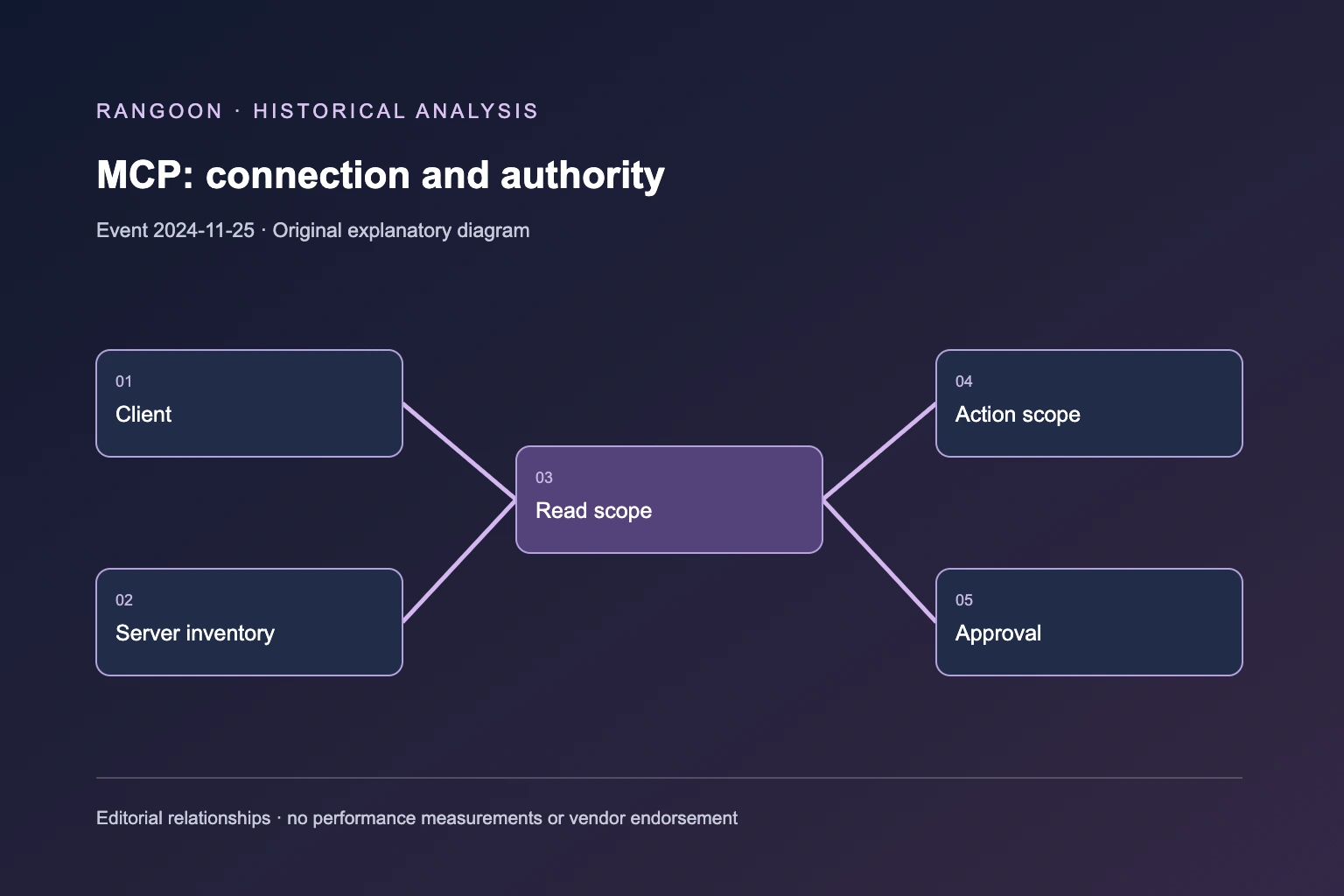
Key takeaways
- A common connector protocol reduces bespoke integration work, but it does not decide what data or tools an application may expose.
- Client capability, server capability, identity, and authorization are separate design questions.
- Connector inventories and narrow scopes make a growing tool surface easier to review.
What arrived in November 2024[source 1][source 2]
On November 25, 2024, Anthropic open-sourced the Model Context Protocol, or MCP, and described it as an open standard for connecting AI applications to systems where data lives. Its announcement named the protocol specification and SDKs, local MCP server support in Claude Desktop, and a repository of server implementations. The initial examples included familiar enterprise and developer systems such as Drive, Slack, GitHub, Git, Postgres, and Puppeteer.
That announcement came after the protocol repository’s 2024-11-05 specification release. The dates matter because they describe different historical events: a protocol revision and the later public announcement. This article concerns the November 25 announcement, not a claim that every current MCP feature or implementation existed on that day.
Editorial analysis: connector complexity changes
Before a common interface, each data source and AI application could require a custom integration. MCP offered a client-and-server shape intended to make those connections more repeatable. That is a practical infrastructure benefit: a team can reuse a protocol implementation and concentrate its effort on the data system or tool it needs to expose.
But repeatability changes the economics of adding a connection. A server that makes a repository, database, browser, or business system available can be easier to add than a bespoke bridge. The result is a reason to make connection review more deliberate, because a useful protocol can also make an unsafe or unnecessary connection easier to deploy.
Editorial analysis: connectivity is not authority
A protocol tells components how to exchange messages; it cannot decide whether a particular request should read a record, invoke a tool, or cause an external change. Those decisions still need an identity, an approved scope, and a policy at the system boundary. Treating a successful connection as proof of authorization confuses transport with permission.
A bounded implementation can expose separate read-only and action-capable servers, then give each client only the small set it needs. Tool descriptions should say what may leave a boundary, which side effect may occur, and what approval is required. A request that lacks a matching scope should stop before a server call rather than relying on a model to infer an organizational rule.
Editorial analysis: record the connector decision
For each connector, keep a short record of owner, data class, client identities, allowed operations, authentication method, and review date. Test the negative cases: an unapproved client, an out-of-scope resource, and a request for an action where only reading was intended. Logging the selected server and granted scope makes an investigation more concrete than a transcript that merely says a tool was used.
The 2024 release did not eliminate those responsibilities. It made a shared language for integrations more available. The durable lesson is to pair that shared language with a connector inventory and explicit access decisions before a growing ecosystem turns convenience into an unexamined permission surface.
Sources
Continue reading
Related reading
 News analysisAnthropic launched a Claude directory for one-click connector discovery3 min read
 News analysisAWS said Project Rainier became operational, separating a running Trainium2 cluster from its next scaling target3 min read
 News analysisGradio’s MCP updates treated hosted applications as agent tool endpoints3 min read