

Bedrock AgentCore preview separated agent logic from operating infrastructure
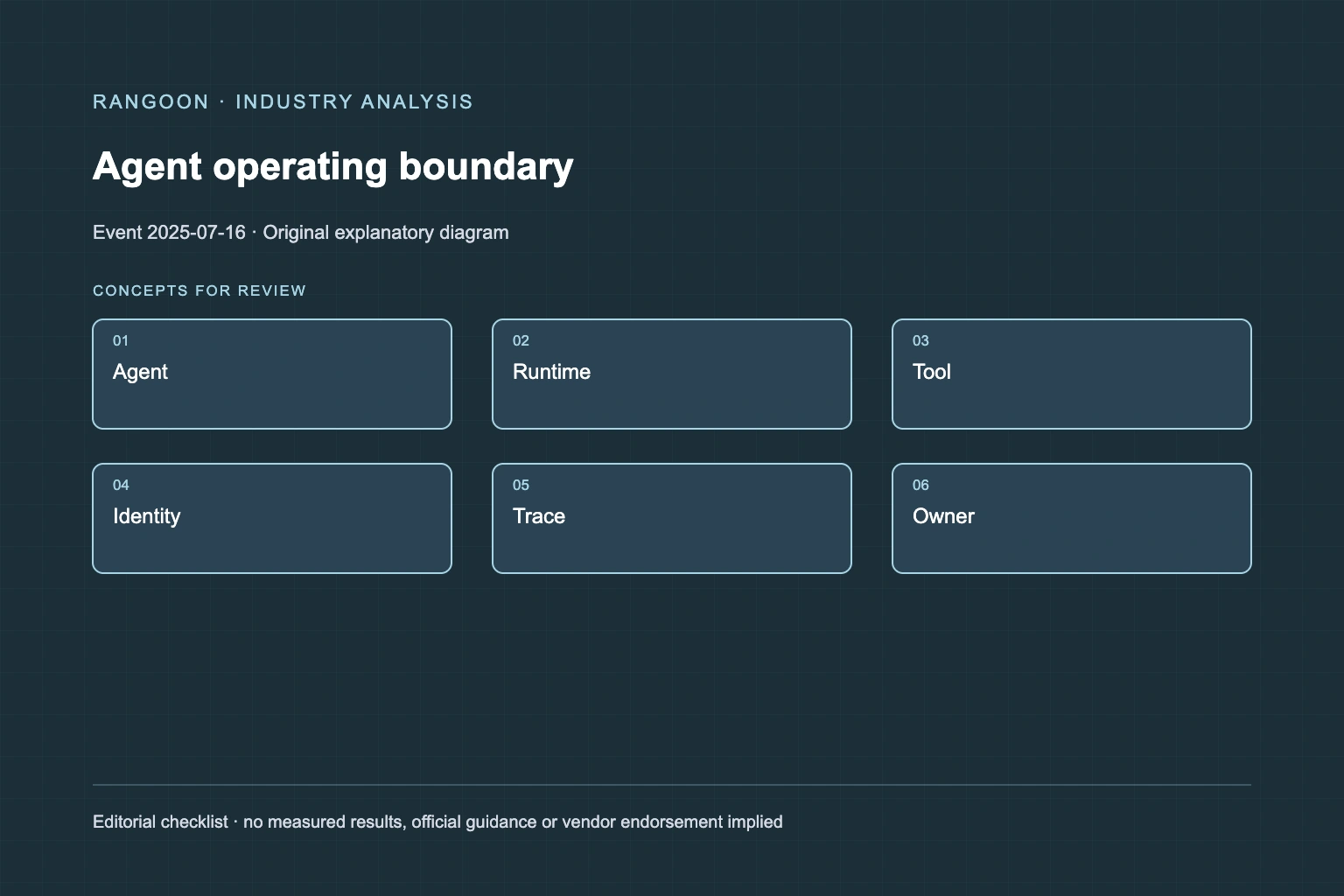
AWS introduced Amazon Bedrock AgentCore in preview on July 16, 2025, naming modular runtime, memory, identity, tool and observability services for operating agents.
Historical reporting: primary documents record this event on 2025-07-16. Vendor statements, planned schedules and comparative figures remain attributed. This retrospective does not infer current availability, price, capacity, performance or support.
Key takeaways
- AWS introduced Bedrock AgentCore as a preview with modular services that could be used together or independently and said it worked with models inside or outside Bedrock.
- A vendor announcement, a plan, an installed system and a completed workload are different evidence states.
- Original analysis: retain configuration and outcome evidence before treating an infrastructure claim as an operating result.
The dated event has a bounded claim[source 1][source 2]
On 2025-07-16, the first primary document recorded this event. AWS introduced Bedrock AgentCore as a preview with modular services that could be used together or independently and said it worked with models inside or outside Bedrock. Its announcement named Runtime, Memory, Gateway, Browser Tool, Code Interpreter, Observability and Identity. The initial developer guide release is also dated July 16.
AgentCore’s July package grouped facilities that are often assembled separately: isolated execution, persistent memory, identity exchange, tool exposure and traces. The significance was architectural packaging. AWS was not announcing a single agent model that could be evaluated without considering the runtime and controls around it.
Engineering facts need a workload boundary[source 1][source 2]
AWS described session isolation and long-running workloads in Runtime; Gateway could turn existing APIs into MCP-compatible tools; Observability connected traces and metrics to CloudWatch and OpenTelemetry. Those components define a control plane, not an automatic quality result.
Runtime isolation and eight-hour workloads address different problems from Gateway conversion of an API into an MCP-compatible tool. Memory introduces retained state; Identity introduces a principal and authorization path; Browser and Code Interpreter introduce execution surfaces. Each service therefore needs its own permissions, data and failure model.
Plans, delivery and use are separate states[source 1][source 2]
A deployment team can make one small agent per capability first: one calls a read-only internal API through Gateway, one uses short-lived Runtime credentials, one writes no memory. Combining them only after those paths work makes it possible to identify whether a wrong result came from reasoning, authorization, state or a tool response.
Managed agent infrastructure changes operational work rather than eliminating it. Session duration, trace volume, browser use, sandbox execution and retained memory can each become measurable consumption dimensions. Budgeting should name those dimensions and set limits before a broad workflow turns a prototype into an open-ended service bill.
Original analysis: make the operating evidence inspectable[source 1][source 2]
Treat an agent deployment as two contracts: task logic and operating boundary. Log tool name, credential scope, input digest, decision, result and retry state. Review a failed run by locating which contract broke before changing prompts or access.
The historical lesson is not that AgentCore guarantees trustworthy agents. It is that agent quality depends on a visible chain from instruction through identity and tool use to trace. A release record should retain that chain for the July preview, with later feature additions documented as later events.
For AgentCore, exercise a deliberately expired identity token, a denied tool action, a malformed gateway response and a runtime timeout. The trace should identify the runtime session, principal, tool call and terminal state without exposing unnecessary request content. Compare the observable record against the intended agent policy. This kind of focused failure drill tests the operating infrastructure named in July more directly than a free-form demonstration of agent conversation.
AgentCore’s modularity is the point of the July event: a memory decision can be audited separately from a browser action, and a gateway exposure separately from a model answer. A composite “agent passed” score hides that useful engineering separation.
Sources
- AWS News Blog: Introducing Amazon Bedrock AgentCore (July 16, 2025)
- AWS: Amazon Bedrock AgentCore now available in preview (July 16, 2025)
Continue reading
Related reading
 News analysisWriter launched AI HQ with a beta Agent Builder and observability tools3 min read
 News analysisAWS introduced Strands Agents as an open-source SDK with a model-driven loop3 min read
 News analysisAWS introduced a bundled next-generation Amazon Connect across the contact lifecycle3 min read